Injuries Related to Mass Casualty Incidents: Mucormycosis

Sometimes, as an author, you need something unusual to inflict your character with so this week I thought I’d focus on two injuries that can be unique to mass casualty incidents.

Mass casualty incidents (MCI’s) are defined as those that overwhelm equipment and personnel by the number casualties. It’s not necessarily the same for every organization. If a rural EMS crew comes upon a three-car accident with three patients– that might be a mass casualty incident for them but this same accident happening in downtown New York would not be.

Often times, when we think of mass casualty incidents, we recall the big things like tornadoes, earthquakes and terrorist attacks (bombings, nerve gas release) and school shootings.

For this post I’m focusing on a unique infection related to Acts of God weather events and next post I’ll do an injury related to bombings.

Mucormycosis is a soil fungus that comes out to play when it is dredged up from the earth with events like flooding and tornadoes. Usually a person comes into contact with the fungus via an impaled object. It is a necrotizing bug (meaning is devours flesh) so aggressive debridement and treatment with broad spectrum antibiotics and antifungals is necessary.

After the Joplin, MO tornado in 2011– thirteen cases were identified of which five (38%) died. Most had accompanying fractures. Interesting to note is that all the patients were located in the zone that sustained the most damage. Infection was associated with penetrating trauma and multiple wounds. You can read further about this rare infection by reading this piece as well.

What also could have contributed to the number of infections was the devastation to the medical system that happened during the tornado as well. The main hospital was damaged and several off-site clinics were set-up so the above news piece surmises that wounds may not have been adequately treated (which would be serious irrigation.) This is understandable considering what the town was dealing with.

What about you? Have you ever been in a natural disaster?

Up and Coming

Hello Redwood’s Fans!

How has your week been? Mine? Hopefully fabulous as I’m out of town enjoying a writer’s retreat. My first one ever. I’ll give you a full report upon my return.

Hopefully, you’ve taken advantage of the fire sale on my novels (Proof, Poison and Peril.) We’re in the last few days of this promotion so no more waiting!

This week I’m dealing with injuries related to mass casualty events. As you know, mass casualty events (whether Acts of God or terrorist events) can quickly overrun the medical system. Not only are we dealing with a large number of patients, but there may be new injuries that we’re not used to dealing with as well.

Tuesday: Mucormycosis infection. Just what is it and when should you worry about it?

Thursday: Blast lung. This is related to bombing events.

Hope you have a great week and have a safe Halloween!

Author Question: Suicide Attempts That Could Lead to Brain Death

Jennifer asks:

I am trying to find a scenario where a suicide attempt would lead to traumatic brain injury with long-term repercussions (reduced mental and physical functioning afterward) but not death.

Jordyn says:

There are actually several ways a person could attempt suicide and end up with a brain injury. It doesn’t have to be a traumatic brain injury but anything that would lead the person to have a hypoxic event (where they weren’t breathing for a period of time) could lead to brain damage and difficulty down the road.

If you want direct brain injury then a gunshot wound to the head would be the best bet. Maybe it was misdirected somehow and the person just got a glancing blow.

If you want to go with the lack of oxygen aspect then:

1. Attempted hanging.

2. Drug Ingestion.
3. Ingestion of poison.
4. Cutting the wrists– if you lose enough blood you will code which could lead to an hypoxic event as well.

Really, any suicide attempt that leads to a code event can cause brain injury.

Follow-up question . . .

Jennifer asks: Would it be covered by insurance since it was a self-inflicted injury?

Jordyn says: Medical insurance will cover if it is a self-inflicted injury. You might be thinking of life insurance that usually does have a clause where if a person dies as a result of suicide the life insurance policy won’t pay out. However, from my personal experience with purchasing life insurance policies, this is usually limited to the first 6 months to two years of the policy depending on the insurer.

*************************************************************************

Jennifer Slatterywrites missional romance novels for New Hope Publishers and Christian living articles for Crosswalk.com. You can visit her online at http://jenniferslatterylivesoutloud.com/

Author Question: Death by Bee Sting

Amie Asks:

My character is allergic to bees. The villains plan on using bee venom to make her death look like an accident if they need to. Is there any drug that would mimic bee venom, or will I need to use actual bees?

Jordyn Says:

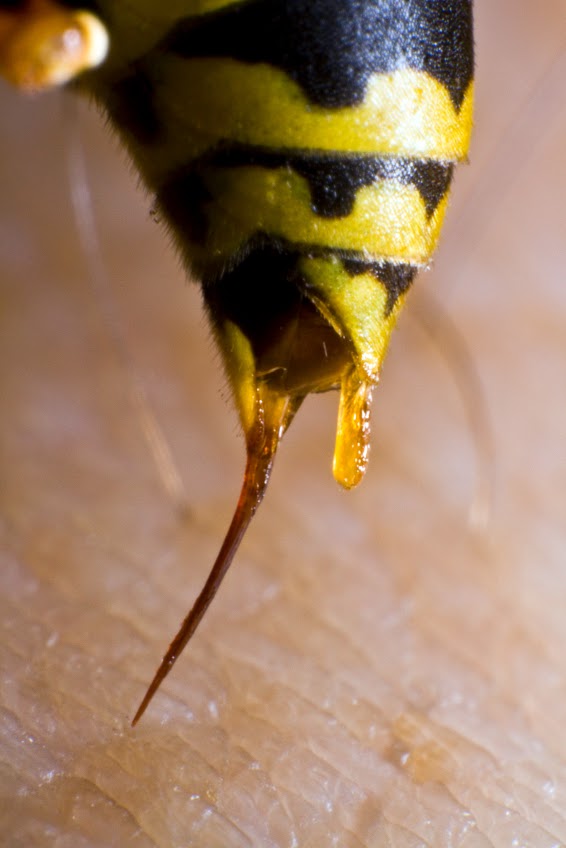
There is no drug that I’m aware of that would mimic bee venom so I think you’re going to need to use the real thing. You could just have the killer trap a bee against her body so it actually stings her versus trying to gather bee venom and try to inject her with it. 

What actually kills a person if they are allergic to bees is not the bee venom itself– it’s the body’s response to the bee venom and the response it mounts is called anaphylaxis.

I think I should point out the difference between an allergic reaction and anaphylaxis. An allergic reaction is a localized response (I get stung by a bee and my whole arm swells up) or a skin rash.

Anaphylaxis is a multi-system reaction due to massive histamine release that leads to capillary leaking, massive swelling and edema. Anaphylaxis is defined as having two or more body systems involved reacting to the substance and can be two or more of the following.

Skin: Hives.
Gastrointestinal: Vomiting or diarrhea.
Respiratory: This would include anything from the mouth to the lungs. Lip swelling. Tongue is swelling. Itchy, scratchy throat. Thick feeling to the throat. Difficulty swallowing. Drooling. Wheezing in the lungs. Low oxygen levels.
Cardiovascular: Increased heart rate and low blood pressure.

When we treat anaphylaxis– each treatment is designed to stop the reaction. The more body systems involved, the more life threatening the reaction is. 

#1 Drug given: Epinephrine via an intramuscular injection. Why not IV? An IV dose in a conscious person could cause enough coronary artery vasoconstriction to give the person a heart attack.
#2 Drug: Inhaled Albuterol IF the person is wheezing. 
#3 Drug: A Steroid. If the person has multiple system involvement (particularly respiratory or cardiovascular) then this will be given IV. If not, then an oral dose is okay.
#4 Drug: Benadryl or diphenhydramine. This blocks one form of the histamine being release (H1 blocker). IV if sick, otherwise by mouth. 
#5 Drug: An antacid like Zantac or Pepcid. This blocks the other form of histamine being released (H2 blocker). And same here, too– IV if sick, otherwise orally.

Patients with anaphylaxis are monitored for 8-12 hours after medications are given. Patients who require more than one dose of IM epi may be admitted to the hospital. The reason is that when the medication wears off we want to ensure the reaction doesn’t come back. Patients will go home with a script for an Epi Pen (or renewal script), a steroid for three days and then H2 blocker for three days.

If you’re interested in more information– here is a post I did on food allergies

Up and Coming

Hello Redwood’s Fans!

Ready for Halloween and all the spooky movies about to release? Or, would you rather read great books instead?

If it’s books– then I have good news for you. The e-books of my entire trilogy (Proof, Poison and Peril) are going on sale this coming week! I hope you’ll take advantage of it– particularly the first few days when each title is a mere $0.99!!

For you this week . . .

Tuesday: Death by bee sting. Is it possible? Is there a drug that could mimic this?

Thursday: What types of suicide attempts can lead to a traumatic brain injury?

Have a great week!

Parents Behaving Badly: The Case of Justin Ross Harris

As a pediatric nurse, I’ve been intrigued by the case of Justin Ross Harris, who is accused of killing his son by leaving him in a hot car.

This is one of those things, personally, that I do kind of scratch my head at. I know people get stressed. I could even understand leaving a child behind for a few moments before your rationale brain kicked in and said, “Hey, the baby’s in the car.”

I mean, we treat phones so much better.

He has pled innocent but this CNN HLN article brings up some interesting points that came from his hearing that I thought I would highlight here. These come directly from their piece.

1. It was a normal morning. Meaning, he was the one who usually took his kid to school. It wan’t unusual for them to stop at Chik-fil-A for breakfast. When you do things repeatedly, there’s less room for error.

2. It’s a short distance from Chik-fil-A to his daycare. Like one minute. So, in one minute, he loaded his son up in the car but then forgot he was there.

3. You could see the child from the rear view mirror. This is a pretty interesting point. Evidently, Harris backed into his parking spot. He doesn’t have a rear view camera so would have had to look in his mirror. When they placed a mannequin of similar size in that seat it was visible in the mirror.

4. Bizarre behavior. Witnesses felt like he was “working” at being emotional.

5. Strange statements. One alleged statement: “I dreaded how he would look.”

6. Additional Injuries. Abrasions to the back of the head.

7. Sexting. Harris was sexting six different women as his son died including sending explicit photos.

8. Life Insurance. The child had two life insurance policies on their son and might have been in financial trouble from credit card use.

9. Internet Activity. Disturbing internet searches for videos with people dying, how to be child-free, how to survive prison and the age of consent for Georgia.

10. Harris is deaf in his right ear. This is used by the defense to perhaps explain that he didn’t hear his son in the car.

Whatever happens in this case, one good thing that might come from these deaths is the invention from one teen, designed to alert parents if they do accidentally leave their child in the car.

What do you think from what you’ve hear of the Harris case? Do you think he committed murder?

Author Question: Wet Nursing

Kristin asks:


I have a question for a novel I’m writing. In it, there is a woman who lost her nursing baby in a space ship crash and finds herself in a place where the have-nots are so malnourished that nursing infants are skinny. So if this newcomer takes on nursing these babies, how many could she sustain? I was thinking six (for the story) to keep them alive, although not well nourished, but better off than before. 

Jordyn says:

Wow. This is a pretty interesting question. I ran it by a few doctors/nurse practitioners I work with and the consensus was about three. If you think of just how much an infant eats and how much the woman would have to drink and eat to sustain even three infants– it would be a lot.

Also, you have to consider what type of environment she’s now living in. The past nutrition she had, if good, would need to be sustained. If she’s now living in an environment where she herself would also have trouble obtaining food– then she’s going to be in the same boat as these other women. 


Up and Coming

Hello Redwood’s Fans!

How has your week been? Did you miss me last Sunday?

What happened?

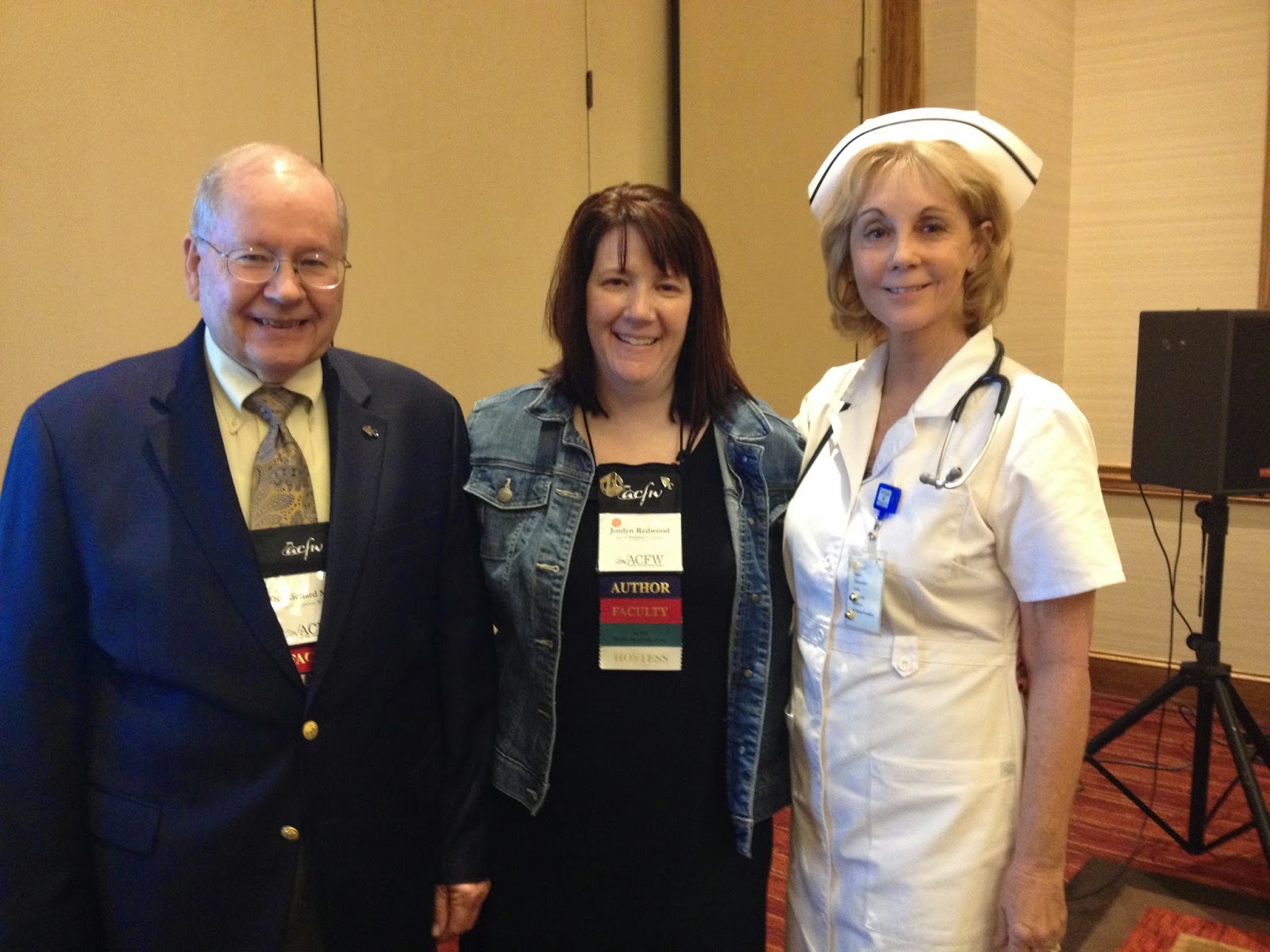
The medical musketeers!
 Richard Mabry, MD, me, and Candace Calvert, RN. 

I was recovering from ACFW (the American Christian Fiction Writers Conference) and my daughters birthday party. Yes, six girls twelve and under overnight. I know parents who have been through this know why I slept all day Sunday!

For my fellow writers– a few nuggets from ACFW.

1. Amish is supposedly on its way out. I’m sorry to my fellow colleagues who are Amish authors but evidently your reign is over. This, however, I do find hard to believe since the CBD catalog still has several full pages of Amish books whenever I get it. It does warm my suspense heart to think this might be true but we’ll see if it happens.

2. No more YA dystopian books but more YA dealing with “real” issues. One editor explained that she was straight up getting Twilight, Divergent and Hunger Games books with just new characters. Down to some of the same exact scenes. Honestly, I don’t understand the audacity of someone even trying to do this. We’ll see how the whole YA, NA trend continues to grow.

3. Indie is definitely in! As traditional publishers continue to discontinue and narrow fiction lines, previously published and debut authors have little choice but to at least try the indie road. Big names in inspirational fiction (Dan Walsh, Jenny B. Jones) are doing the indie road. Some are going hybrid but the stigma of going indie, I would say, has all but disappeared.

For you this week:

Tuesday: An author question that deals with how many infants a woman could sustain just breast feeding.

Thursday: The Justin Ross Harris case. Do you think it was homicide by hot car?

Have a great week! I’m LOVING this fall weather.

Are Kids Just Small Adults?

I started in adult nursing. For three years, I worked adult ICU and a community centered ED which primarily saw adult patients with a few kids mixed in.

I thought I knew everything I needed to know about treating pediatric patients. Needless to say, my eyes were opened when I took a class called Pediatric Advanced Life Support (PALS). That was just a taste of discovering I knew very little about the uniqueness of a pediatric patient.

During my time in the adult world, I discovered my joy of working with kids. In fact, I would bargain with my co-workers to take all of their patients eighteen-years-old and younger if they took everyone over the age of seventy-five. Surprisingly, this was an easy trade and I began to learn most adult centered nurses were very uncomfortable working with a child– particularly a young child.

Then, an epiphany happened. There are places . . . whole big hospitals . . . where there are only kids. I need to go there. That began my career in pediatric nursing and I’ve never regretted choosing kids over adults.

What irks me about some of my adult counterparts is that they’re very unwilling to admit that pediatric hospitals are the best places for kids to go. They think they can do it the same or better. Trust me, I’ll be the first to admit that if you have crushing chest pain, I can do the basics to save your life, but I’ll also be the first one to drag you by the shoulders across the threshold to the adult ED because I know you’ll fair better there.

Why? Because they do adults every day and you get very good at what you practice.

I found this article very interesting. Confessions of a Preemie: How I Am Different than a Full-Term Baby. Isn’t that amazing to think about? The difference four months can make in development?

In a humorous way . . . it got me thinking about things pediatric nurses have to consider that would be very odd for an adult ER nurse to have to think of or deal with.

1. When stripping for the scale— kids are handing off favored stuffed animals, blankets and toy cars.
2.  The size difference. We have at least eight different sizes of BP cuffs (probably more when you get into preemie sizes.) In fact, we have multiple sizes of everything where as an adult focused ED might have a very small supply of pediatric equipment.
3. Vital signs are different according to age group. A newborn’s resting heart rate can be 160 where as this would be considered abnormal for a teen. We have to memorize a large range of “normal” vital signs for about five different age groups. The only vital signs consistent across age groups is temperature and oxygen level. Heart rate, respiratory rate, and BP all change with age.
4. Does your child suck their thumb? If so, which one? Hopefully, my adult counterparts are not asking this question (and if they are, maybe adding a psych consult) but in pediatrics, it’s very important when it comes to IV placement. We don’t want to put an IV in the hand that contains their favorite thumb for soothing. Ultimately, everyone gets cranky because the child will be cranky.

That’s just a very small sampling of some of the things that pediatric nurses have to deal with every day. Do you think you could do pediatric nursing?

Author Question: Glass and Spinal Cord Injuries

Today’s post is a short and sweet medical question.

I got this question from Paula via Twitter.

Paula asks: Can you tell me if an injury of glass to someone’s back could cause a spinal cord injury?

Jordyn Says:
Yes, I would think this is in the realm of possibility. Anything with enough velocity behind it can cause injury. So, a large piece of glass falling from a significant height could work. Also, a small piece of glass embedded in the back to the point where it went between the vertebrae and nicked or severed the spinal column could cause significant injury as well.