Author Question: Car Accident Injuries 2/2

We’re continuing with Amy’s question. Dianna gave her thoughts here. I’m going to give my thoughts from an ER perspective.

Amy asked:
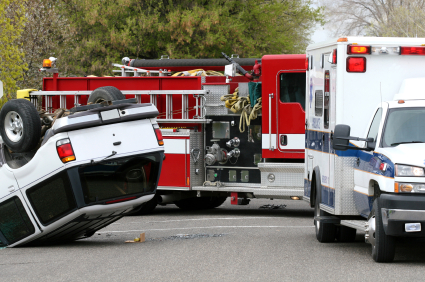
I am putting one of my characters in a pretty major car accident — a rollover in which she lands on a broken window and ends up with a lacerated back full of broken glass, in addition to a broken leg, fractured ribs, etc. I need a scene to take place in the hospital where she is recovering. With those kinds of injuries, what treatments would she be under? More importantly, how exactly would she be laying in the bed? Obviously not on her back. But would she be on her side or stomach? Perhaps that depends on the other injuries she sustains… but the lacerated back is the biggest one I want her to have.

Jordyn says:

The biggest issue here is that she will likely have to lie on her back for a while. Considering her mechanism of injury (MOI)– the big rollover accident. The EMS crew is going to be very concerned that she may have injured her neck or back and she will be put onto a spine board and C-collar. To alleviate the pressure on her back, they may then tilt the whole board to one side but it’s going to cause some pain to lay on that flat board until her x-rays are complete.

Care for lacerations: One, she’ll need x-rays of her chest to look for the glass. She’d likely have this anyway for her MOI which could then reveal the rib fractures. If the lacerations are severe and extensive– she may end up going to the OR so they can be cleaned and stitched up under general but they’d have to be REALLY bad. Otherwise, we irrigate them out with sterile saline. Stitch them up. Antibiotic ointment over top. Make sure she’s up to date on tetanus. She would get a shot if she hadn’t had any in five years. It’s 10 years without injury.

Rib fractures are generally problematic because you don’t want to take a deep breath because of the pain which can lead to pulmonary problems. Lung contusions can actually put you on a ventilator if they are extensive enough. If several ribs are broken in succession– this is actually referred to as a flailed chest which can inhibit the patient’s ability to breathe. So, I’d keep it simple with one or two rib fractures so the character mostly has to deal with the pain issue and not the lung issues.

********************************************************************

Amy Drown has a History degree from the Universityof Arizona, and has completed graduate studies in History and Archaeology at the University of Glasgow. An executive assistant by day, she also moonlights as an award-winning piper and photographer. But her true addiction is writing edgy, inspirational fiction that shares her vision of a world in desperate need of roots—the deep roots of family, friendship and faith. Her roots are in Scotland, England and California, but she currently makes her home in Colorado. Find her on Facebook at www.facebook.com/GlasgowPiper.
Author Question: Car Accident Injuries 1/2

Author questions are some of my most favorite posts to do. How do you really write an accurate medical scene? Which injuries are plausible and which are not?

Amy is visiting and Dianna Benson (EMS expert) and myself (ER nurse extraordinaire) are going to tackle her question. Dianna will be today and I’ll be Friday.


Amy asks: I am putting one of my characters in a pretty major car accident — a rollover in which she lands on a broken window and ends up with a lacerated back full of broken glass, in addition to a broken leg, fractured ribs, etc. I need a scene to take place in the hospital where she is recovering. With those kinds of injuries, what treatments would she be under? More importantly, how exactly would she be laying in the bed? Obviously not on her back. But would she be on her side or stomach? Perhaps that depends on the other injuries she sustains… but the lacerated back is the biggest one I want her to have.

Dianna Says: The story and the characters are first priority, so I’ll make the medical aspects fit into what you’ve explained. Since it sounds like you don’t have an EMS scene at all (no scene where rescue crews—EMS and fire—are present), it keeps it simple from my end, but I’ll give you pertinent background on what I’d do if I were the EMS crew on your scene. Also, based on the MOI (mechanism of injury) you described, I’ll explain what type of injures are possible. Every patient is different, every MVC (motor vehicle collision) is different, and every rollover is different, so that definitely gives you leeway.

First of all: I like the scenario: Your character runs a red light causing another car to slam into hers, which causes it to spin then roll over while her back is dragged on the asphalt over the broken window. I also like the adding of a boyfriend; yes, he’d definitely worsen her injures by landing on her, so have him either land elsewhere inside the car or just have him belted in (unless you want her seriously injured to the point she’s in-hospital for a long while and possibly suffering with lasting effects). Just so you know: The reason for the seatbelt law is not just to protect the person wearing the seatbelt; it’s to protect others from being struck by that person propelling in the air (inside and outside of vehicles) like a weapon. Just a thought — if she landed on the driver window and it’s a rollover, then the car is on its side (driver side) upside down, right? Make sure you’re clear about that.  

Any rollover is a high index of suspicion of injury; meaning, severe injuries and death likely. You have two separate impacts in this story: 1) Smash from the other car 2) Rollover. Therefore, you have two separate MOI’s and both cause different injuries.

Since fiction is about the story and the characters, make the speed of the car fit; meaning, if you want your character(s) to be seriously and extremely injured, keep the speed high. For a character who is injured and needing in-hospital care (not just on-scene EMS treatment and ED treatment) yet doesn’t sustain any life lasting effects or long term damage, then keep the speed down low.  

Possible injuries for both the side impact and the rollover: Again, every patient and incident is different, and I’ve seen it all—some accidents where based on the MOI patients surprisingly die and some where patients surprisingly live.   

1)      Whiplash: back and neck
2)      Air bag deployment: facial injures (soft tissue), labral tear (shoulder), etc.
3)    Seat belt injures (chest injuries, labral tear, etc.)
4)      Head injures
5)      Anything flying around inside the vehicle and hitting her and boyfriend
6)      Other possibles: knee ramming into door and shattering patella, elbow ramming into steering wheel, shoulder striking window., etc. etc. 
7)      Fractured femur or fractured tib/fib or just one of them (tibia or fibula) from twisting or hitting, etc. 
8)    Fractured hips
9)      Fractured ribs
10)      Etc. Etc. Etc.

A fracture is the medical term for broken bone.

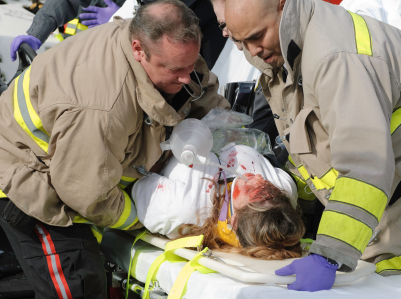
Assuming the patent is unconscious when I arrive on scene, I’d verify she has a pulse and is breathing efficiently. If so, then I’d control all bleeding via wound care—sterilization and bandaging. I’d strap a C-collar (cervical collar) around her neck then extricate her from the vehicle onto a back board with padded blocks holding her head in place and strapped to the board. I’d splint any dislocations or suspected fractured (I don’t have x-ray vision) if not properly splinted via backboard. We do a ton of medical treatments and monitoring, but I won’t blah, blah, blah it all, especially since you don’t have an EMS crew on your scene.

****************************************************************

Dianna Torscher Benson is a 2011 Genesis Winner, a 2011 Genesis double Semi-Finalist, a 2010 Daphne Finalist, and a 2007 Golden Palm Finalist. In 2012, she signed a nine-book contract with Ellechor Publishing House. Her first book releases March 2013.

After majoring in communications and a ten-year career as a travel agent, Dianna left the travel industry to earn her EMSdegree. An EMT and a Haz-Mat and FEMA Operative since 2005, she loves the adrenaline rush of responding to medical emergencies and helping people in need. Her suspense novels about adventurous characters thrown into tremendous circumstances provide readers with a similar kind of rush. You can connect with Dianna via her website at www.diannatbenson.com.  

A Sad Story of Royal Obstetrics: Part 1/4

I’m so pleased to host JoAnn Spears again. Her nursing musings on the medical ailments of some famous and not so famous royals has been a real crowd pleaser. In this series, she focuses on Queen Anne the Good and her very interesting obstetrical history. 
Personally, I found this fascinating.
Welcome back, JoAnn!

Part One: Who was the woman this happened to?

By the time Queen Anne the Good ascended the throne of Britain in 1702, she had been pregnant a remarkable seventeen or eighteen times. She died, twelve years later, childless. What was this remarkable woman’s story?

Part One: Who was the woman this happened to?
Henry VIII is the British monarch most associated with serious fertility issues. The failure of his first marriage to produce a surviving son led to the English Reformation, the execution of Ann Boleyn, and ultimately, six marriages. Henry in his youth was tall, healthy, vigorous, athletic and intelligent. In old age, he became markedly corpulent.
Queen Victoria is the monarch most associated with royal fecundity. Her nine pregnancies produced nine children and made her, through carefully orchestrated intermarriages, ‘The Grandmother of Europe’. Unfortunately, Victoria also appears to have been the point at which the hemophilia gene entered Europe’s royal houses. Victoria, like Henry VIII, was obese in later life.
Pretty much midway between these two extremes of royal fecundity, Britain was ruled by a queen named Anne, known as ‘the Good’. She is little remembered today. As a study in fertility and infertility, Ann deserves to be better remembered.

Ann was a Stuart, a descendant of the Tudors and of the romantic Mary Queen of Scots. Her father and mother were controversial figures. James II seems to have been always out of step. Anne’s mother, Ann Hyde, was a non-royal that James married, typically, against absolutely all advice. When Ann Hyde died–corpulent– in 1671, she had experienced eight pregnancies and left behind two living children.

The ‘good’ moniker is probably the best description of Anne as a child and young woman. In looks and intellect, it’s most likely that she was pretty average. She was a good and serious English Protestant. Her father, out of step as usual, was not. This political liability led to his losing his throne and to the reigns of Anne’s brother-in-law and sister, William and Mary. When Mary and then William died, childless, Anne ascended the throne.
At an appropriate age, Anne had married an appropriate young man: Prince George of Denmark, a cousin once removed. They were married for about twenty-five years and were a devoted couple. George seems to have been a lot like Anne, both unexceptional and unexceptionable. The wittier members of the English court found him boring, joking that the loud breathing caused by his asthma was the only way they had of knowing that he was actually alive.
Anne’s reign lasted from 1702 to 1714. It was notable for being the time when the two-party system emerged in British politics. It was also notable as a time when female friendships had more of an impact on government behind-the-throne than romantic alliances did. Anne’s friend Sarah Churchill, a distant relative of the modern Princess Diana, was a key political player of the day.
Anne’s obstetrical history was over and done with by the time she became Queen. The year 1700 had seen her final pregnancy. That pregnancy had been preceded by another sixteen or seventeen. The number of living children she had when she ascended the throne–sadly, and almost unbelievably to modern minds–was zero.

************************************************************************
JoAnn Spears is a registered nurse with Master’s Degrees in Nursing and Public Administration. Her first novel, Six of One, JoAnn brings a nurse’s gallows sense of humor to an unlikely place: the story of the six wives of Henry VIII. Six of One was begun in JoAnn’s native New Jersey. It was wrapped up in the Smoky Mountains of Northeast Tennessee, where she is pursuing a second career as a writer. She has, however, obtained a Tennessee nursing license because a) you never stop being a nurse and b) her son Bill says “don’t quit your day job”.

Medical Air Evacuation in World War II—Part 3

I am so so pleased to host amazing author and fellow research hound, Sarah Sundin, back to Redwood’s this week. Sarah is a fabulous historical author whose novels highlight the WWII era. This week she is discussing her research into medical air evacuation and flight nursing.

Sarah has also graciously agreed to give away one copy of her newest release, With Every Letter, to once commentor on any of this weeks posts. Simply leave a comment with your e-mail address. Must live in the USA. Drawing will be midnight, Saturday September 29th. Winner anounced here at Redwood’s Sunday, September 30th.

Welcome back, Sarah!

The broad grin on the private’s face didn’t reveal how serious his condition was. “Hiya, nursey.”

“Lieutenant,” Mellie said, but she smiled back. “How are you feeling?”

“Depends. How many girls you got at that hospital in Algiers?”


“Oh, not one of them is good enough for you.”


“She wears a skirt, she’s good enough.”


Mellie clucked her tongue. “Too bad. All the women wear trousers.”


In my novel With Every Letter, the heroine serves as a flight nurse. If you’re writing a novel set during World War II, a soldier character may get sick or wounded, and you might need to understand medical air evacuation.


On September 24th I discussed general principles of air evacuation, on September 26th we followed one patient in his flight experience, and today we’ll meet the flight nurse.


Training

The profession of flight nursing began in World War II. The US Army Air Force started the first training program at Bowman Field in Louisville, Kentucky in the fall of 1942. Training was haphazard at this point, and the first two squadrons (the 801st and 802nd) were sent overseas before training was complete. The formal program ran six to nine weeks, changing throughout the war. The first class of flight nurses graduated in February 1943.

The program was named the School of Air Evacuation in June 1943 and moved from Bowman Field to Randolph Field, Texas in October 1944. The US Navy started a flight nursing program in December 1944 in Alameda, California.


In training, the nurses studied academic subjects such as aeromedical physiology. They also learned field survival, map-reading, camouflage, ditching and crash procedures, and the use of the parachute. The program included calisthenics, physical conditioning, and a bivouac in the field with simulated enemy attack.


Organization


Each Medical Air Evacuation Transport Squadron (MAETS) was headed by a flight surgeon and chief nurse. The MAETS was divided into four flights, each led by a flight surgeon and composed of six teams of flight nurses and surgical technicians. A Headquarters section included clerks, cooks, and drivers.


Uniform

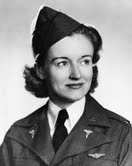
The typical Army Nurse Corps uniform of white dress or a skirted suit uniform did not work in flight. Although some resisted—including in ANC leadership—the women were allowed to wear trousers. The first few squadrons improvised uniforms, often cutting down the dark blue ANC service jacket and purchasing trousers. Eventually an official flight nurse uniform was authorized—a waist-length gray-blue jacket and matching trousers and skirt, with a light blue or white blouse. Depending on the climate, nurses also wore the combat airman’s heavy flight gear.


The official insignia of the flight nurse was a pair of golden wings with a maroon N superimposed. These wings were changed to silver later in the war.


Duties


The role of the flight nurse was revolutionary. No physician accompanied her on the flight, and she outranked the male surgical technician, who worked under her authority. She was trained to start IVs and oxygen, tasks reserved for physicians at the time. In addition, she was trained to deal with medical emergencies including shock, hemorrhage, and sedation. One flight nurse even performed an emergency tracheotomy using improvised equipment.


Dangers

The primary responsibility for the lives of the patients rested on the shoulders of the flight nurses. Their emergency training was put into use in many cases throughout the war. Flight nurses and technicians successfully evacuated patients into life rafts after a ditching in the Pacific, unloaded patients from a burning plane after crash landing in North Africa, and loaded patients under enemy fire in the jungles of Burma.

One flight nurse was taken prisoner briefly by the Germans after crashing behind enemy lines, and another parachuted to safety in the mountains of China. In one dramatic incident, a plane carrying a dozen nurses from Sicily to Italy was blown off course and crash landed in Nazi-occupied Albania. With the help of their survival training and Albanian partisans, the crew and nurses all evaded capture and crossed snowy mountains to be rescued at the coast—a two-month ordeal.


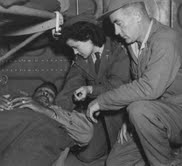
Seventeen flight nurses lost their lives during the war. Lt. Ruth Gardiner, 805thMAETS (pictured), was the first flight nurse killed, in a plane crash in Alaska.


Through professionalism and courage, the five hundred women who served as flight nurses in World War II saved many hundreds of lives and comforted over a million sick and wounded servicemen.


***********************************************************************

Sarah Sundin is the author of the Wings of Glory series from Revell: A Distant Melody (March 2010), A Memory Between Us (September 2010), and Blue Skies Tomorrow (August 2011). She has a doctorate in pharmacy from UC San Francisco and works on-call as a hospital pharmacist.

Medical Air Evacuation in World War II—Part 2

I am so so pleased to host amazing author and fellow research hound, Sarah Sundin, back to Redwood’s this week. Sarah is a fabulous historical author whose novels highlight the WWII era. This week she is discussing her research into medical air evacuation and flight nursing.

Sarah has also graciously agreed to give away one copy of her newest release, With Every Letter, to once commentor on any of this weeks posts. Simply leave a comment with your e-mail address. Must live in the USA. Drawing will be midnight, Saturday September 29th. Winner anounced here at Redwood’s Sunday, September 30th.

Welcome back, Sarah!

Mellie smiled at her patient. “Are you enjoying the flight?”

“Sure.” Corporal Fordyce stared at the fuselage curving over his head. Mud from the battlefield speckled his hair, and dark stubble covered his cheeks.


Mellie settled her hand on his blanketed arm. “How does your leg feel?”


“It’s gone,” he said through clenched teeth.


“I know,” she said softly. Now was no time for platitudes.


In my novel, With Every Letter, the heroine serves as a flight nurse. If you’re writing a novel set during World War II, a soldier character may get sick or wounded, and you might need to understand medical air evacuation.


On September 24thI discussed general principles of air evacuation, today we’ll follow one patient in his flight experience, and on September 28th we’ll meet the flight nurse.


Pre-Flight

Let’s follow my fictional patient, Corporal John Fordyce. While retaking Sbeïtla, Tunisia from the Germans in March 1943, Fordyce steps on a landmine. Medics perform first aid and take him from the battlefield to the battalion aid station, where he’s stabilized. An ambulance carries him to a field or evacuation hospital, where his right leg is amputated below the knee. Since the corporal will receive a medical discharge, he will return stateside. An ambulance will take him to the airfield at Youks-les-Bains, Algeria. A C-47 will fly him to Algiers. Later he’ll fly to Casablanca in French Morocco, where he’ll take a hospital ship home for convalescence.

At Youks-les-Bains he arrives at a tent hospital at the airfield. The flight surgeon evaluates the patients to decide which are good candidates for air evacuation. Due to high altitude, the doctors prefer not to send patients with serious head injuries, sucking chest wounds, or severe anemia. Each combat theater has different policies on “neuropsychiatric” patients, but if they’re allowed, an extra technician will attend these patients.


At the airfield holding unit, the physician briefs flight nurse Lt. Mellie Blake on each patient. Mellie in turn orients the patients—most of whom have never flown—on what to expect. Corporal Fordyce wears an Emergency Medical Tag (EMT) which summarizes his condition and treatment. A large envelope with his medical records and X-rays rests beside him on the litter.


Loading the Plane


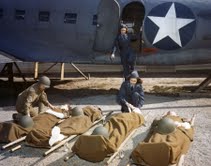
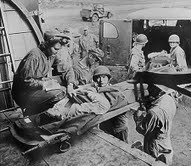
The surgical technician and medics from the holding unit carry the litter patients onto the plane. At the cargo door, Mellie checks the EMT against the list of patients on her flight manifest and directs the tech where to place each patient based on his medical needs.


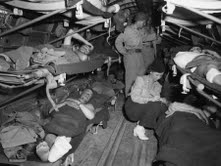
The litters are clamped into aluminum racks along each side of the fuselage, stacked three litters high. Later versions of the C-47 will come equipped with lightweight web-strapping systems to hold litters. Fordyce is placed in the top tier with his bandaged stump facing the aisle for easier access. Lower tiers are reserved for patients with heavy casts or needing more intense care.


Flight

After the patients are secured, the C-47 glides down the runway. When the plane levels off, the flight nurse and technician see to the patients’ needs. They record Fordyce’s “TPR” (temperature, pulse, and respiration) on the flight manifest, and check for signs of bleeding and infection. Mellie is trained to treat shock, hemorrhage, pain, air sickness, and other medical emergencies, but Fordyce is stable and needs little care.

The flight team also provides water and food if needed. They converse with the patients, a voice of calm for the anxious and of encouragement for the depressed. If no patients are on oxygen, the men are allowed to smoke.


The interior of the C-47 is poorly ventilated and heated, and becomes stifling in hot weather and frigid in colder climates or higher altitudes. Smells can become overwhelming, especially when burn patients are aboard or someone becomes airsick. Surprisingly, air sickness occurs in less than 1 percent of flights. Corporal Fordyce is thankful his flight is in the 99 percent.


Unloading

After an uneventful two-hour flight, the C-47 lands at Maison Blanche Airfield in Algiers, Algeria. Mellie and the technician unload the plane with the help of men on the ground. A trained flight team can unload a full plane in 5-10 minutes, which is crucial in case of crash landing, ditching in water, or landing at a field under enemy fire.

An ambulance ferries Corporal Fordyce to a hospital in the Algiers area while he waits for the next step in his journey home.


**********************************************************************


Sarah Sundin is the author of the Wings of Glory series from Revell: A Distant Melody (March 2010), A Memory Between Us (September 2010), and Blue Skies Tomorrow (August 2011). She has a doctorate in pharmacy from UC San Francisco and works on-call as a hospital pharmacist.

Medical Air Evacuation in World War II—Part 1

I am so so pleased to host amazing author and fellow research hound, Sarah Sundin, back to Redwood’s this week. Sarah is a fabulous historical author whose novels highlight the WWII era. This week she is discussing her research into medical air evacuation and flight nursing.

Sarah has also graciously agreed to give away one copy of her newest release, With Every Letter, to once commentor on any of this weeks posts. Simply leave a comment with your e-mail address. Must live in the USA. Drawing will be midnight, Saturday September 29th. Winner anounced here at Redwood’s Sunday, September 30th.

Welcome back, Sarah!

“Do you have room for one more litter case?” the doctor asked. “Private Jenkins fell headlong on a landmine. The nearest hospital’s in Cefalù, a long ambulance ride over rough roads. By air he’ll be in Mateur in two hours. He needs a thoracic surgeon.”

Mellie stared at the unconscious patient. He lay on a litter, his torso swaddled in white gauze.
Bloody streaks painted his face, arms, and khaki pants. “We’re his only hope.”

In my novel With Every Letter, the heroine serves as a flight nurse. If you’re writing a novel set during World War II, a soldier character may get sick or wounded, and you might need to understand medical air evacuation.


Today I’ll discuss general principles of air evacuation and share resources, on September 26th we’ll follow one patient’s flight experience, and on September 28th we’ll meet the flight nurse.


History of Air Evacuation

As soon as the Wright brothers took to the air, clever minds thought of ways to use the new contraption. In 1910 two Army officers constructed the first ambulance plane, and during World War I the Army experimented with transporting patients by air.

The advent of large multi-engine cargo planes in the interwar years made these dreams realistic. In November 1941, the US Army Air Force authorized the Medical Air Ambulance Squadron. Air evacuation was first performed informally early in 1942 during the construction of the Alcan Highway and in Burma and New Guinea. The first official air evacuation with flight nurses was flown on March 12, 1943 in Algeria.


Advantages of Air Evacuation

Speed is the primary benefit of air evacuation. Planes can also traverse inhospitable terrain or dangerous seas. The military came to see that air evacuation required less equipment than ambulance transport, aided recovery, and increased morale on the front.

However, planes were unable to fly in bad weather, and planes were not reserved for ambulance use. Since top priorities for transport planes were airborne missions and carrying supplies, medical air evacuation depended on availability. Also, dangers existed from crashes and enemy planes. Since transports carried cargo and troops, they were not allowed to be marked with the Red Cross and were legitimate military targets. Fighter coverage was provided in some combat theaters.


Use of Air Evacuation in World War II


Thirty Medical Air Evacuation Transport Squadrons served in World War II in every combat theater. In all, 1,172,000 patients were transported by air. About half were ambulatory patients (the “walking wounded”) and half were litter patients. Only 46 patients died in flight, although several hundred died in crashes. By 1944, 18 percent of all Army casualties were evacuated by air.


Planes


The C-47 was the workhorse of air evacuation. This dependable two-engine plane was used for shorter flights within a combat theater and could fly into forward landing strips close to the battlefield. A C-47 carried 18-24 patients, depending on how many were on litters.

For transoceanic flights, the four-engine C-54 Skymaster was used. The preferred load for a C-54 was 18 litter patients and 24 ambulatory. These flights carried patients from the combat theater stateside when the patient required 90-180 days of recovery or was eligible for medical discharge.

The C-46 Commando was used less frequently. Although it could carry 33 patients, the cargo door made loading difficult, and the plane had an unsavory habit of exploding when the cabin heater was used.


Medical air evacuation revolutionized the care of the wounded. Gen. Dwight Eisenhower credited air evacuation, sulfa drugs, penicillin, and the use of plasma and whole blood as key factors in the significant drop in the mortality rate among the wounded from World War I to World War II.


Resources:


Sarnecky, Mary T. A History of the U.S. Army Nurse Corps. University of Pennsylvania Press, Philadelphia. 1999.


Links, Mae Mills & Coleman, Hubert A. Medical Support of the Army Air Forces in World War II. Office of the Surgeon General, USAF. Washington, DC. 1955.


“Winged Angels: USAAF Flight Nurses in World War II.” On National Museum of the US Air Force website.
http://www.nationalmuseum.af.mil/factsheets/factsheet.asp?id=15457

The World War II Flight Nurses Association. The Story of Air Evacuation: 1942-1989. Taylor Publishing Co., Dallas TX, 1989. [Source of most of the photos used in this article]


Website of the World War II Flight Nurse Association.
http://www.legendsofflightnurses.org/ Contains photos, news clippings, and PDF of The Story of Air Evacuation.

Futrell, Robert F. Development of Aeromedical Evacuation in the USAF: 1909-1960. USAF Historical Division, Research Studies Institute, Air University, 1960. Available free online at
http://www.ibiblio.org/hyperwar/AAF/AAFHS/AAFHS-23.pdf

***********************************************************************

Sarah Sundin is the author of the Wings of Glory series from Revell: A Distant Melody (March 2010), A Memory Between Us (September 2010), and Blue Skies Tomorrow (August 2011). She has a doctorate in pharmacy from UC San Francisco and works on-call as a hospital pharmacist.

The Secrets Nurses Keep: 2/2

In the November, 2011 issue of Reader’s Digest— there was an article entitled 50 Secrets Nurses Won’t Tell You. I mean, of course, I am going to read this. As a nurse, as an author, and as a blog editor– I’m going to see what it has to say. Please, take some time to check out the full article.

I thought I’d give my thoughts here on whether or not I agree with the trueness of these statements. I’m not sure that’s truly a word– so don’t use it in Scrabble or anything. The items are taken directly from the article– so credit is given to Reader’s Digest for these.

You can read about my first post here.

Item Four: “When a patient is terminally ill, sometimes the doctor won’t order enough pain medication. If the patient is suffering, we’ll sometimes give more than what the doctor said and ask him later to change the order. People will probably howl now that I’ve said it out loud, but you have to take care of your patient.” A longtime nurse in Texas.

Hmmm…. this one is painful– no pun intended. First, let me say that I understand where this nurse is coming from. I’ve been in situations where the patient has needed more pain medication than the physician is willing to order and it is really frustrating because you’re the one whom the patient is staring at, begging for relief.

However, the nurse is right about the howling part. Put simply, this is illegal. A nurse who chooses to do this is operating outside her scope of practice. She would be giving a narcotic without an order. An uber-big no-no. She is at risk for losing her license.

Personally, I would not choose to do this. I’ve never done it nor has it even crossed my mind. What I have done is called the doctor relentlessly and summoned the physician to do a bedside exam so they can SEE exactly what I’m talking about.

Item Five: “Every nurse has had a doctor blame her in front of a patient for something that is not her fault. They’re basically telling the patient, ‘You can’t trust your nurse.'” Theresa Brown, RN.

Sadly true. I’ve had this happen. I spoke a little bit about this in the last post. A nurse would get in a lot of trouble for doing the same of a physician so there is a double standard. All corrective conversation should never be done in front of a patient, at the nurse’s station, etc— only a private room with reasonable discussion.

Item Six: “Never talk to a nurse while she’s getting your medications ready. The more conversation there is, the more potential there is for error.” Linda Bell, RN

True…true…true. In fact, this is becoming part of training videos for fellow staff– to not talk to your co-workers when they are calculating and drawing up meds. It is fine to ask medication questions– in fact, you should. But wait until you have your nurse’s undivided attention.

What do you think of these items?


The Secrets Nurses Keep: 1/2

In the November, 2011 issue of Reader’s Digest— there was an article entitled 50 Secrets Nurses Won’t Tell You. I mean, of course, I am going to read this. As a nurse, as an author, and as a blog editor– I’m going to see what it has to say. Please, take some time to check out the full article.

I thought I’d give my thoughts here on whether or not I agree with the trueness of these statements. I’m not sure that’s truly a word– so don’t use it in Scrabble or anything. The items are taken directly from the article– so credit is given to Reader’s Digest for these.

Item One: “When you tell me how much you drink or smoke or how often you do drugs, I automatically double or triple it.” A longtime nurse in Texas.

Jordyn Says: Absolutely TRUE. A person over the legal limit has surprisingly only EVER had 1-2 beers. Always. What I will add to this statement is a teen driver who comes in involved in a minor traffic accident. I always add at least 20mph over the limit they state because they are likely not going to be truthful in front of a parent about how fast they were really going.

Item Two: “We’re not going to tell you your doctor is incompetent, but if I say, ‘You have the right to a second opinion,’ that can be code for ‘I don’t like your doctor’ or ‘I don’t trust your doctor.'” Linda Bell, RN.

Jordyn Says: This is a tough one for sure. What is the nurse to do? Primarily, we are an advocate for the patient and NOT the doctor. I have been in this situation. Not necessarily with a diagnosis but more with the emergency treatment provided for the patient. I had a sick asthmatic once at a hospital where I worked previously and the doctor was ready to discharge the patient after one treatment when really the patient needed a barrage of treatments and steroids to control the asthma attack. The child was still in obvious respiratory distress. I had the doctor reassess. They didn’t agree with my assessment (and clearly– I’m always right.) At discharge, I told the family, “Look for these respiratory signs that your child should be seen in the ER.” The mother says–“Well, she has all those right now.” My response, “Exactly.” Wink, wink. “I know this ER is open.”

A nurse puts herself and the hospital in a bad position and will never outright say a physician has made a poor decision or is incompetent but be mindful of language and if a nurse says– “do such and such” like get a second opinion or seek out this course of action– do it.

A nurse can also approach another physician on duty to see if they’ll assess the patient and/or they can call a medical director for intervention. I’ve done this as well when I thought the treatment/or lack of– would result in a patient’s death.

Item Three: “If you’re happily texting and laughing with your friends until the second you spot me walking into your room, I’m not going to believe that your pain is a ten out of ten.” A nurse in New York City.

Jordyn Says: True. True. True. Amen, brethren in New York!

From the time a nurse goes through nursing school, we’re taught that pain is subjective and the only person who can truly assess how significant pain is is the patient themselves. In many situations, the patient overestimates their pain.

The general scale used is 0-10. Zero being no pain and 10 being the worst. I’ve started to say, even to pediatric patients, “a 10 is like someone took an ax and chopped of your arm.” A 10 means you cannot sit still in a chair. A 10 means if I don’t do something about the pain, you’d rather die than live with it any longer. You cannot text. You’re not laughing and joking. Do we still treat the pain– yes, but a nurse will report to the physician your demeanor and that does influence the amount of the narcotic you’ll get.

A nurse will also advocate for a patient who should get more pain medication or in instances where the patient or family refuses pain meds. I had a girl with an obviously broken arm and her father refused to let her have Ibuprofen. I’m guessing he had a religious objection but wouldn’t say it out loud. Normally, I’m all for a parent’s right to have a say in their child’s treatment but this time I’m practically begging to give this child Ibuprofen. He says–“shouldn’t I be able to decide her treatment”– oh, that’s a whole other post for sure. I said, “Well, perhaps if it was your arm that was broken, you might think differently.” One of the few times I actually said what I really wanted to say.

What do you think of these situations?

The Universal Language of Parenthood

I’m pleased to welcome back Dr. David Carnahan as he writes about a personal experience caring for an Iraqi youngster during his military service.

Welcome back, David.

It was easy to hate the people who had produced the martyrs of 9/11. Maybe hate was too strong a word, but I certainly had no compassion for them, even though I’d taken an oath to do so. That was until one night in Iraq, when the squawk box relayed a trauma on its way in.

“Trauma call, Trauma call, Trauma call, times one, pediatric,” a voice cried over the hospital speakers. A collective moan echoed in the emergency room as physicians, nurses, and technicians streamed in to take their positions.

The squawk box sounded again in staccato sentences. “Vitals stable. Patient fell off roof. Fall distance: twenty feet. Seven year old boy trying to fly his kite. Significant head injuries. Would call the Neurosurgeon. Over.”

Trauma Tahoe arrived listless and unresponsive with a bluish hue. Orders reverberated off the walls as the Trauma Czar, Dr. Garrett, directed Tahoe’s initial resuscitation, stabilizing him for his eventual surgical care. Within an hour, he was taken to surgery and  then placed in the Intensive Care Unit on the ventilator.

The next morning I got up early to check on him. His physical examination had degenerated, and now showed signs of herniation, a condition incompatible with life. The ominous signs on the initial CT scan suggested that Tahoe had suffered severe damage akin to having major strokes on both sides of the brain, and had little chance of recovery, but we all were praying he would be the outlier. The neurosurgeon leaned against the door of the “doc box,” the room where the doctors stay overnight to care for the ICU patients. “There’s nothing more we can do,” he said. All gazes cast downward, and the room remained quiet. We had all arrived at the same conclusion, but saying it had cast the reality into the universe with finality.

The pediatrician, ICU director, neurosurgeon and I walked into the room, and looked at the silent, unconscious patient. His head was wrapped in white bandages. His long, dark eyelashes curled up hinting of his former handsome features, but his swollen face now cast a shadow over his angelic appearance. The ICU staff worked all around me as I watched them perform as professionals: removing tubes, shutting down machines, gradually causing the room to grow still. Dr. Williams, the pediatrician, asked the nurse to bring in the nicest blanket we had. She returned with a hand-quilted blanket sent from a family in Wisconsin.

The beautiful design contrasted against the hideousness of the moment. Then, we waited. The little boy’s father approached the door, his face somber and eyes heavy. The mother was close behind. She was dressed in a black robed dress, shawl and shoes. She held a handkerchief to her face as the tears streamed down her face. Her voice filled the room with an Arabic phrase uttered repetitiously and mournfully. I imagined what I would say, how I would react, and my mind began to whirl as I pictured my own seven-year old daughter in the bed. The father pulled the blanket off and leaned over the bed to kiss his boy’s feet. His tears washed his son’s toes as he slumped over his feet, rocking back and forth in grief.

His mother kissed his lips, brooded over him as she continued to chant the doleful phrase trying to bring her boy back to her. Then as if she suddenly realized we were in the room, she looked up at Dr. Williams and with begging eyes asked him the question in Arabic. The translator in the room knew that he need not explain, Dr. Williams had been asked the question that all doctors despise, the question that raises the issue of the limitations of medicine and the injustice of harm that befalls innocent children. He shook his head and said, “I’m sorry, there’s nothing we can do.”

In that moment, I stood with tear-brimmed eyes, struggling with the sorrow and grief that losing a child will bring.

**********************************************************************

Dr. David Carnahan is a Board Certified Internist, who fell in love with writing while getting his Masters Degree in Epidemiology at the University of Pennsylvania. He has served in the Air Force for the past 14 years as an academic clinician/educator and now works in the area of Healthcare Informatics. He has a wonderful wife and two beautiful daughters, and invites you to read about his life (www.dhcarnahan.blogspot.com), and weekly installments of his current work in progress, The Perfect Flaw (www.theperfectflaw.com).

Strangulation: Care of the Victim 3/3

I’m concluding my series on strangulation today. You can find Part I and Part II by clicking the links.

Victims of strangulation/hanging require emergent evaluation due to the structures in the neck that could have obtained injury (trachia, hyoid bone, vocal cords, blood vessels, and brain from lack of blood flow).

image by thetombstonesnake courtesy of Flickr via baratunde.com
If the victim was hanged, it is important to know the height from which they dropped. If if was equal to or greater than their height, there is a high probability of C-spine injury. Therefore, these patients need to be placed in a C-collar until such injury is ruled out.

Remember, there may few external signs of injury. This doesn’t rule out significant damage. However, there may be signs of bruising around the neck and petechia above the point of the ligature. There may also be bleeding in the eye, changes to the voice. Symptoms may range from general soreness to difficulty breathing.

Other signs and symptoms include:

1. Difficulty swallowing.
2. Mental Status Changes: may indicate a period where the brain has gone without oxygen.
3. Miscarriage
4. Swelling of the neck
5. Lung Injury: if the patient vomited during strangulation.
6. Chin Abrasions: from the victim trying to protect their neck.
7. Defensive wounds to the neck from the victim tryng to break free.

How do we care for this patient? History of the event will be paramount in helping the physician determine what tests to run. Hopefully the patient will be able to supply pertinant information.

1. Baseline vital signs including continuous monitoring of the patient’s oxygen level.

2. Assessment of neurological (did the patient lose consciousness, are they neurologically intact?), respiratory (are they having difficulty breathing) and cardiovascular systems.

3. If the patient was hanged– they will need X-rays of the spine to rule out fracture as well as soft tissue films of that area. If they were strangled, soft tissue films of the neck are still warranted.

4. Direct Laryngoscopy: Visualizing the vocal cords to look for damage.

5. CT of the brain: if the patient was unconcious at any point.

6. CT/MRI scan of the neck: to look for soft tissue/vascular injury.

7. Chest x-ray: aid in diagnosis of aspiration.

8. Carotid Doppler: Looking at the neck vessels with ultrasound to look for injury and clots as a result of the attack.

This patient, depending on their severity of injury, could be observed in the emergency department for several hours and sent home or intubated out of concern for further airway compromise and admitted into the ICU. There is a lot of lattitude for the writer here.

Resources:

General Overview: http://emedicine.medscape.com/article/826704-overview

Wisconsin Medical Journal: Strangulation Injuries http://www.wisconsinmedicalsociety.org/_WMS/publications/wmj/pdf/102/3/41.pdf

Emergency Medicine Reports: Strangulation Injuries. http://www.ahcmedia.com/public/samples/emr.pdf:

How to Improve Your Investigation and Prosecution of Strangulation Cases. http://www.ncdsv.org/images/strangulation_article.pdf: