For you, my faithful reader, I took in the latest foray into the medical drama by watching New Amsterdam. I was hesitant because of being burned recently by The Good Doctor and The Resident. I know, some of you are loving those two shows, but let’s try to be somewhat medically accurate if you’re going to write a medical drama.
 Anyway, I decided to give New Amsterdam a try. It stars Ryan Eggold as bright and shiny new medical director, Max Goodwin, at the healm of a safety net hospital called New Amsterdam. He’s a flawed character, which I liked, and he’s in charge of a staff where they’ve had a new medical director every year for the last five years.
Of course, his moral center is to upend the system for the benefit of patients and not necessarily the gain of money. This is in itself strange since they make it a point to say this is a public service hospital— which still needs to worry about money— but the feeling is different than working at a for profit hospital.
To carry through his moral center, he needs to make big changes fast. I’ll step through some of what I found problematic with the first episode, but I was intrigued enough to keep watching so I’ll keep you posted.
Problem One: One of his first acts as medical director is to fire the entire cardiothoracic surgical team— like every. single. one. Put aside that generally there are a lot of hoops to go through when firing anyone, particularly a doctor, this action puts the hospital at risk of not being able to serve the people he wants so desperately to save. Level I trauma centers must meet certain requirements in order to keep their doors open and firing the entire cardiothoracic surgical team is going to put this in significant jeopardy.
Problem Two: Committing a patient to inpatient psychiatric treatment to keep her out of foster care. Again, as with my recent post on the movie Unsane, there are strict laws on how long you can involuntarily commit someone and generally it needs to be reevaluated on a weekly basis. So, though commendable (because she does like the staff where she is and it would keep her safer than where she’s been), it’s just not feasible that any scenario like this would ever pan out.
Problem Three: Saying the same thing, but fancier. Sometimes I wonder who they find to be medical consultants for these shows. There must be someone. Then I wonder who this someone is and what is the nature of their medical background. In two different areas of the show, the doctor is basically saying the same thing.
Here are two examples:
1. “The patient got diazepam and Valium.” Okay, awesome. These are exactly the same medication. So, you gave the same drug twice?
2. This is a set of orders given by an ER physician. “I need a CBC, BMP, Chem 7 and a saline lock.” Sweet! A CBC is a complete blood count, however a BMP (basic metabolic panel) and a Chem 7 are the same test.
Overall, an intriguing show and I’ll give it another try, but I’m also available for medical consulting!
 There will be spoilers for this movie in this post so you’ve been warned.
 Problem Three
 have a nurse check on it, then know how to use it. As noted in the photo, the IV tubing is not loaded into the IV pump.
 On a recent episode of the wildly popular ABC series
  Dr. Strange,
  Problem #4: Shocking asystole
 gospel truth of Jesus Christ. Her stories dive into the healthcare environment where Shannon holds over twenty years of experience as a Registered Diagnostic Medical Sonographer. Her extensive work experience includes Radiology, Obstetrics/Gynecology and Vascular Surgery.
 come-true via a hyper advanced virtual reality program. The participants receive an implant that allows them to interact virtually with a program partly of their design.
 However, medically, this man would have already been dead because they are not providing for either hydration or nutrition. This could be solved simply medically by inserting a feeding tube via his nose and providing free water interspersed with bolus liquid feeds. After all, thousands of people live in comatose states for years if their basic medical needs are met such as oxygen (if needed) and nutrition.
 In episode 2, the producers must have gotten some feedback that they needed some actual medical equipment if they were concerned about these clients suffering medical complications. This time, a woman’s heart is going into erratic rhythms, specifically V-tach, because of the stress she’s under in her dream scape. But the medical equipment must make sense. What’s pictured in the photo to the right is what we call a rapid fluid infuser. It delivers IV fluids very quickly. Typically, it would be used in a trauma patient or one who is suffering from overwhelming sepsis where rapid delivery of IV fluids can be lifesaving. It is not appropriate for this patient who is suffering from a heart arrhythmia— much better to park a defibrillator at her bedside.
 In the last three medical thrillers I’ve read, the author always notes the doctors that helped with the novel, but I honestly don’t think I’ve ever heard a nurse mentioned. Trust me, they needed a nurse. Our expertise is in delivering the medical care as ordered by the physician so we know what makes sense and what doesn’t.
 In the movie, a group of medical students intentionally put one another into cardiac arrest so they can have a near death experience (NDE). Let’s examine medically whether or not their method would work.
 Issue #3
 Flatliners centers around a group of medical students who become curious with the phenomenon of near death experiences (NDEs) to the point that they “flatline” one another so that they can purposefully have one.
 Ray: “The protocol of actually living in the real world. Where guys with crappy HMO’s go undiagnosed with spinal injuries.”
 Attending: “What is it?”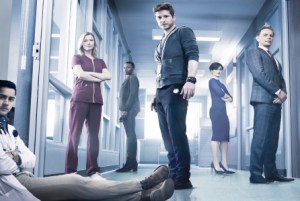
 Redwood's Medical Edge