A recently released movie, Unsane, starring the remarkable Claire Foy, highlights the plight of Sawyer Valentini after she’s been involuntarily committed into an inpatient psychiatric hospital.
 This post does contain spoilers to the movie so stop reading if you don’t want to know more about the film.
The crux of the story is that Sawyer believes her stalker has made his way into the psychiatric unit where she is a patient— whether or not that is the case is the mystery.
Unfortunately, the way that psychiatric care is highlighted in the film is disturbing at best. At worst, I hope it doesn’t deter anyone from seeking mental health treatment if they need it.
Problem One: Not disclosing to a patient why she’s being admitted. The genesis of Sawyer’s admission into the psychiatric unit stems from a visit with a counselor where she discloses at times she thinks about hurting herself. She’s left unattended (a no-no if you think someone is suicidal) and the next scene is a nurse escorting her into an intake room. The nurse never fully explains to the patient the reason for the admission and leaving it out doesn’t really increase the drama of the scene— it just makes the nurse look mean and uncaring. Simply, a nurse could say, “Your mental health provider has placed you on an involuntary hold because she’s concerned you’re going to hurt yourself. ” Then the heroine can argue with her about why she feels the admission is unnecessary.
Problem Two: Having the patient undress but allowing her to keep her bra. A bra is considered a ligature risk and patients can’t have anything on their person that they might use to hurt themselves. Hair ties, piercings, and other jewelry are all removed.
Problem Three: Drug injection sites. Emergency drugs for agitated patients are usually given IM (intramuscular) and not IV (intravenous) to the neck or arm. Can you imagine trying to start an IV on an agitated patient? It’s much easier to land a needle in a large muscle group then to try and finesse a tiny IV catheter into a moving target.
Problem Four: Leaving a patient alone in restraints all night. There are very specific regulations around restraints and significant documentation that goes along with it. Patients in restraints are continuously observed by a staff member and circulation to their extremities is checked often. Also, the patient must be offered bathroom breaks at a minimum of every two hours and you can’t deny them food as punishment. The goal is always to get patients out of restraints as soon as they can be safe— and that doesn’t always imply that they are calm.
Problem Five: A mixed gender open unit. Need I say more?
Problem Six: That psychiatric care is an insurance scheme for money and that patients are intentionally kept until their insurance money is exhausted. This is a large crux of the movie to the point that one of the patients is actually an undercover police officer trying to uncover the scam. This is the most disappointing aspect of the film. There are so few mental health beds around the country right now that it is not difficult to fill them. Here’s a news article here, here, here, and here— which all posted within one week. Trust me, mental health facilities can keep their beds full without perpetuating insurance schemes.
Overall, an interesting movie, but portraying the current state of mental health care in this country would have only increased the tension and drama for this film.
 The setup
 There will be spoilers for this movie in this post so you’ve been warned.
 Problem Three
 have a nurse check on it, then know how to use it. As noted in the photo, the IV tubing is not loaded into the IV pump.
 On a recent episode of the wildly popular ABC series
  With burns to the back, it would really depend on what percentage of his back is burned. Burns are always calculated in percentages so it’s hard to know exactly what the treatment would be without knowing that number.
 Truth is, it’s a team effort to keep patients from suffering from these complications. We are all responsible for looking out for one another regardless of scope of practice. For instance, if an EMT sees something the doctor (or new resident) is doing wrong, they should speak up to prevent harm from coming to the patient.
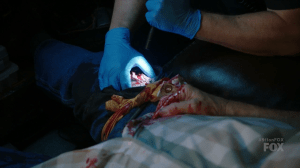 In the first episode of the season, a man gets hit with an old artillery shell in his leg. As noted on the picture on the right, by simply shining a flashlight into the wound, the paramedic declares that his femoral artery has been severed. This could be more believable if there was even some mild pulsatile bleeding, even with a tourniquet in place, at the site which is characteristic for
  arterial bleeding.
 When the bomb squad gets there, they are able to take this sweet x-ray in the field. It is a plain, diagnostic x-ray. There is no way for an EMS crew to take an x-ray like this. Can the bomb squad? Yes. So the show is doing it’s due diligence by having the bomb squad perform this task. However, the bomb squad would not need the military to diffuse this— my law enforcement brother who used to work with the bomb squad verified this.
 Today, we’ll focus on how to add tension and conflict from real-life scenarios in the ultrasound department.
 gospel truth of Jesus Christ. Her stories dive into the healthcare environment where Shannon holds over twenty years of experience as a Registered Diagnostic Medical Sonographer. Her extensive work experience includes Radiology, Obstetrics/Gynecology and Vascular Surgery.
 Redwood's Medical Edge