The Lyme Wars: Part 2/2

Today, I’m concluding my interview with author Brandilyn Collins. You can find Part 1 here. Today, we focus on healing and what medical professionals can do to improve the care for those affected by chronic illness.

Jordyn: You’ve been open about God healing you during your first Lyme infection. Did your feelings/attitude toward God change when you were reinfected? Are some of these attitudes reflected in Janessa’s attitude toward God as displayed in the novel?

Brandilyn: When I was reinfected with Lyme in 2009, I couldn’t believe it! I gave God a hard talking-to. What are you doing? We’ve been here, done this. And aren’t you worried about your reputation—so many people know you cured me once? What if they doubt you now?

Well first, God informed me that He’d been dealing with the reputation thing since He brought the Israelites out of Egypt, so thank you very much, but He had that under control. Second, I can see now in hindsight that if I hadn’t experienced round number two of Lyme, I wouldn’t have written Over the Edge. As it turned out, six months of antibiotics cured me of that round.

Regarding Janessa, her spiritual journey is similar to mine. When I had Lyme the first time, I learned how to pray the psalms, both as petition and in praise—whether I felt like praising God or not. Most of the time I didn’t. It was a wonderful lesson that has changed me to this day.

Jordyn: Any words of wisdom for doctors/nurses in dealing with patients who have chronic pain/illness?

Brandilyn: Please, please don’t tell them it’s “all in their head” or some form thereof. Just because you can’t diagnose an illness—that doesn’t mean the patient simply wants attention or is a hypochondriac. It’s bad enough facing chronic illness. Worse still to be invalidated by the medical community. And please—educate yourself about Lyme. Admittedly, this is hard to do, because typical education would be in the form of reading published articles in esteemed medical journals. Unfortunately, these articles are based on the old, wrong assumptions about Lyme (or the authors simply ignore other research altogether). Google “lyme wars” to start online research. And—I have to get in that plug—read Over the Edge. It will alert you to the symptoms and issues involved in the Lyme wars—and how those wars came about.

Secondly, I want to talk to you doctors/nurses who do know about Lyme but are afraid to diagnose it. I understand your dilemma. I understand you don’t want to get into a battle between treating a patient long-term as he or she needs and your medical board. The political climate for you regarding Lyme is very bad. But please don’t send that patient away, saying, “I don’t know what’s wrong with you.” At least admit to the patient that he may have Lyme and refer him to an organization that can help find a Lyme doctor. (Googling “find a Lyme literate doctor” is easy.)

Leaving a possible Lyme patient completely in the dark opens him up to extended, further debilitating disease—if he does indeed have Lyme. I’ve seen this happen. I’ve seen Lyme patients lose all quality of life and become bedridden because their doctors didn’t want to admit Lyme, even when those doctors recognized the signs. I’ve even seen doctors refuse to test for Lyme when the patient requested it.

Jordyn: Any final thoughts?

Brandilyn: Good health and blessings to all. ~ Brandilyn

Thank you so much, Brandilyn, for your time. Blessings to you in your writing and to the continued success of Over the Edge.

Even in writing fiction, it’s a must to be factual for the story to ring true. Brandilyn also started a web-site for Lyme patients to discuss their experiences as well as some additional education regarding Lyme disease. These are great resources for research.

Blog Note: This interview with Brandilyn was originally published in May, 2011. Still, there appears to be confusion on how to deal with these patients as evidenced by just one recently published news piece called Defining Lyme: Medical community struggles with treatment.

Do you know anyone who suffers from chronic Lyme disease? Have you ever incorporated a disease into a story line?

Help spread the word about Brandilyn’s interview and Lyme Disease!

Brandilyn Collins’ insight into Lyme Disease: Part 1/2. Click to Tweet.
Brandilyn Collins’ insight into Lyme Disease: Part 2/2. Click to Tweet.

 

The Lyme Wars: Part 1/2

Since May was Lyme Disease Awareness month and we’re getting into tick season with everyone enjoying the outdoors, I thought it would be great to repost Brandilyn Collins’ thoughts on the topic. You can check out all of Brandilyn’s amazing books by vising her website. Part two of her interview can be round by following this link.

What do you do if your a novelist, infected with a potentially life-threatening illness (twice) and there are two camps of medical thought as to the diagnosis, seriousness and treatment of that illness?

How about . . . write a suspense novel.

This is the situation that best-selling author Brandilyn Collins found herself in. Over the Edge is a novel based on her real life experience of battling the medical community in their current thought process concerning Lyme Disease. I have to confess, I learned a lot about Lyme while reading this engrossing suspense tale.

I’m honored to have had the chance to interview Brandilyn for her thoughts on Lyme Disease.

Welcome to Redwood’s Medical Edge, Brandilyn!

Jordyn: I was told once by an editor with a well-known publishing house that “issue-based novels don’t sell well.” Does this thinking concern you especially when writing this novel under a new publisher?
Brandilyn: First, thanks very much for our discussion today. I appreciate the opportunity.
As to your question—I never even considered it. A couple thoughts: One, it’s important that the novel first and foremost be about entertainment, not informing. If the author fails to keep readers turning pages, those readers will stop reading—and never “hear” the message. So when I sat down to write Over the Edge, topmost in my mind was meeting the four-point promise of my Seatbelt Suspense® brand: fast-paced, character-driven suspense with myriad twists and an interwoven thread of faith. Two, once I’ve met my brand promise in Over the Edge, I then have thousands of potential new readers—those in the Lyme community, who will feel validated by the story. So in that case, an issue-based novel only helps in marketing. Further, I’m passionate about the subject, which can only help as I interview in various venues.
Jordyn: Redwood’s Medical Edge focuses on dispelling medical myths that are commonly perpetuated in writing. What do you consider to be the three most popular myths among the lay public concerning Lyme disease? Among medical professionals?

Brandilyn: Great question!

Among medical professionals:

1.  That Lyme disease can always be cured by a two to four week round of antibiotics. In truth, chronic Lyme can take months, even years, to treat with antibiotics.

2. That a patient must display the bulls-eye rash to have Lyme. Many patients never have the rash. Others may have a rash, but it doesn’t look like a bulls-eye.

3. That a negative test result means a patient doesn’t have Lyme. The CDC (Centers for Disease Control) says on its web site that Lyme is a clinical diagnosis, meaning that the entire presentation of the patient is taken into account. In addition, tests for Lyme are notoriously unreliable, partly due to faulty criteria for certain tests, and partly due to the nature of the Borrelia (the bacteria that cause Lyme). Borrelia are a very formidable foe. They can hide from the body’s immune system by changing their outer protein coat, for instance. Since tests look for antibodies to the Borrelia, not the bacteria themselves, a true Lyme patient can test negative. Therefore symptoms of a patient can mean more to the Lyme-literate doctor than test results.

Myths among the lay public:

1. That doctors in general, or even specialists like Infectious Disease Specialists, know how to properly test and diagnose Lyme. Wrong—reference above.

2. That Lyme isn’t very widespread. In reality, the CDC has verified Lyme in all 50 states. What’s more, the cases of Lyme reported to and verified by the CDC is estimated to be only one-tenth of the actual number of cases.

3. That you’ll always know if you’ve been bitten by a tick. Nope. Many Lyme patients never knew they were bitten. The most likely stage for a Lyme-infested tick to transmit is during its nymph stage, in which it’s no bigger than the head of a pin. Very hard to spot on a body, especially after it’s half submerged under the skin.

Jordyn: You list several recommendations in the Author’s Note section to improve care for Lyme patients. If you could pick one for nationwide implementation, which do you think would have the most beneficial effect?
Brandilyn: The first step, even before redefining treatment, is to create better testing. Too many patients test negative for Lyme under the CDC criteria, then take years before they find a Lyme-literate doctor to administer more accurate tests, which show positive. Meanwhile, the Borrelia have had time to spread throughout the body systems and burrow deep into body tissue, where they’re hard to eradicate. Lyme patients, therefore, face a double whammy. They’re first told they don’t have Lyme—when, if they’d been allowed to catch the disease early, it in fact is treatable with two to four weeks of antibiotics. Then when they’re finally diagnosed months to years later—when the disease will now take long-term antibiotics—they’re denied the long-term treatment.
Jordyn: Are you a proponent of a Lyme vaccine?

Brandilyn: The first Lyme vaccine was a major disaster and was soon pulled off the market. Of course I’d be in favor of a vaccine that really worked. But the medical profession has such a hard time even defining Lyme. It was defined far too narrowly the first time around and is still being too narrowly defined. Hard to create an effective vaccine under those conditions. However, researchers continue to work on it.

We’ll continue this two-part interview on Thursday. What’s your Lyme IQ? Also, for your education, here is a helpful slide slow regarding Lyme Disease. These were interesting to me after reading Brandilyn’s book as some of the myths she is trying to expose are perpetuated in these clips. Can you find what they are?

Brandilyn Collins’ insight into Lyme Disease: Part 1/2. Click to Tweet.

*Originally posted May, 2011.*

Can You Fake an Ultrasound in Real Time?

Gerard Asks:

I came across your blog as I was googling my question. This week, I was watching Grey’s Anatomy (Season 14, episode 18) in which an unscrupulous (or maybe it he was just a fraud?) doctor was giving false diagnoses for breast cancer through ultrasound—I think to sell treatment?

Knowing a little about computers, I wondered how that could be possible. Can an ultrasound store the millions of images or 3d imaging from another patient to be “played” on another patient? Of course, I wrecked the show for my wife by questioning the episode she was enjoying.
So, in case I’m all wet in my assumptions, is it possible to fake an ultrasound in real time?

Jordyn Says:

Hi Gerard! Thanks for submitting your question to me. The perfect person to answer your question is Redwood’s resident medical expert, Shannon Moore Redmon.

Shannon Says:

Today’s ultrasound technology does offer the ability to record video clips that an extremely unethical doctor could replay while pretending to scan a patient with a probe. Most patients would not know the difference between normal breast tissue compared to a malignant mass and the shape of the entire breast isn’t really a factor on the ultrasound screen, since we’re only scanning a small section at a time.

With that said, the hoax displayed in the Grey’s Anatomy episode – Hold Back The River, would be difficult to achieve in real medical life.

Gold Standard

First, ultrasound is not the Gold Standard for detecting breast cancer. That role belongs to mammography (x-rays of the breast). Highly trained technologists position and complete several different mammography views. Ultrasound simply supports suspicious lesions first detected on these images. Doctors use the scan to provide more information and ultrasound should never be used alone to detect malignancy. I hope most patients would not simply take a doctor’s word based on an ultrasound alone when determining whether they have breast cancer or not.

When a mass is identified on a mammogram and followed up with ultrasound, these images or video clips do not give a complete diagnosis of cancer. We can suspect cancer by the appearance of the mass we see, but the only way to know for sure if the mass is malignant, is through a biopsy. Stereotactic breast biopsies are often performed at imaging centers or hospitals. A large needle is used to take samples of the mass and then send them off for pathology testing. Those results tell if a mass is cancerous or not. If the patient is not a candidate for stereotactic breast biopsy, then the mass can be removed in surgery and sent to pathology for testing.

Appearance

When a sonographer finds a suspicious mass on ultrasound, we look for several factors in the appearance. Is it solid or fluid filled? Does is have smooth borders or finger-like spiculations extending into normal tissue? Does a shadow present posterior to the mass? The mass shown during the episode did not meet the specified criteria for malignancy. Let’s break the moment down:

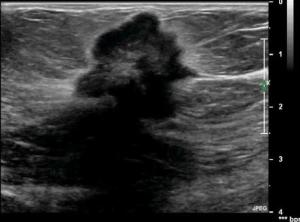
The doctor shows the female character a mass on the screen. There was no shadowing posterior. The borders were smooth and looked like the normal tissue adjacent to it. The area the physician suggested was solid but had a Cooper’s ligament running through the tissue which is typical for a normal lobe of the breast. I’ve included an ultrasound image of a true malignant mass, so you can see for yourself what a true breast cancer might look like on ultrasound. I think you’ll find the video clip played in the scene looked nothing like the true cancer below.


Exam Inaccuracies

During the scene, a swishing heartbeat noise can be heard in the room. Grey’s Anatomy seems to think that when an ultrasound is being used, every machine creates this noise. Let me assure you, that’s unrealistic.

The noise heard in the background is created by a Doppler sample of a vascular structure, such as an unborn baby’s heartbeat or blood flowing through an artery. Neither of these were being scanned during our breast exam.

When no Doppler is activated on the screen, this sound cannot be heard. But yet, we have the heartbeat noise once again. I wish someone at Grey’s Anatomy would update their sound effects team.

After the blond female doctor goes back to Seattle Grace, she has her doctor friend scan her breast to make sure there is no cancer. The doctor who performs the scan and supposed to be knowledgeable enough to detect breast cancer, is holding the wrong probe. She should be holding a linear transducer used in high frequency imaging and provides a rectangular footprint on the screen. Instead, her probe is curved and used for abdominal and pelvic scanning because of the lower frequency range.

Another flaw in the episode is how all these doctors are experts at performing scans in every area of the body. In real life, trained, registered sonographers and technologist work in these modalities. They would be the ones to execute the imaging. Then a radiologist would read the exam and communicate with the surgeon or other physicians. But once again on TV, we see the Grey’s Anatomy doctors performing all the imaging exams. No sonographers or technologists around anywhere. So unrealistic and a little insulting.

I think it is time for the Grey’s Anatomy team to hold back more than the river— they need to hold back on performing any more ultrasounds until they consult a living breathing registered Sonographer.

********************************************************************************************
Shannon Moore Redmon writes romantic suspense stories, to entertain and share the gospel truth of Jesus Christ. Her stories dive into the healthcare environment where Shannon holds over twenty years of experience as a Registered Diagnostic Medical Sonographer. Her extensive work experience includes Radiology, Obstetrics/Gynecology and Vascular Surgery.

As the former Education Manager for GE Healthcare, she developed her medical professional network across the country. Today, Shannon teaches ultrasound at Asheville-Buncombe Technical Community College and utilizes many resources to provide accurate healthcare research for authors requesting her services.

She is a member of the ACFW and Blue Ridge Mountain Writer’s Group. Shannon is represented by Tamela Hancock Murray of the Steve Laube Agency. She lives and drinks too much coffee in North Carolina with her husband, two boys and her white foo-foo dog, Sophie.

Author Question: Treatment of Teen Suicide Victim (2/2)

Today, we’re continuing our discussion of the medical treatment of a fifteen-year-old male suicide victim who slit his wrists at school. You can find Part I of the discussion here. In this post, we’ll focus on more of the mental health aspects over the medical treatment.

Pink Asks:

Upon examining a patient, and if sexual abuse is suspected, what is the hospital protocol? How do the hospital staff work with police and the victim’s family?

Jordyn Says:

If outward physical exam of the skin shows injuries concerning for sexual abuse, this can be handled several ways. In order to answer this best, I’d need to know what kind of hospital your patient/character is at in order to give advice as to how that community would likely respond but I’ll give thoughts as to how my institution would handle it—which is a large, urban pediatric medical center. A rural hospital would likely handle it much differently.

One thing I want to say is that no sexual assault exam would be done without the patient’s consent (or parental consent—a court can order if needed)—so this would not be done on an unconscious person. What you can see from the outside would be the limit. For instance, in girls and women no internal vaginal exam.

There might be an extreme outlying caveat to an internal exam if the patient were near death, concern for loss of evidence, or other victims were at risk, but it would have to be VERY PRESSING circumstance and likely the courts/law enforcement would be involved in order to move forward.

Regarding the suicide attempt, the next thing to keep in mind is that the patient’s medical needs are always addressed first. In fact, the patient must be “medically cleared” by a physician before they can participate in a mental health evaluation.

If there is a concern for sexual abuse, we would first contact social work through our hospital to develop a game plan. If a sexual assault exam needs to be done, we have health care professionals that are very experienced in doing these with kids/teens and we want the most experienced professional to do the exam and collect any evidence. Social work will do a couple of things if they think the concerns are valid. One, report it to the state (Department of Children and Family Services—something along those lines depending on the state) and second, report it to the police if they believe a crime has occurred. The incident is reported to the police jurisdiction where the crime took place and not the location of the hospital where the patient is receiving care.

As an example, if a woman is raped in Anchorage, AK, flies to Seattle and seeks treatment there, the hospital in Seattle is going to have to call Anchorage, AK police to report the crime. Local police can help determine the appropriate jurisdiction if it’s not clear.

The timing of the sexual assault is important in collecting evidence. If a person was just raped, we’d be very anxious to encourage the person to have a sexual assault exam done ASAP. If they are reporting something that happened more than three days prior (it’s 72 hr for us)—it’s not as pressing that an exam should be done immediately but plans can be made with the patient and family for follow-up exam and care.

Larger police departments typically have victim advocates that can help families through processes like this, but it is up to them to call that person in. Contrast this with a more rural hospital that may “hotline” the concern for abuse to the state, call the police, and depend on state social workers to determine the course of action.

Pink:

Are patients who attempt suicide always sent to a mental health facility for treatment? I know patients speak with a crisis counselor, but what if the attempt wasn’t caused by being under the influence of drugs, or a mental illness, but due to a desperate situation (domestic violence)?

Jordyn:

The most important determination about whether or not someone will receive psychiatric care is whether or not they are a current danger to themselves (and/or others) and how likely are they to act on it. This is determined by a mental health professional and not the medical staff. The reason for the attempt doesn’t necessarily differentiate potential lethality—it’s what the patient is thinking about in their mind and how at risk they are to act on it.

I think you’re trying to make a distinction that a desperate situation caused by domestic violence leading to a person’s suicide attempt would be seen as less lethal and it wouldn’t. If a person is trying to kill themselves because their home situation is driving them to do that—that is very significant and taken as seriously as someone who swallows pills, or slits their writs, or is having a psychiatric break. Someone attempting suicide due to domestic violence will likely have other co-existing mental health issues like anxiety and depression.

This is a very serious topic and definitely worthy of fiction to help foster discussion of suicide. Good luck with this novel.

Author Question: Treatment of Teen Suicide Victim (1/2)

Pink Asks:

Hi there! I’m so glad I’ve found your site and thanks for taking the time to read this. Ok, here goes.

I’m writing about a fifteen-year-old boy who is being abused physically and sexually by his father. One day at school, he tries to commit suicide by slitting his wrists. He becomes scared by the amount of blood, so he leaves the restroom to try to find help. He is found by his teacher and passes out. Now, I know with any kind of suicide attempt, the police are always contacted, and given the all clear for the paramedics.

Jordyn: I think it would depend on the city, county, school district (and whether or not there was a school resource officer) as to the level of police involvement if he just really needs medical attention. I would advise that if this is written about a real place you ensure they have co police response because a paramedic team would be able to handle this call.

Pink: What will the ED staff do to stabilize a patient who has slit their wrists? Is surgery necessary if the wound is pretty deep?

Jordyn: We always look at airway, breathing, and circulation first. If the patient is talking to us then we can quickly check off the first two as at least functional for the time being. As far as circulation the priority is to stop all active bleeding first by direct pressure. Also, does the patient exhibit any vital sign measurements that show he’s suffering from blood loss—which in this case could be increased heart rate, low blood pressure, and also low oxygen levels.

After that, the medical priority for this patient is to further control the bleeding and determine how much blood he’s already lost. Direct pressure is the method used to control the bleeding. Blood work would be done to look at his blood counts to see if he needs any blood replacement. Next would be to look at if he damaged any arteries, tendons, ligaments or nerves during the attempt. Generally, an exam of the function of the fingers can reveal if there is a concern there. For instance, do his fingers have full range of motion? Do any fingers have areas of numbness? Arterial bleeding is very distinct so it’s usually obvious if an artery has been severed. If he has damaged anything that would limit the function of his hand then he would need follow-up evaluation by a hand surgeon for surgery. If there is no damage to the structures as listed, there is a possibility the wound could be closed in the ER as a simple laceration repair.

Pink: Upon discharge, what will the patient be given to take home for treatment of their wound (the slit wrist)?

Jordyn: If the patient gets a simple laceration repair (merely closing the skin even if it takes a lot of stitches) then pain could be managed at home with over-the-counter pain relievers like Tylenol or ibuprofen. If the patient requires surgery, a short course of a narcotic may be given for pain control,    but we also have to look at other factors to determine if this would be wise for the patient (are they a current drug addict or is there continued concern for suicide attempt). If the patient has surgery, then it is up to the surgeon to determine the patient’s home pain relief.

Pink: If a nurse or doctor notices any bruises on the patient’s body, can they examine an unconscious patient?

Jordyn: Yes, an unconscious patient’s skin can be externally examined. In fact, it is often protocol to do so because we are looking for clues as to why the person is unconscious.

Well continue this discussion next post.

Author Question: Tawse Hand Injuries

Anonymous Asks:

I’m really glad I found your blog! I don’t know whether this is the sort of question you’ll answer on the blog, since it’s “injury to order”, but I very much hope so as I try to be scrupulous about my research and want to get this right.

I have a male character in his mid-30s. He’s right-handed, and his left hand is permanently damaged. It can be either a birth defect or something that occurred when he was young (before the age of ten). I’m completely open to what the injury is— I would like him to have at least limited use of his hand, and it would be a bonus to have a childhood surgery and/or to have him use a splint or brace in adulthood (even only occasionally), but none of this is required.

However, what’s fixed is that he believes the injury was caused by parental abuse— specifically, being whipped across the palm with a leather strap known as a tawse.
Because he’s mentally conflating his actual injury with the abuse, those two things don’t have to match up. It might even be better if someone in his adult life said “could being hit with a strap really cause that damage?”, but I do want to know exactly what the issue is so I can depict it accurately.

Many thanks for anything you can suggest!

Jordyn Says:

Thanks for sending me your question.

I love “injuries to order”. Sometimes it’s easier to fit an injury into what the writer wants than framing the writing to a particular injury the author wants to write about.

I’ve never heard of a tawse and its use in corporal punishment. For readers, a tawse is a piece of leather with split end. You can find some representative images by following here. Just reading about this device being used– it would easily cause soft tissue damage– bruising (even though they were seemingly designed to not bruise), swelling, and if used with enough force– fractures. I think continued, persistent use could potentially even cause nerve damage. I looked specifically for articles dealing with “tawse hand injuries” and really didn’t have much luck.

The reason I list these potential injuries is so that you can “pick your own” injury within these guidelines. I’m including a couple of links to websites that list several congenital malformations of the hand. Read through them and see if any connect with you and the goals of your story.

http://emedicine.medscape.com/article/1285233

http://www.hopkinsmedicine.org/healthlibrary/conditions/plastic_surgery/congenital_hand_deformities_85,P01120

https://my.clevelandclinic.org/health/articles/congenital-hand

Hope this helps and best of luck with your story.

Author Question: Gunshot Wound to the Chest

Virginia Asks:

I’m putting the final touches on a romantic suspense novel in which my hero is shot. The most important part of this is that he has to continue to function until he saves the day, then falls and has to be treated. The wound cannot be bad enough that he can’t pass the physical and qualify to become an FBI agent within a few weeks.

My fit male character (34 years old) is in a shootout. He’s shot with a 9mm handgun but the bullet ricochets, grazes his chest, and fractures a rib. He doesn’t notice initially. He begins to feel some pain after about five minutes. Then feels woozy and has a head rush. I want him to fall after the action is over, but be able to talk a little with some struggling.

He’s far from a hospital when he’s shot, but a military medic is there with his kit. The hero can be medevaced to a hospital on a military helicopter. What would the medic do in the field? I don’t want the bullet to penetrate the chest wall, but would the medic check for pneumothorax and if so how?

What would happen at the hospital? How long would he be hospitalized?

I’ve read and re-read about pneumothorax and hemopneumothorax, but think that might require too much recovery time and be too much for him to qualify and be able to pass the physical. I’ve done some research on pulmonary contusion but am a bit overwhelmed with the possibilities of the use of continuous positive airway pressure and high-frequency chest wall oscillation. And the long term recovery.

Since I really don’t know what would be best as a gunshot wound that my hero can recover from and pass a physical in a few weeks, I really need some guidance and specific information that can easily be explained in a romantic suspense novel. I’m hoping this “bullet grazes the rib” scenario is workable. If not, what should I consider instead?

Jordyn Says:

Thanks so much for sending me your question, Virginia.

I think the simplest thing to do is to have the bullet graze his chest. It could potentially hit the rib, break it, and ricochet away. Leaving a nasty gash with a broken rib underlying but nothing else injured. Generally, a fractured rib will heal in 4-6 weeks so he will have pain and limited movement until then. The worst pain will probably be in the first 1-2 weeks and then should taper off after that.

As far as the military medic assisting off duty. I think it’s fine if he has a small first aid kit that he could dress the wound with. He likely would not be carrying an oxygen tank, etc. So the dressing to control bleeding is necessary. Lots of emergency medical types might have a small kit in their car (I do), but not an oxygen tank or a way to deliver oxygen to the patient.

The military medic could check for a pneumothorax by listening to your hero’s breath sounds. Clear and equal breath sounds bilaterally generally indicate no pneumo (though a small one could still be present). It will hurt to take deep breaths if his rib is fractured.

If he’s transported by a military medevac then they could start oxygen, an IV, and give some IV fluids. Place him on a monitor to keep tabs on his heart rate, breathing, oxygen levels, and blood pressure.

In the hospital, he’ll get chest and belly films and possibly a CT of his chest and abdomen. If it seems like a fairly benign wound, the wound could just be irrigated with a lot of saline and sutured closed. He needs an updated tetanus shot if he hasn’t had one in over five years.

If his breathing is good and he suffers just one cracked rib, there is likely not enough injury criteria for him to be admitted into the hospital. He’d likely be observed in the ER for several hours to make sure everything is okay. He’d be sent home with a short course of narcotics (like three days) and instructed to take over the counter pain relievers to help with the pain as well. He should have limited activity but not be bedridden. He’d be encouraged to take deep breaths (usually at every commercial break if watching TV) to prevent lung complications because patients don’t like to breathe deep when they have a cracked rib.

Hope this helps and good luck with your story!

Author Question: Scythe Wound to the Chest (2/2)

We’re continuing with Sue’s question regarding a scythe injury to the chest to a seventeen-year-old male. You can find Part 1 here.

Sue Asks:

I have a few follow-up questions regarding the surgery. Is it possible for a thoracotomy to be done by two people? The hospital in my story is severely understaffed and only two doctors are available to perform the surgery. There are not enough nurses on staff either, and it’s the middle of the night. Is that feasible or should I tweak the story so more people are available to make sure the teen makes it out alive?

And lastly, what kinds of medications would be pushed through the IV to sedate and/or paralyze him for surgery?

Jordyn Says:

This was a great question to ask my OR expert friend, Kim Zweygardt, who works as a CRNA.

Here are her thoughts.

Most hospital’s policy states that an RN must be in the room for assessments and patient safety. The bare minimum OR staff would be a circulator (RN), scrub tech, anesthesiologist, and surgeon. If you want chaos in your story— take out the scrub tech because the doctor will have to figure out the instruments for himself versus calling out and them being handed to him.

A patient this unstable would be intubated in the ER. Generally they are given a pain medication (Fentanyl), a benzodiazepine (Versed) for the amnesic effect, and the paralyzing agent will vary but Succinylcholine was common in your time frame of 2006.

Once in the OR— they would give him anesthetic gases to keep him down. I don’t see your scenario playing out without a anesthesiologist on hand.

Hope this helps and best of luck with your novel.

Author Question: Scythe Wound to the Chest (1/2)

Sue Asks:

The year is 2006 and a seventeen-year-old male gets stabbed through the right side of his chest all the way through to the back, but the blade (a hand scythe) that could potentially stop him from bleeding out gets removed. Naturally, he starts bleeding out.

I already know a lot about what goes into stabilizing him: Checking the ABCs, IVs for blood and fluid replacement, intubation (an endotracheal tube), but my question is, what is the exact treatment for this type of injury in a surgical theatre? What are the indications that he may need a thoracotomy or a lobectomy? Or is it as simple as a chest tube to treat the hemopneumothorax, connecting him to a ventilator, and then suturing the lacerations in his lung?

Jordyn Says:

Thanks so much for sending me your question, Sue. Very intriguing scenario you have here!

Let’s first clarify some of these medical terms for readers. A thoracotomy is a surgery that involves removing the lung. Lobectomy can be removal of any lobe of organs such as your thyroid, liver, or lung. In this case, you’re referring to the lung. A hemopneumothorax is a collection of blood and air inside the chest wall that is usually relieved by placement of a chest tube. Pneumothorax is an abnormal collection of air in the chest between the lung and the chest wall– also typically relieved by placement of a chest tube (though some very small ones may just be watched).

I asked a physician friend (thanks, Liz!) her thoughts on your questions.

She says the following:

Since the patient is unstable, he needs a thoracotomy by default. Other indications for surgery would be blood draining from the chest tube at greater than 100 milliliters per hour. The lungs cannot be sutured. Generally, bleeding vessels are either tied off or cauterized and the bronchi (the larger breathing tubes) are repaired. If the lobe is severely damaged then it does get removed.

What is the Glasgow Coma Scale?

Often times on television and in movies, you’ll hear a medical character exclaim, “His GCS is 5!” or some other variation. What is this score? What does it mean for the patient?

The Glasgow Coma Scale (GCS scale) is one way to gauge the significance of brain injury. There are three components to the measurement. Eye Opening. Verbal Response. Best Motor Response. In general, the highest score is 15. The lowest score is 3. You can be dead and still score a 3 so the higher the score the better.

Eye opening looks at four components and each is given a score:
4: The patient opens their eyes spontaneously.
3: The patient opens their eyes after being spoken or shouted to.
2: The patient opens their eyes to a painful stimulus.
1: No eye opening at all.

Verbal response looks at five components:
5: The patient knows person, time and place.
4: The patient can speak but is not oriented.
3: Speaks unintelligibly.
2: Moaning.
1: No verbal response.

Best motor response looks at six components:
6: The patient can obey a two part request such as touch your nose and then your shoulder.
5: The patient moves to push away a stimulus. For instance, if I’m starting an IV in your left hand, you take your right hand to push it away. This is called localizing pain and the patient usually needs to move across their midline or above their clavicle (if the stimulus is placed to the head) to score here.
4:  Pulls extremity away from pain.
3: Abnormal flexion.  Also referred to as decorticate posturing.
2: Abnormal extension. Also referred to as decerebrate posturing.
1. No motor response.

Initially, we might look at the overall score to determine whether or not a patient needs to be placed on a breathing machine. Generally, a score equal or less than eight is used as a cut off point. The lower the initial score, the more likely the patient will be intubated. Over the long term, the GCS can be used to trend improving or worsening neurological status.

Have you ever heard this scale used on television or in a movie?