Christine’s story: Diagnosing Breast Cancer

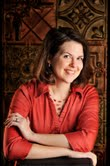
I’m happy to host author Christine Lewry as she shares her first hand account of a breast cancer diagnosis. Christine– thank you so much for sharing such a vulnerable part of your life with us today. I am humbled by your honesty and bravery and am glad you have been cancer free for over 10 years.
I felt the lump again. ‘It’s probably nothing,’ I said out loud. It wasn’t a hard lump but a knot of soft tissue under my arm. A wave of overwhelming doom made my knees buckle, I sat back on the bed.
I rang the doctors’ surgery. ‘Is it an emergency?’ the receptionist asked.
I thought for a moment. Is it?
‘Well … yes,’ I replied. She gave me an appointment for later that day. I wandered about the house, kept looking at the clock, didn’t get anything done.
 ‘I don’t think it’s anything to worry about,’ the doctor smiled. ‘But I’ll send you for a mammogram.’
My husband, Tony, came with me for the mammogram. We sat in a comfortable pink waiting room and read the newspapers. He made a cappuccino from the machine. The nurse’s hands were round and warm as she squeezed my breasts into the X-ray machine. ‘I’ll show these to Dr Wainwright,’ she said. I got dressed and returned to my newspaper – I didn’t want to look at the frightened faces of the other patients.
‘Doctor wants to do an ultrasound,’ the nurse with the warm hands said.
I lay on a narrow bed while Dr Wainwright squeezed cool gel on my chest and ran the ultrasound probe over it. The room was dark apart from the faint glow from her computer. Shadows fell on the walls like ghosts in the night.
‘There,’ she pointed to a haze of white on the screen. ‘I’ll do a biopsy, then we’ll organise a taxi to take it to the lab.’
Tony stayed home with me until the hospital rang. ‘Very sorry, but you have breast cancer.’ The words sounded so trivial and yet so profound and life changing. I tried to stay positive. Anyway, what could I do? Break down? Scream? I had to hold on tight to the belief that I was going to be alright.
The morning of my operation, Dr Wainwright and the surgeon gathered around my bed. ‘We’re going to do a larger operation than we originally planned,’ Dr Wainwright said. ‘We’ve decided to take the lymph nodes from under your arm, in addition to the lumpectomy. The lymph nodes are used to diagnose whether the cancer has spread outside the lump.’
 I signed the form, leaving it to them to do whatever they thought might save me.
The next day my surgeon came to see me. He smoothed out the starched sheet and sat on my bed. ‘I’ve got the results of the lymph node biopsy. I’m afraid it’s bad news,’ he said. ‘Of the twelve lymph nodes I removed, six have cancer. I’ll arrange for you to see an oncologist. I expect he’ll recommend chemotherapy.’
I turned over and stared at the wall, waiting for Tony to arrive. My life was slipping away, like grains of sand falling through my fingers. The thought that I had cancer spreading through my body was terrifying. What if I died leaving my children without a mother? They were so young that there would come a time when they wouldn’t even remember me. I would be that photograph smiling back from the mantelpiece, a sad remnant of a woman who died long ago, never moved or put away since she left.
The oncologist talked in percentages and statistics, about improvements in life expectancy of five or ten years, his voice set in a monotone devoid of hope or compassion. What bloody good was five or ten years? I wanted to live, not wait it out. I wasn’t going to take on his fear or negativity.
The chemotherapy made me feel sick. I tasted its bitterness in the delicate lining of my nose and at the back of my throat. It made me feel like every cell in my body had been poisoned and that I had the most dreadful hangover, yet I hadn’t even had a glass of wine.
Mentally I had to pace myself. Six times, once every three weeks. I could manage that. I counted them off. Still, it was hard for me when all the hair on the top of my head fell out despite the torture of the cold caps. I always did care too much about my appearance.
‘Do you love me?’ I asked Tony whilst having the pinky-red chemotherapy dripped into my veins. The anti-sickness medication made me constipated for days and I became frail and weak. The more ill I became, the more I thought that if I died he might find a new wife; someone younger, thinner, better than me.
When my treatment finished, I was cast adrift. All the time I had been having hospital appointments, chemotherapy or radiotherapy I had been doing something positive to fight the disease. Now I floated about, waiting to see whether I would sink or swim.
***********************************************************************

Christine Lewry lives in Hampshire, UK with her husband and two youngest children. She worked in the defence industry as a finance director for twenty years before leaving to write full-time. Thin Wire is her first book. For more info: http://www.christinelewry.com/


 

Up and Coming

Hello Redwood’s Fans!

How has your week been? Mine . . . still mired in Peril’s edits but they should be DONE by Friday which will be very good news.

I’m also hoping that the snow is gone for good for this winter. Colorado has been unwilling to let Jack Frost go home but we hope he’s escaped so the flowers can bloom.

For you this week:

Monday: Author Christine Lewry shares her personal experience of being diagnosed with breast cancer.

Wednesday and Friday: Author and double Christy Award nominee Jocelyn Green returns to discuss opium abuse during the Civil War.

Hope you all have a great week.

The Civil War and Prosthetic Limbs: 2/2

Jocelyn has returned for Part II in this series on Civil War medicine and amputees. Check out Part I here.

As an added bonus, Jocelyn has graciously offered to give away a personalized copy of her latest novel, Widow of Gettysburg, to one commentor. To enter, leave a comment on any of her posts over the next three weeks WITH your e-mail address. Must live in the USA. Winner drawn midnight, Saturday, May 11th, 2013 and announced here at Redwood’s on May 12th, 2013.

Jocelyn has also graciously said she’ll send you a signed bookplate if you have any of her novels and would like one. Again, MUST have your e-mail. 

Good Luck!

Jocelyn appeared before at Redwood’s and you can read those posts here and here.

Welcome back, Jocelyn!


Many entrepreneurs who developed artificial limbs were Civil War veteran amputees themselves. In fact, one of the most successful pioneers in prosthetics was Confederate veteran James Edward Hanger, whose amputation in West Virginia was the first recorded amputation of the Civil War. He was 18 years old at the time. Union surgeons discovered him wounded and performed the amputation, giving him a standard issue replacement leg: a solid piece of wood that made walking clunky and difficult. 
Hanger’s adjustments included better hinging and flexing abilities using rust-proof levers and rubber pads. He also used whittled barrel staves to make the limb lighter-weight. He won the Confederate contract to produce limbs, and by 1890, had moved his headquarters to Washington, D.C., and opened satellite offices in four other cities. The company he founded – Hanger, Inc. – remains a key player in prosthetics and orthotics today.
One of James Hanger’s early patents from 1891. Courtesy of Hanger.com.

The Civil War-era commitment to support veterans continues today through programs of the VA and the Defense Advanced Research Projects Agency (DARPA) to ensure ongoing progress in prosthetics design. The war set the prosthetics industry on a course that would ultimately lead to today’s quasi-bionic limbs that look like the real thing and can often perform some tasks even better.

To see just how far we’ve come in the realm of prosthetic limbs, I invite you to take a look at the video below. This is a brief look at the story of Taylor Morris, the fifth quad amputee veteran in the U.S. Army. You will see Taylor, who is from my hometown of Cedar Falls, Iowa, go from the hospital bed shortly after his surgeries, to dancing with his girlfriend again at the end of the video. (Have a Kleenex handy!)


For further reading:
Hasegawa, Guy R. MendingBroken Soldiers: The Union and Confederate Programs to Supply Artificial Limbs. Southern Illinois University Press, 2012.
*********************************************************************
A former military wife, Jocelyn Green authored, along with contributing writers, the award-winning Faith Deployed: Daily Encouragement for Military Wives and Faith Deployed . . . Again. Jocelyn also co-authored Stories of Faith and Couragefrom the Home Front, which inspired her first novel: Wedded to War. She loves Mexican food, Broadway musicals, Toblerone chocolate bars, the color red, and reading on her patio. Jocelyn lives with her husband Rob and two small children in Cedar Falls, Iowa.

The Civil War and Prosthetic Limbs: 1/2

I’m so pleased to host author Jocelyn Green again. She’s an amazing woman and author of inspirational fiction surrounding the Civil War.  Jocelyn will be here over the next three weeks sharing wonderful information about her research. Often times, during war, there is a lot of advancement in medical technology which is why I’m giving her so many days.

Plus, I just love her.

As an added bonus, Jocelyn has graciously offered to give away a personalized copy of her latest novel, Widow of Gettysburg, to one commentor. To enter, leave a comment on any of her posts over the next three weeks WITH your e-mail address. Must live in the USA. Winner drawn midnight, Saturday, May 11th, 2013 and announced here at Redwood’s on May 12th, 2013.

Jocelyn has also graciously said she’ll send you a signed bookplate if you have any of her novels and would like one. Again, MUST have your e-mail. 

Good Luck!

Jocelyn appeared before at Redwood’s and you can read those posts here and here.

Welcome back, Jocelyn!


“It is not two years since the sight of a person who had lost one of his lower limbs was an infrequent occurrence. Now, alas! There are few of us who have not a cripple among our friends, if not in our own families. A mechanical art which provided for an occasional and exceptional want has become a great and active branch of industry. War unmakes legs, and human skill must supply their places as it best may.”
~Oliver Wendell Holms, M.D., “The Human Wheel, Its Spokes and Felloes,” 1863
If necessity is the mother of invention, it should come as no surprise that the Civil War, which produced some 45,000 amputee veterans, also prompted major progress in the development and production of artificial limbs. One of the characters in my novel Widow of Gettysburg is the recipient of one of these limbs. Let’s take a closer look at what was involved in this rehabilitation of amputee veterans. (You can see more on amputations from a previous blog I wrote for Jordyn, here: http://jordynredwood.blogspot.com/2012/08/civil-war-amputations-and-anesthesia_31.html
Double Amputees of the Civil War
Once the stump was healed after amputation and the patient able to do without dressings, the surgeons’ work was finished, and the patient was left to shift for himself in securing the best apparatus. But not everyone was a good candidate for a prosthetic. If the limb was taken off at the joint, such as the hip or shoulder, there was no stump to which an artificial limb could be attached. The surgeon may have performed the operation too high or too low on the limb for a good fit to be possible. Also, if the stump was prone to frequent infection, it would have been too painful to attach an artificial limb to it.
For those who could pursue a prosthetic, in the North, the most popular artificial leg was a “Palmer” leg, named for Benjamin Franklin Palmer, who patented the design. A previous design by James Potts was made of wood, leather, and cat-gut tendons hinging the knee and ankle joints, and dubbed “The Clapper” for the clicking sound of its motion. Palmer improved upon this design with a heel spring in 1846, and his “American leg” was produced continuously through World War 1.
Palmer’s leg cost about $150, a prohibitive amount for the average private, whose pay was about $13 per month. Add to that the cost of travel and lodging expenses to see a specialist, and the number of amputees who could afford it went down even further. The cost of an artificial limb for Confederate veterans was between $300-$500, due to the soaring inflation.
Since the majority of veterans had been farmers, planters, or skilled laborers before the war, the need for artificial limbs was, indeed, a crippling problem. To help address it, the U.S. government appropriated $15,000 in 1862 to pay for limbs for maimed soldiers and sailors. In January 1864, a civilian association in Richmond was established to pay for artificial limbs for Confederate amputees.
After the war in 1866, North Carolina became the first state to start a program for thousands
of amputees to receive artificial limbs. The program offered veterans free accommodations and transportation by rail; 1,550 veterans contacted the program by mail. During the same year, the State of Mississippi spent more than half its yearly budget providing veterans with artificial limbs.
 Return for Part II on Friday.
**********************************************************************
 A former military wife, Jocelyn Green authored, along with contributing writers, the award-winning Faith Deployed: Daily Encouragement for Military Wives and Faith Deployed . . . Again. Jocelyn also co-authored Stories of Faith and Couragefrom the Home Front, which inspired her first novel: Wedded to War. She loves Mexican food, Broadway musicals, Toblerone chocolate bars, the color red, and reading on her patio. Jocelyn lives with her husband Rob and two small children in Cedar Falls, Iowa.

Motor Vehicle Collision: Dianna Benson, EMT

I love this post by Dianna Benson, EMT written in first person about the treatment of a patient involved in a MVC. A lot of information presented in such an interesting way.

Dianna’s debut novel, The Hidden Son, released in March.

Welcome back, Dianna!

EMS #16 and #22 MVC at Park Avenue and Green Street.

I toss the rest of my sandwich into a trashcan, and rush out of the fast food joint toward my ambulance, my partner behind me.

Less than five minutes later, we roll up on scene behind an arriving ladder fire truck. I slip mybright orange reflector EMS vest over my head and lurch toward two cars mangled together in a huge intersection, their hoods now one. The EMS #22 crew heads to the one patient in one car, so my partner and I bolt for the two patients in the other.

civilian is leaning inside the driver’s door.
“Sir?” I say, approaching.
He looks at us, eyes wide, face pale. “Glad you’re here. I’m a doctor, an urologist, but I see patients in my office. I don’t deal with emergency—”
“It’s okay. We got it.”
Blowing out a sigh, he backs away.    
Unconscious, the driver’s face is buried in the deployed air bag, arms dangled around it in a laxhug.
“Sir?” I feel his pulse. It’s thready and rapid. Blueness surrounds his mouth and colors his lips, his chest not rising and falling. Respiratory arrest,” I say to my partner who’s assessing the unconscious passenger, the lifeless patient’s head caught in the shattered door window.
Frowning, my partner shakes his head. “Cardiac arrest over here. Facial skin ripped away. Neck twisted 180 degrees and split open. Bled out.”
Code for: We can’t do a thing for her.
My partner rushes our equipmentloaded stretcher around the trunk to the driver door, as I wave a firefighter over to climb into the backseat. With both hands, the firefighter stabilizes the patient’s head straight against the headrest as I assess the minor facial wounds caused by flying glass. Another firefighter grabs the airbag, punctures it and rips it out of my way.  
I insert an oropharyngeal down my patient’s throat to protect his airway. I cover his mouth and nose with a BVM—bag valve mask—connected to oxygen tubing and a D-tank running at 15 liters per minute. As I squeeze the footballsize bulb every five seconds to oxygenate his system,I assess his legs. Right femur appears fractured, left is covered with bleeding abrasions and lacerations, but no hemorrhage threat.
I strap a C-collar around his neck. Keeping his spine in-line, my partner and two firefighters place his body on a backboard on top of the stretcher, as I continue to bag him. I check his pulse again. Still present. I check for spontaneous breathing. Still nothing, although cyanosis no longer blankets his lips. I brace his entire right leg in a traction split to assist with hemorrhage control.
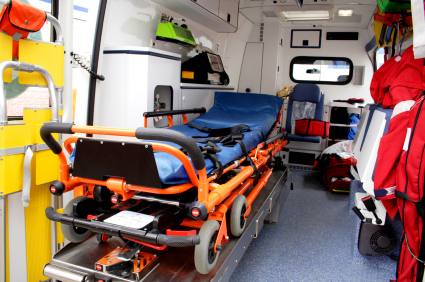
Inside the ambulance, my partner hooks our patient up to the cardiac monitor via a 12-lead, a firefighter bags the patient, and perform a rapid trauma assessment, head to toeAfter I find no other significant trauma or issues, I spike a bag. Less than a minute later we have an IV bolus in place, running high fluids.      
Spiked and dipped lines display on the monitor screen. “Normal sinus rhythm,” I speak out loud. “But hypotension and tachycardic.” Meaning low BP and high pulse rate. I’m thinking it’s possible this patient is headed to hypoperfusion (shock) due to internal blood loss.
   
“Ready?” another firefighter asks from the ambulance’s driver’s seat.
“Yep, take off.” I listen to our patient’s chest. Heart beating rapidly but strong. Lungs sounds absent on the left side. Diminished on the right.
I eye my partner. I’m thinking left pneumothroax. Right may be heading in that direction.” I read the monitor screen. “Severe hypotensive now. How about administering Dopamine?”
Already on it,” my partner says, filling the IV catheter with the med. “He needs chest decompression. Let’s—
“I’m having trouble bagging,” the firefighter says. “You wanna intubate him?”
   
“Do you have full resistance or only some?” I ask.
“Full.”
Blood quirts out of the patient’s mouth.
I gain my partner’s eye contact. “Cricoid intubation?”
“Yep. Chest decompression can wait.”
I locate the cricothyroid membrane, and prep the area with betadine. My partner punctures the skin with a needle while aspirating for air with a syringe, then slides a cannula along needle and syringe. I secure the cannula with a neck strap, and osculate for breathing with my stethoscope.
I hear solid breath sounds. “We’re good, I say then eye the firefighter. “Continue bagging.
snag the radio and switch the channel to the number one trauma hospital.
“Wake Med? This is EMS #16. We’re en route with an MVC patient. Unconscious. Absent left lung sounds. Diminished in right. Surgical trach in place. O2 saturation 90% with BVM at 15lpmBolus IV in placeDopamine dose administeredBP 90/50, pulse 162.  ETA 15 minutes.”
“Chest decompression,” my partner says as he arranges equipment.
To prep the site, rub iodine to the patient’s second intercostalin the mid-clavicular line. My partner inserts a 14-guage catheter into the skin over the third rib. He advances the catheter through the parietal pleura.
“Pop,” he says indicating he felt a pop, which is the goalHe advances the catheter to the chest wall, then removes the needle, leaving the catheter in place.
I secure the catheter to chest wall with dressings and tape.
Six days later, I see the patient exiting the hospital in a wheelchair, his right leg casted. Two hospital employees assist him into an awaiting car. I smile huge and thank God.

***********************************************************************

Dianna T. Benson is a 2011 Genesis Winner, a 2011 Genesis double Semi-Finalist, a 2010 Daphne de Maurier Finalist, and a 2007 Golden Palm Finalist. In 2012, she signed a nine-book contract with Ellechor Publishing House. Her first book, The Hidden Son, released in print world-wide March 1, 2013. 
After majoring in communications and a ten-year career as a travel agent, Dianna left the travel industry to earn her EMS degree. An EMT and a Haz-Mat and FEMA Operative since 2005, she loves the adrenaline rush of responding to medical emergencies and helping people in need. Her suspense novels about adventurous characters thrown into tremendous circumstances provide readers with a similar kind of rush. Dianna lives in North Carolina with her husband and their three athletic children. Learn more about Dianna at www.diannatbenson.com.

<!–[if !mso]>st1\:*{behavior:url(#ieooui) } <![endif]–>

   

Up and Coming

Hello Redwood’s Fans!

You’re going to have to forgive any grammatical areas as I’m likely brain fried from editing ALL week and running my first 5K. Really, keep the liquor locked up. I have to stay bright eyed until at least May 20th. Then . . . well, who knows!

Congratulations goes to Patti Shene for winning a copy of Dr. Mabry’s Stress Test!!

For you this week:

Monday: Dianna Benson stops in for another fictional (though medically accurate) first person account of taking care of someone who has been involved in a MVC. I love the way she writes these posts as not only are they really informational but educational as well.

Wednesday and Friday: So pleased to host author and double Christy Award finalist, Jocelyn Green, who is talking about the medical research involved with her latest novel, Widow of Gettysburg. She’s also offering a chance to win this amazing book so check out her posts for further information.

Have a great week.

Back to editing.

Someone. Send. Help.

Author Question: Disease for Infant

My good friend, Candace Calvert, drops by today with a medical question. Even though she is a former ER nurse extraordinaire– pediatrics was not her specialty so she is doing what medical people do best– consult an expert and I am happy to help out with the help of one of my physicians.

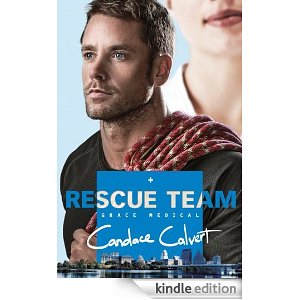
Candace writes inspirational romance with a medical backdrop. I happily endorsed, Rescue Team, releasing May 1st which is book #2 in the Grace Medical Series. Hope you’ll check out all of her books. She is one talented lady.

Candace Asks:

I need a disease/disorder for a 6 month old baby that would require hospitalization and is hereditary.

Jordyn Says:

Okay, first I have to confess that I got the answer to this question from a physician co-worker who is an encyclopedia for crazy medical conditions. If your child is that zebra in the forest, she will figure out what it is so thanks Cathy for this answer.

A perfect condition would be a Fatty Acid Oxidative Disorder. In this case, a long chain mixed fatty acid oxidase deficiency. Now, before your eyes glaze over with that– I could never write that— checked out look like I may have had in high school algebra you could simply say the child had an inherited metabolic disorder.

The child would appear to be normal and all body symptoms normally functioning until something happens to cause the child to fast such as stomach flu (gastroenteritis) that would cause the child to stop eating due to vomiting.

This definition comes from the follow link:

Definition: Fatty acid oxidation disorders are inherited conditions that affect the way a person’s body breaks down certain fats (fatty acids). A person with a fatty acid oxidation disorder cannot breakdown their stored fat for energy. Consequently, the body begins to fail once food the person has eaten runs out. In addition, fatty acids build up in the blood. In the case of fatty acid oxidation disorders, the inability to break down fats for energy and the build up of fatty acids can cause serious health problems.

In a normal, functioning body, when you no longer are taking in food, your body starts to metabolize muscle and fat for energy. This is actually the basis of some diets that cut out carbs in order to get you to burn fat. It puts your body in a state of “ketosis” which isn’t necessarily an awesome thing– but I digress.

When the body is burning muscle and fat for energy, you get a build-up of ketones in the blood. We can actually see the body is burning ketones by performing a urinalysis that shows ketones.

In this case, what would actually point the physician to think about this particular metabolic disorder is the absence of ketones in a state where the patient would normally be ketotic. For instance, the blood sugar would be dangerously low (10-20– where you could actually seize.) Normal blood sugar is 60-100. When the blood sugar is low, the body should naturally go to protein (muscle) and fat for energy because it is very self serving in wanting to stay alive. On the urinalysis, there would be absence of ketones showing the body’s inability to breakdown these tissues.

Treatment would include infusing a high sugar solution (like D10).

Epidurals: The Good, The Bad, and The Ugly


I’m pleased to host anesthesiologist and suspense author, H.S. Clark, as he discusses his thoughts on epidurals. Very informative post. I hope you’ll check out his medical thriller Secret Thoughts available on Amazon. 

On the morning on April 7, 1853, a little known innovative physician, Dr. John Snow, was called to Buckingham Palace to administer Chloroform anesthesia to Queen Victoria for the birth of her fourth child, Prince Leopold. The Prince was healthy, and the Queen did not feel the pain of childbirth. That was the beginning of the end for “natural” childbirth, and the dawn of modern anesthesia for labor and delivery.

Buckingham Palace
Now, 25% of mothers give birth by Caesarian section, and 75% of the remaining vaginal births receive either a spinal or epidural anesthetic, so that leaves less than 20% to experience “natural” childbirth. We know now that the designation “natural” does not mean medically superior. The pain and stress of labor and delivery raises maternal blood pressure, increases circulating adrenaline, impairs breathing, and interferes with muscle control and fetal descent, all to the detriment of both mom and her unborn baby. Pain also leads to expulsive deliveries that increase the occurrence and severity of pelvic lacerations.

We’ve now progressed from Chloroform to the use of epidural anesthesia. Small amounts of local anesthetic placed in the lower back near the spinal nerves set up a regional block of the bottom half of the body. It’s like two cops stopping all the highway traffic with a roadblock. Modern epidural anesthesia reduces stress for mom and baby, which is especially helpful if the baby is medically compromised. Epidurals are used not just for pain control, but also as an active tool to manage labor and delivery, and to provide flexible options, safety, and control that is not possible during “natural” childbirth. Unlike the early days of epidural anesthesia, modern epidural methods do not slow labor, have minimal effects on the unborn child, and often help to speed labor and fetal descent.

But in medicine, there is always a down side. Epidurals are wonderful, when they work. Even in the most skilled of hands, epidurals are highly technical, difficult to place and maintain, sometimes marginally effective, and frequently fail. They are best placed after the labor is well established, usually at 3 to 5 cm of cervical dilation. If labor is rapid, there may not be adequate time to place an epidural. Minor complications include a 1% chance of a migraine-like headache that may require treatment, and the rare possibility of nerve damage, seizures, infection, or other life threatening problems. Techniques, drugs, equipment, and monitoring used during an epidural anesthetic are all geared toward preventing complications.

Epidurals are usually an elective choice, but not always. There are labor situations in which epidurals may be mandatory for the safety of both mom and baby. Anesthesia for childbirth is unique because the anesthesiologist must treat two patients at once, each one with very special needs. Epidurals are used by default, because other methods of pain control have unacceptable effects on mom or her unborn child. The delicate balance between pain control and safety during labor and delivery is like a tightrope walk. I wonder if Dr. John Snow realized what he started on that foggy April morning in London.
Secret Thoughts Book Trailer:
****************************************************************************

H.S. Clark is a mystery writer, physician, anesthesiologist, and the author of Secret Thoughts: a Medical Thriller, set in Seattle. His thrillers are ultimately about the interface of ethics and medicine, and the human struggle for health and wellness. The technology he writes about is 99% cutting edge fact mixed with a 1% glimpse into the future. He showcases the abuses of medicine in order to focus attention on the wonders of medical achievement. Mostly, he wants the reader to enjoy the journey. You can connect with H.S. at his website at:
www.hsclarkmystery.com
Secret Thoughts: a Medical Thriller is available for immediate download from Kindle, and in paperback from Amazon http://goo.gl/UWLVR  


Dr. Richard Mabry: Stress Test

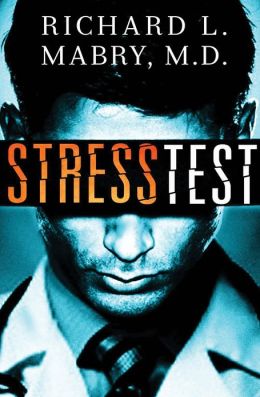
I’m so pleased to host fellow medical thriller author Richard Mabry, MD today to Redwood’s Medical Edge. Richard has a new book out and we are running a contest to give away one FREE book to a commenter who is willing to post a review of the novel. In the comments section– please leave a note about what you’ll do to help promote Stress Test along with your e-mail address. Winner chosen at random. Must live in the USA. Winner drawn Saturday, April 20th at midnight and announced here on April 21, 2013.

Welcome back, Richard!

I love the books written by the late Robert B. Parker. You may not recognize his name, but Parker is the man who wrote the novels on which the TV shows featuring private detective Spenser and police chief Jesse Stone are based. I think one reason I like Spenser is that he’s just enough of a smart-aleck for me to identify with him. Someone once asked him why he was a private detective, and I love his answer: “Because I can’t sing and dance.”

What Spenser is saying is that he does what he does because he likes it and can do it well, as opposed to other choices he might have. So, when I’m asked why I write, I have two standard responses. The first, like Spenser, is “Because I can’t sing and dance.” The second is the oft-quoted and very true phrase about true writers: “We write because we can’t NOT write.” And there you have it.

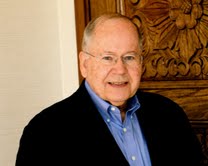
I’m a retired physician. I was in solo private practice for 26 years, then spent another 10 as a professor at the University of Texas Southwestern Medical Center. Although I wrote or edited eight textbooks and had over 100 scientific papers published in professional journals, I never once thought about non-medical writing. Then my wife of 40 years died, and one tool I used to help me climb out of the deep depression I felt was journaling. When a friend read these raw journal entries, he encouraged me to turn them into a book. But I had no idea how to proceed.
From there, it was a matter of attending writer’s conferences, going through the cycle of write/edit/write/edit/write, and shopping the finished product to editors. Fortunately, The Tender Scar: Life After The Death Of A Spouse found a home with Kregel Publications, and it continues to minister to thousands each year. But while I was writing my non-fiction book, authors and editors urged me to try my hand at fiction. I tried it and found that I liked it.
Over the next four years, I quit once and almost quit another dozen times. You’ll notice I said I “almost quit” along the way. Why didn’t I quit? Because, time after time I found myself sneaking back to the computer to write some more. Truly, I couldn’t NOT write.
So that’s why I write “medical suspense with heart.” The genre fits. I enjoy the challenge. And…I can’t sing and dance.

**************************************************************************

Dr. Richard Mabry is a retired physician, past Vice-President of the American Christian Fiction Writers, and the author of five published novels of medical suspense. His books have been finalists in competitions including ACFW’s Carol Award and Romantic Times’ Inspirational Book of the Year. His last novel, Lethal Remedy, won a 2012 Selah Award from the Blue Ridge Mountain Christian Writers Conference. His most recent medical thriller, Stress Test (Thomas Nelson), was released in April, and will be followed by Heart Failure in October.

Up and Coming

How are you Redwood’s Fans?

Me…hmmm… other than surviving a freakish April snow storm… doing well.

For you this week!

Two of my inspirational medical colleagues are releasing books here in the next couple of weeks and will be visiting Redwood’s. Dr. Richard Mabry will be giving away a chance to win his latest novel, Stress Test.

Don’t worry– I’ll have Candace back after her book releases and we’ll see if I can talk her into giving away a book.

For you this week:

Monday: Dr. Richard Mabry and a chance to win Stress Test. This novel has been getting a lot of early praise and I’m super pumped to be able to get my hands on it!

Wednesday: Author and anesthesiologist H.S. Clarke stops by to talk about the good and the bad surrounding epidurals.

Friday: Candace Calvert scrubs in with a medical question and it’s a very interesting one. In fact, one of my favorite author questions thus far.

Have a GREAT week.

Jordyn