Sarah Asks:
My character was assaulted and, among other injuries, her right forearm was fractured severely. It was surgically repaired using pins.
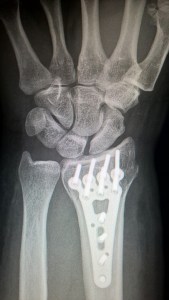 My question is: Is it possible for her to develop osteomyelitis after a blunt-force trauma (that does not result in a fracture) two years after the original injury? If not, is there another scenario that could cause osteomyelitis after the fact like that? And what would be the immediate treatment plan following the second injury and osteomyelitis? Also, if left untreated for a period of time, could osteomyelitis become life-threatening?
Jordyn Says:
The first part of your question does not seem plausible to me. First, you imply that there isn’t a fracture associated with the second injury to this arm and the length of time doesn’t quite work. The arm should be fully healed two years post surgery to repair the fracture.
If this character were to develop osteomyelitis near the site where she received a blow by a blunt object, but that arm had been previously fractured two years prior, I don’t see the medical staff thinking these two things are related. They are just too far apart.
I don’t know of another scenario that could cause this to happen two years out– that the blunt force blow (that doesn’t break the skin or cause fracture) somehow ignites an osteomyelitis at a previous surgical site. If it did, I think it would be considered happenstance.
Ostemyelitis generally happens when bacteria gets to the bone through an open wound (open fractures are a great way to write this complication) or the infection to the bone is seeded from another area in or on the body (a septic joint for instance). The infection will generally develop within two weeks. Even in the article linked in this paragraph, chronic osteomyelitis usually develops within two months. Nothing even close to two years.
The course of treatment for osteomyelitis would depend on what bacteria (or fungus) is causing the infection. Surgery could also be indicated.
Yes, any infection can become life threatening particularly if the bacteria or fungus gets into the bloodstream.
Hope this helps and good luck with this story!
 My hero is mauled by a polar bear. He’s suffered a dislocated right shoulder, tearing of the ligaments, rotator cuff, and whatever tendons are in the shoulder and across his scapula. He’s got bite punctures on his upper arm, his right ear was bitten and repaired via plastic surgery. He’s got a scalp laceration with twenty-eight staples to reattach it.
 I have a character get shot at point blank range in the lower right abdomen from the front. Then in the right shoulder/clavicle, also from the front, about five to ten feet away, breaking the clavicle. Finally, in the left calf from behind from ten to fifteen feet away, breaking the tibia which is made worse when the shooter grinds his foot into it.
 I wouldn’t know what is done if the clavicle is “shattered” and is in a multitude of pieces. The wound would have to be a glancing hit that results in a fracture. Anything more severe in the area could result in ruptured arteries, as well, and the person cannot die from this wound.
 This is what I’m proposing happens to this child.
 Today, I’m hosting Tim B. (my own physical therapist!) If you’re south of Denver and need an excellent physical therapist I’d be happy to refer you.
 I’m thinking open or compound fracture because then I can have him develop a bone infection. What I’m wondering is the order of things and how long it would take to develop what and how to recover, how long it takes, and so on.
 Today, I’m going to focus on a couple of general guidelines if you injure a character with some type of fracture.
 Redwood's Medical Edge