Author Question: Treatment of the Burn Patient

Jennie Asks:

What happens when someone gets burned? What do the EMT’s do on the scene? The story line involves the explosion of a crosswired electrical box.  Two individuals are burned.
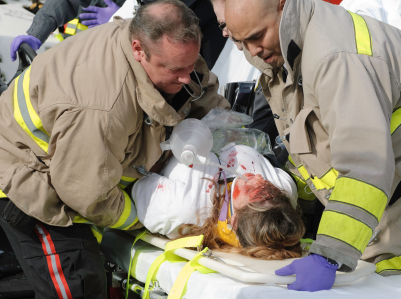
First, the man who threw the switch is thrown onto the floor and sparks are showering down on him and his clothes.  He is pinned beneath a shelf that he knocked over.  The second man takes his jacket and tries to put out the flames while others pull the shelf off the man on the floor.  The second man’s arm and hand are burned trying to put out the fire, and keep the sparks from falling on the man on the floor.

I have the paramedics taking the first man to the hospital. I describe very little about his condition. However, the hero is attended by the heroine who is an EMT. His burns are secondary. Would he have to go to the hospital?  Get a tetanus shot if he needs one?

Jordyn Says:

The first distinction to make is that there are several different types of Emergency Medical Service (EMS) providers and their level of responsibility to this patient will be different. An emergency medical technician (EMT) generally provides basic first aid, CPR, can administer oxygen and can assist the patient in giving some of their own medications (like an asthma inhaler or nitroglycerin tablets.) A paramedic does more advanced medical procedures and gives drugs. The level of your provider will need to be clear in the medical care they can provide.

For EMT’s, in general, burn care is as follows:

1. Remove clothing from the burn that is non-adherent.

2. Remove any constricting items. For instance, if the burn is on the ring finger, you would try and take the ring off.

3. Cover burn with a cool, wet, clean dressing. This will help control pain.

If you have a paramedic responding— it is possible that an IV could be started and the patient could get an IV narcotic for pain (something like morphine or fentanyl.)

If the character is burned by the electrical current, this poses a whole new set of problems. I get the feeling he is burned by the electricity because you mention that he has been thrown back. Electrical burns typically have an entrance and an exit wound like the hand and foot. The electricity enters one part but has to exit somewhere.

The other problem with electrical burns is that your heart pumps based on an electrical conduction system. An electrical burn can injure the electrical conduction system of the heart and we will look very closely at whether or not the heart sustained injury. This could be evaluated initially by a 12-Lead ECG and lab work that measures muscle breakdown specific to the heart. The issue with electrical burns is that the damage is often unseen because the electricity will injure you internally but we can’t see it externally except and the entrance and exit sites.

The other thought was the extent of your patient’s burns and this would make a difference in their medical care. Burns are generally calculated based on the percentage of skin that is affected. You can find examples of these tables by clicking this link. Adults and kids are calculated differently.

Burns <15% body surface area (BSA) would get cool, moist compresses. However, burns > 15% would get dry, sterile dressings. The reason for this is that burn patients have lost their skin integrity. Your skin helps your body maintain its temperature. Some consider it the largest organ in the body. When you burn >15% and apply cool, wet dressings, this can pull enough heat away from the patient to cause them to become hypothermic. We actually have to help burn patients maintain their body temperature by cranking up the heat in the room or using other warming techniques.

Your patient will have to go to the hospital. Initial ED treatment would be IV placement, fluid resuscitation (there is a formula we use for this and is dependent on the burn percentage), pain medication (like morphine), and likely consulting with a burn center to help determine his course of treatment. Tetanus shot would be updated if he hasn’t had one in the last five years.

Did you know that paramedic protocols are relatively easy to find online? For instance, this link shows all of the Denver Metro Prehospital Protocols. Referencing these will be one of the best sources for researching what type of prehospital care your character would receive for their given ailment.

***This content originally posted December 10, 2010.***

Finding Photos of Hospital Interiors

Recently, I was contacted by an author who wanted me to research how to find a particular hospital’s interior— particularly the ER. The institution happened to be Cedars-Sinai Hospital in California.

architecture-931283_1920This is not as hard as you might think. The more popular, or should I say well known, the hospital is the more likely you’ll be able to find photos. Hospitals like to show off, particularly if they’ve done any sort of recent remodel. Typically, on hospital websites, you’ll find a few shots of the interior of some of the more high cost, technologically dependent areas like the ER, the ICU, and radiology suites.

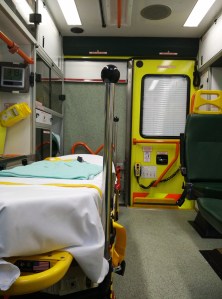
In this instance, I was actually able to find several shots of the interior on an architectural firm’s website who had remodeled the hospital’s ER in 1997. The only piece of information that would need to be ferreted out passed that point is whether or not the hospital has remodeled since then which I would personally find unlikely.

Most often, for this type of information just Google search very specifically. For instance, I searched “photos of Cedars-Sinai Hospital ER” and one of the first links was to the architectural firm.

If you are using an existing hospital in your novel then it is probably a wise move to try and find actual photos as a reference for your descriptive passages. Trust me, someone who works in that ER will read your novel and know the difference.

Trauma Call/Domestic Violence: Dianna T. Benson, EMT

I am pleased to welcome back award-winning novelist Dianna T. Benson. I love how she writes these scenes fictionally but conveys a host of medical details along with it. 

Welcome back, Dianna!
EMS 6, Stabbing, TAC Channel 12”
     Responding to a domestic disturbance call, my partner and I park our ambulance in front of an upscale home over a million dollars. Not atypical – EMS is too often called out to the rich on domestic violence.
     “Did you know the power company turns off this zip code for lack of pay more than any other in the state?” I ask my new partner.
     “Yep. Idiots living beyond their means. No wonder they’re so stressed out and hurt each other.”
     At the front door, we join a fire crew, as three cops enter the house, all three with weapons drawn.
     “Scene isn’t safe?” I ask.
     “Not sure,” the last cop answers then trails his two buddies.
     The fire crew of four hangs back with me and my partner.  
     “Was the door unlocked?”
     “Yup,” one of the firefighters answers me.
     After five long and boring minutes of standing around on the lawn in the dark of night, I radio in to dispatch. “EMS 6. Standing by outside residence. Any updates from PD on scene?”
     “Yes. Scene is secure. PD is with victim.”
     “Copy that.” I roll the front of our loaded stretcher into the house.
     In the family room, I find one officer bent over a body, the other two talking with an agitated man.
     I kneel at the woman’s other side. She’s supine on the carpet, her lapped hands pressed to her lower abdomen and covered in blood.
     “Ma’am?” I touch her shoulder in comfort.
     My patient blinks at me then flutters her eyes closed.
     “Can you tell me your name?”
     “Judy,” she whispered in a pained voice.
     I brush my hand over hers. “Judy, are you hurt anywhere other than here?”
     “Don’t know,” she mumbles.
     “Judy?” I stare into her eyes, mascara smudged underneath them. “Can you move your arms down at your sides?”
     She does.
     My partner hands me trauma scissors, a stack of 5X9 sterile gauze pads, and an occlusive dressing. As I rip open the gauze packages, my partner hooks up the patient to our cardiac monitor and focuses on assessing and monitoring vital signs.  
     “How can I help?” one of the firefighters asks me.
     “Perform a rapid trauma assessment.”
     “You got it.” He starts at the head.
     With the trauma scissors, I cut Judy’s shirt, exposing the wound. Noting no debris other than blood, I cover the gushing horizontal wound—thin but long—with one sterile gauze pad after another, and apply direct pressure with my palms. “Did a knife do this, Judy?”
     “He did.”
     “With a knife?”
     “Steak knife.”
     “I see nothing else,” the firefighter informs me at the patient’s feet.
     I nod. “Thanks.”
     I glance at the monitor screen for Judy’s vital signs. Her heart rhythm is normal, but her blood pressure is too low, pulse too high, indicating she’s headed to shock due to blood loss. My guess is she’s bleeding internally, the knife blade sliced an organ or two, maybe the abdominal aorta. Regardless of what’s injury, she needs a surgical team.
     I look at my partner. “We gotta go. Now.” 
       
     “Give me the switchblade,” one of the cops says, alarm in his tone. “Sir, you’re just making things worse for yourself.”  
     “Past time to go,” I whisper to my partner, a rush of panic clogging my throat.
     “No kidding,” he whispers back, wide-eyed.
     “Get out of here,” one of the cops says to us.
     “What’d you say to them?” the agitated man shouts.
     “You don’t want a murder charge, do you? The EMS crew needs to get her to the hospital.”

     The cops deal with the perpetrator, as my partner readies the stretcher. I blanket the dozen or so bloody gauze pads with a towel.
     Inside the moving ambulance, I raise the foot of the stretcher to treat for shock. I cover Judy’s mouth and nose with a non-rebreather oxygen mask and turn on the O2 to 15 lpm. Since none of her organs eviscerated, I do not apply an occlusive dressing. Instead, I add additional 5X9s and a fresh towel and instruct the one firefighter who joined us en route to press his hands over it for direct pressure. I insert an IV saline bolus and consider administering morphine or fentanyl for pain.
  
     “More cops dispatched to scene,” my partner yells back from the driver’s seat. “Guy stabbed one of the cops and fled the scene on foot.”
     I look down at my patient. She doesn’t indicate she heard those disturbing words.
  
     “We’re ten minutes out,” my partner yells back at me.
     I pick up the radio. “Wake Med ED, this is EMS 6.”
     “Go ahead EMS 6.”
     “We are enroute with a thirty-eight year old female. Left lower quadrant adnominal stab wound. No evisceration. BP 82 over 56. Heart rate 173. Non-rebreather at 15 liters per minute. Legs elevated for shock treatment. Place OR on stand by. ETA 10 minutes.”
     “See you in 10. Wake Med out.”
     “EMS 6 out.”  
**********************************************************************
Dianna Torscher Benson is a 2014 Selah Award Winner, a 2011 Genesis Winner, a 2011 Genesis double Semi-Finalist, a 2010 Daphne de Maurier Finalist, and a 2007 Golden Palm Finalist. In 2012, she signed a nine-book contract with Ellechor Publishing House. She’s the author of The Hidden Son, her debut novel. Final Trimester is her second release. After majoring in communications and a ten-year career as a travel agent, Dianna left the travel industry to earn her EMS degree. An EMT and a Haz-Mat and FEMA Operative since 2005, she loves the adrenaline rush of responding to medical emergencies and helping people in need. Dianna lives in North Carolina with her husband and their three children. You can connect with Dianna via her website.


Dianna T. Benson: A Son’s Tale of Traumatic Brain Injury


The term concussion is well known. The medical field refers to a concussion as a TBI – Traumatic Brain Injury. Contact sports are one of the top causes of a TBI, another are MVCs – Motor Vehicle Collisions.
My teenaged son has endured four concussions. The first two as a goalie for the Junior Hurricanes and the third in a MVC. The first one took him out of school for a month and hockey for three months. The second, a year later, was more mild, which is unusual. Typically, a patient suffers a more severe TBI the second time. In the MVC, a classmate was driving them to school when another car struck them. This third TBI ended my son’s hockey career, preventing him from attending the Junior Hockey draft in Canada Spring of 2013.
The problem wasn’t simply that this was his third concussion, although that in itself is a strong reason to end a contact sport career. With this third TBI, a neurologist evaluated him versus just the concussion clinic MDs who’d treated him with the first two. Not only was it his third TBI, but his symptoms were extremely severe, which didn’t make sense to me – the details of the MVC didn’t suggest such injuries for my son: 1) None of the others involved in the crash suffered any injuries 2) No air bags deployed 3) Vehicle damage was minor. As an EMT for nearly a decade, I wondered about underlining health conditions in my son. I also considered he had not fully recovered from the first two concussions and was in denial about his symptoms in order to play hockey.
Sure enough, the neurologist diagnosed my son with hyper-mobile joints (something I already knew but wasn’t aware of the danger with contact sports.) The MD also diagnosed him with mild CP (cerebral palsy), a diagnosis that made sense to me since my son was born in respiratory arrest and was non-verbal and had spasticity until over age two. Both diagnosis are a recipe for injury, especially in contact sports. The MD gently told my son he was done playing goalie forever – it was devastating and crushed him. Understanding his hockey career was over, he admitted he’d ignored symptoms because he had a shot to play Junior Hockey, college hockey, and possibly professional hockey. A life-long athletic competitor myself, I completely understood the denial that led him to ignore his body.
Hyper-mobile joints, while creating an incredibly athletic body, are highly susceptible to any musculoskeletal injury in that individual. For my son, after two TBIs in a contact sport, his hyper-mobile neck was easily and severely whip-lashed in the MVC, jostling his brain fiercely, causing all his concussion symptoms to return and more heightened than ever.
Ten months after the car accident, the fourth TBI occurred December 2013 just days after the neurologist cleared my son to return to his life minus contact sports. The neurologist gave my son the green light to snowboard. That December day on the mountain, my son didn’t even hit his head and he sustained no head trauma – simply snowboarding jostled his brain enough to cause another TBI.   
Even though he’s extremely athletic, my son’s body shouldn’t do what it can to do. The risk of permanent brain damage and partial or full paralysis is too high for him– something he now understands. I described it to him as this: When Cam Ward (the goalie for the NHL team Carolina Hurricanes) is playing goalie, his body is naturally like a SUV of protection in a MVC. Whereas, for my son, his body is like a motorcycle in a MVC – no protection.
Until Spring 2015, my son is restricted from doing anything with speed, wheels, height or repetition (basically everything fun.) This next year his brain will heal, then little by little he can attempt things (no contact sports ever, though) to see how his body responds. At 6’7” in height and extremely athletic, he appears a medically sound seventeen-year-old, but inside his body tells a different story. 


God works in amazing ways and this is my son’s blessing. Since cerebral palsy only affects motor function, and none of the four TBIs caused him any loss of cognitive abilities, he’s still as annoyingly brilliant as ever and is anxious to head off to college this fall. For now, his goal is to graduate medical school with a degree in neurology and become a neurosurgeon since he feels (understandably so) he can relate to patients’ symptoms with head trauma. 
***********************************************************************


 Dianna Torscher Benson is a 2014 Selah Award Finalist (winners not yet announced), a 2011 Genesis Winner, a 2011 Genesis double Semi-Finalist, a 2010 Daphne de Maurier Finalist, and a 2007 Golden Palm Finalist. In 2012, she signed a nine-book contract with Ellechor Publishing House. She’s the author of The Hidden Son, her debut novel. Final Trimester is her second release.
After majoring in communications and a ten-year career as a travel agent, Dianna left the travel industry to earn her EMS degree. An EMT and a Haz-Mat and FEMA Operative since 2005, she loves the adrenaline rush of responding to medical emergencies and helping people in need.
Dianna lives in North Carolina with her husband and their three children. 
Her releases are available wherever books are sold. Below are the links to Final Trimester at the three largest booksellers:


Author Question: Death by Food Allergy

Sally asks:

My villain is going to kill his wife. She has a severe peanut allergy. My initial plan was for him to put peanut oil in a salad dressing, one that needs to be shaken to combine the oil and other ingredients. He also damages her epi pen. He does this right before he leaves town for business in order to give himself an alibi.

Using Epi Pen

He’s a professional athlete so news of his wife’s death will make media outlets like ESPN. I want initial news reports to say that it doesn’t seem to be foul play, even though it is.

Does that work?

Jordyn Says:

The cause of death would be anaphylaxis. That’s how the person would die. Basically, an allergy causes a huge histamine release that can lead to cardiovascular collapse– difficulty breathing, low blood pressure, increased heart rate (tachycardia.) The reaction can get to the point where it can lead to death.

This is what your character would die from. So– the ME would be able to determine that the patient had an anaphylactic reaction. How easy it would be to pinpoint the exact cause of the reaction may be harder.

My follow-up question to Sally was: What’s to prevent the character from calling 911?

Death by allergic reaction does take a while. There is not set amount of time and my guess is it could be fairly expedient– perhaps 30 minutes for a person who is highly sensitive.

This is where the setting would come into play. In a city– the EMS response time should be 2-6 minutes. However, in the country where there may be only volunteer response, it feasibly could take 30 or more minutes.

The photo from this piece comes from a great article about whether or not to use epi pens.

Some free nursing advice for you here today– if you are a parent or adult and the thought comes to your mind– “Hmm– should I use the epi-pen?” Then yes, you should. Don’t wait. Don’t question it. Give it and either call 911 or go straight to the ER.

The issue with anaphylaxis is that it can spiral to a point where we cannot reverse the reaction and you may die. However, I’ve not yet seen a person die from giving themselves a single epi injection when perhaps they didn’t need it.

We’d rather monitor you alive for several hours than tell your family you’ll no longer be with them. 

**************************************************************************

Sally Bradley has worked for two publishers, writing sales and marketing materials, sorting through the slush pile, and proofreading and editing fiction. She has a BA in English and a love for perfecting novels, whether it’s her work or the work of others. A judge in fiction contests, Sally is a member of ACFW, The Christian PEN, and the Christian Editor Network. She runs Bradley Writing and Editing Services from her home outside Kansas City. A mother of three, Sally is married to a pastor who moonlights as a small-town cop.

Author Question: Treatment of Car Accident Victims


Taylor asks the following regarding treatment of multiple victims of a car accident. 
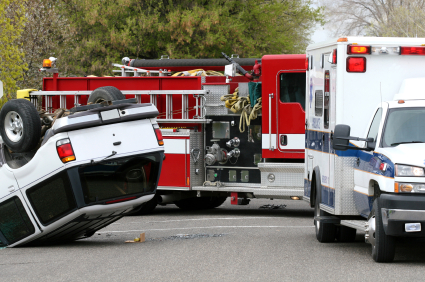
SCENARIO: Serious MVC involving two cars and multiple victims. All passengers were wearing seatbelts, and airbags deployed, but the crash was serious enough that victims are still severely injured.
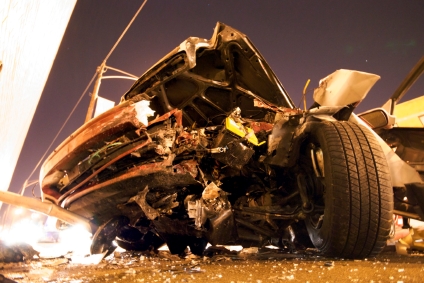
Jordyn: When writing about the car crash—I’d have it be pretty visual that the car is near ruin. Particularly if someone has died on scene. Having the car rollover several times would accomplish this.

Taylor: Three girls (friends) were in one car together, on the way to a Christian concert. Drunk driver character had an argument with his wife about his drinking, denying that he has a drinking problem, then got angry, left the house and went out for drinks (doing the very thing they just argued about, partly to spite her and partly “to calm down”). He causes a crash with the girls.
CAR ONE: This vehicle contains only the driver.
DRIVER:The driver is a male in his early thirties. He is slumped forward in his seat, initially unresponsive, but rouses when medics address him. There is a strong smell of alcohol on his breath, and although he is responsive, he is displaying obvious signs that he is intoxicated. Upon seeing the crash scene in front of him, he becomes upset, crying and saying things like, “I didn’t mean to”, “My wife is going to kill me”, and “What have I done?” He has a bleeding laceration on his forehead and minor scrapes and bruises on his face (from the impact of the crash and airbags), and bruising from his seatbelt. Aside from these, he is uninjured. Vital signs are elevated, but within normal limits.
Jordyn: This patient would be placed in C-spine precautions. An IV/fluids started. Usually, when EMS starts an IV—they’ll grab several tubes of blood that the hospital can send to the lab. They’ll dress the laceration on his forehead and not likely worry about the minor cuts and scrapes. Whenever there is seatbelt bruising, we always worry about what would be injured underneath.
In the ER: Since he’s intoxicated, he’s not a reliable informant about his pain. So, he’ll get automatic C-spine films to rule out neck/back fracture. They might even consider a CT of his chest and abdomen (they’ll take vital signs into consideration). Law enforcement will be involved and they’ll want blood alcohol levels and if your book is in a specific/real location—I would figure out what the procedure is in that town/city. After major stuff is ruled out—his cuts will be cleaned. The laceration to his forehead would be irrigated and stitched. Tetanus shot if none in the last five years. Once he’s medically cleared, I’m guessing he would be off to jail.
CAR TWO:This vehicle contains a driver and two passengers.
DRIVER:The driver is a female, age 18. She has no detectable pulse or respirations. Apparent DOA, killed on impact in the crash.
Jordyn: She may be declared dead at the scene. That would probably be the easiest way to manage this patient.
PASSENGER ONE:Female, age 17. Managed to free herself from the car after the crash, and is sitting in the grass a short distance away. She is displaying signs of shock. Respirations are slightly shallow and rapid, skin is pale and clammy, and pulse and heart rate are elevated but still within normal limits. She is mostly responsive, but groggy/drowsy and complaining of severe headache, nausea, and dizziness. Chest and neck are bruised from her seatbelt, and she has several other bruises and superficial bleeding cuts on her body. Her right arm is bruised, swollen, and oddly angled, and she is cradling it against her chest and complaining of pain.
Jordyn: Since she is shocky, she’ll get an IV/fluids and tubes drawn for labs at the ER. Considering the mechanism of injury (the fact that one of the occupants of the crash has died) she’ll be placed in C-spine precautions as well. All surviving patients (including the drunk) will also be give oxygen (as it is treatment for shock as well). Her arm will be splinted in a position of comfort. It’s hard to know if they would give her pain medication or not—her c/o of headache, nausea and dizziness could signify head injury and giving a narcotic could complicate that assessment. So, she may just have to tough it out until she’s in the ED.
ER: Vital signs. X-rays of neck, back and deformed arm. Possible CT of the head, chest and abdomen. Often times, deformed extremities need to be reduced either in the OR or can be done under conscious sedation while in the ED. Depends on how you want to go. This patient may be able to go home if her arm can be set in the ED and no other significant injuries are noted.

PASSENGER TWO:Female, age 17. Pinned in her seat inside the car, unable to free herself. Conscious and responsive, but clearly very frightened, and displaying signs of shock. She is complaining of some pain in her neck, numbness and lack of sensation below the waist, and inability to feel or move her legs. Chest and neck are bruised from her seatbelt, and she also has several bruises and cuts on her face, arms, and legs. There is a large, deep bleeding laceration on her right lower leg.
Jordyn: Same: C-spine/back board. IV, fluids, oxygen. Get blood for labs. Laceration of right lower leg will be bandaged to control bleeding. 

ED: Largest concern for this patient is her sign of C-spine injury. So, not only would she get C-spine films. She’ll likely get CT of her neck, spine, chest and abdomen. Probably would x-ray the leg with the laceration to look for foreign bodies before closing it up. Stuff like the leg laceration can wait until a medical game plan is decided upon after they figure out what her neck injury is.

Near Death Experiences: A Paramedic’s Perspective

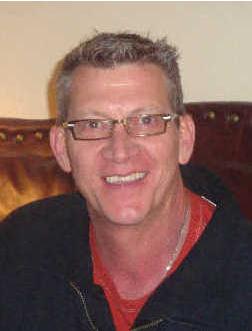
I’m pleased to host Tim Casey as he shares some of his patient experiences with near death.

Welcome, Tim!

Over my 30 plus years as a firefighter/paramedic I witnessed many souls depart this world, but also had the privilege to participate in the resuscitation of hundreds of patients. I developed a habit over the years of asking the previously lifeless about what they had experienced while dead.

As I was generally the very first face they saw upon rejoining the living, once I knew their physical well being was stable, I would simply ask them what they experienced. Some had a story and some had no memory of what had happened.

But first let me take you through the process of resuscitation in the field as a paramedic. We generally had advanced notice from our dispatch center that we were responding to a possible cardiac arrest, and a description of what was happening at the scene we were approaching. We would be advised if CPR had been initiated and if the patient was believed to be pulseless and not breathing (apneic).
This gave us time to mentally prepare for what procedures would be needed to begin as soon as we arrived. If in fact we found a dead human being defined as a person not breathing and without a heartbeat, the first thing to do is determine if there was any kind of heart rhythm we could treat. The patient was attached to a cardiac monitor to access what kind of electrical activity was occurring with the heart.
There are many heart rhythms that we can treat with electricity, but one quick note; we don’t shock what is colloquially known as a flatline. This rhythm is asystole and no amount of electricity will convert this rhythm back to a functional heartbeat. If a treatable rhythm is present we will “shock” the patient and in successful cases (cardio version) this will bring the heart beat back to a functional condition.

Many other things can happen following this first procedure including intubation of the airway, administration of drugs to assist life and other supportive care. Not all patients regain consciousness but in the rare case they did and they were not intubated, I felt compelled to question them about their experience.

Almost all these cases occurred in the back of an ambulance while transporting the patient emergent (lights and siren) to the hospital. I only had a handful of cognitive patients that could talk to me and describe what had happened.
All were profoundly at peace and their former life threatening condition seemed to become more stable. I must add a quick note, when I was on scene with a conscious patient that was on the verge of a heart attack but had not yet become unconscious; one of my primary questions was if the person felt an impending sense of doom. All said they did. They knew on a base level deep within themselves that their life was about to slip away.
The patients that had survived and regained consciousness had lost that feeling of doom. There was a noticeable change I could see right before my eyes. Now was this due to the treatment I had administered? The drugs and electricity that I had applied to a lifeless body?
I was told by these people it was not because of my efforts, it was in fact they felt that they had been sent back by someone or something. Many had complete memory of the whole event including what I had said. I always talked to my patients and encouraged them to help me, to stay alive. A common phrase in emergency medicine is this, “The last thing to go is the hearing.” and my experiences confirmed this for me.
On one occasion in a remote location where the ambulance was very far away I had the experience of resuscitating a gentleman in his bedroom. My engine crew was with me but because of his improved condition I had asked them to gather equipment to prepackage the patient for transport.
The gentleman and I were alone for a few moments. He had changed from ghostly white soaked in sweat to pink and dry, he smiled and thanked me. I had to ask.
“Did you see anything while you were gone?”
“I don’t believe I was gone. I was here. I watched you.” He said. “But there was another person here with us. I guess you could say, not a person, but God I believe. He told me it wasn’t my time and said I had to go back.”
“Did you see Him?” I was very excited.
“Not really, more felt Him, felt surrounded by Him I guess I would call it.” 
“And then what?” I asked.
“And then I was looking at you.” He said.
These experiences gave me a sense of my own spirituality. Maybe I wasn’t such a big deal as a paramedic after all. Maybe it was all predetermined and out of my hands. Or maybe God worked through me. Either way I guess I will never know until it is my time.
*********************************************************************

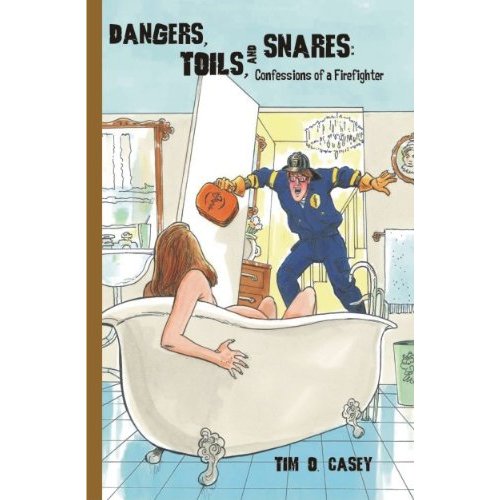
Tim Casey is a retired firefighter/paramedic with more than 30 years on the streets caring for the sick and injured. He has also written a memoir: Dangers, Toils, and Snares: Confessions of a Firefighter which has been number one on Amazon in the Kindle Store many times. Tim now
is a full time author and his new book on how to date a firefighter will be out later this year,

Author Question: Car Accident Injuries 2/2

We’re continuing with Amy’s question. Dianna gave her thoughts here. I’m going to give my thoughts from an ER perspective.

Amy asked:

I am putting one of my characters in a pretty major car accident — a rollover in which she lands on a broken window and ends up with a lacerated back full of broken glass, in addition to a broken leg, fractured ribs, etc. I need a scene to take place in the hospital where she is recovering. With those kinds of injuries, what treatments would she be under? More importantly, how exactly would she be laying in the bed? Obviously not on her back. But would she be on her side or stomach? Perhaps that depends on the other injuries she sustains… but the lacerated back is the biggest one I want her to have.

Jordyn says:

The biggest issue here is that she will likely have to lie on her back for a while. Considering her mechanism of injury (MOI)– the big rollover accident. The EMS crew is going to be very concerned that she may have injured her neck or back and she will be put onto a spine board and C-collar. To alleviate the pressure on her back, they may then tilt the whole board to one side but it’s going to cause some pain to lay on that flat board until her x-rays are complete.

Care for lacerations: One, she’ll need x-rays of her chest to look for the glass. She’d likely have this anyway for her MOI which could then reveal the rib fractures. If the lacerations are severe and extensive– she may end up going to the OR so they can be cleaned and stitched up under general but they’d have to be REALLY bad. Otherwise, we irrigate them out with sterile saline. Stitch them up. Antibiotic ointment over top. Make sure she’s up to date on tetanus. She would get a shot if she hadn’t had any in five years. It’s 10 years without injury.

Rib fractures are generally problematic because you don’t want to take a deep breath because of the pain which can lead to pulmonary problems. Lung contusions can actually put you on a ventilator if they are extensive enough. If several ribs are broken in succession– this is actually referred to as a flailed chest which can inhibit the patient’s ability to breathe. So, I’d keep it simple with one or two rib fractures so the character mostly has to deal with the pain issue and not the lung issues.

********************************************************************

Amy Drown has a History degree from the Universityof Arizona, and has completed graduate studies in History and Archaeology at the University of Glasgow. An executive assistant by day, she also moonlights as an award-winning piper and photographer. But her true addiction is writing edgy, inspirational fiction that shares her vision of a world in desperate need of roots—the deep roots of family, friendship and faith. Her roots are in Scotland, England and California, but she currently makes her home in Colorado. Find her on Facebook at www.facebook.com/GlasgowPiper.

Author Question: Car Accident Injuries 1/2

Author questions are some of my most favorite posts to do. How do you really write an accurate medical scene? Which injuries are plausible and which are not?

Amy is visiting and Dianna Benson (EMS expert) and myself (ER nurse extraordinaire) are going to tackle her question. Dianna will be today and I’ll be Friday.


Amy asks: I am putting one of my characters in a pretty major car accident — a rollover in which she lands on a broken window and ends up with a lacerated back full of broken glass, in addition to a broken leg, fractured ribs, etc. I need a scene to take place in the hospital where she is recovering. With those kinds of injuries, what treatments would she be under? More importantly, how exactly would she be laying in the bed? Obviously not on her back. But would she be on her side or stomach? Perhaps that depends on the other injuries she sustains… but the lacerated back is the biggest one I want her to have.

Dianna Says: The story and the characters are first priority, so I’ll make the medical aspects fit into what you’ve explained. Since it sounds like you don’t have an EMS scene at all (no scene where rescue crews—EMS and fire—are present), it keeps it simple from my end, but I’ll give you pertinent background on what I’d do if I were the EMS crew on your scene. Also, based on the MOI (mechanism of injury) you described, I’ll explain what type of injures are possible. Every patient is different, every MVC (motor vehicle collision) is different, and every rollover is different, so that definitely gives you leeway.

First of all: I like the scenario: Your character runs a red light causing another car to slam into hers, which causes it to spin then roll over while her back is dragged on the asphalt over the broken window. I also like the adding of a boyfriend; yes, he’d definitely worsen her injures by landing on her, so have him either land elsewhere inside the car or just have him belted in (unless you want her seriously injured to the point she’s in-hospital for a long while and possibly suffering with lasting effects). Just so you know: The reason for the seatbelt law is not just to protect the person wearing the seatbelt; it’s to protect others from being struck by that person propelling in the air (inside and outside of vehicles) like a weapon. Just a thought — if she landed on the driver window and it’s a rollover, then the car is on its side (driver side) upside down, right? Make sure you’re clear about that.  

Any rollover is a high index of suspicion of injury; meaning, severe injuries and death likely. You have two separate impacts in this story: 1) Smash from the other car 2) Rollover. Therefore, you have two separate MOI’s and both cause different injuries.

Since fiction is about the story and the characters, make the speed of the car fit; meaning, if you want your character(s) to be seriously and extremely injured, keep the speed high. For a character who is injured and needing in-hospital care (not just on-scene EMS treatment and ED treatment) yet doesn’t sustain any life lasting effects or long term damage, then keep the speed down low.  

Possible injuries for both the side impact and the rollover: Again, every patient and incident is different, and I’ve seen it all—some accidents where based on the MOI patients surprisingly die and some where patients surprisingly live.   

1)      Whiplash: back and neck
2)      Air bag deployment: facial injures (soft tissue), labral tear (shoulder), etc.
3)    Seat belt injures (chest injuries, labral tear, etc.)
4)      Head injures
5)      Anything flying around inside the vehicle and hitting her and boyfriend
6)      Other possibles: knee ramming into door and shattering patella, elbow ramming into steering wheel, shoulder striking window., etc. etc. 
7)      Fractured femur or fractured tib/fib or just one of them (tibia or fibula) from twisting or hitting, etc. 
8)    Fractured hips
9)      Fractured ribs
10)      Etc. Etc. Etc.

A fracture is the medical term for broken bone.

Assuming the patent is unconscious when I arrive on scene, I’d verify she has a pulse and is breathing efficiently. If so, then I’d control all bleeding via wound care—sterilization and bandaging. I’d strap a C-collar (cervical collar) around her neck then extricate her from the vehicle onto a back board with padded blocks holding her head in place and strapped to the board. I’d splint any dislocations or suspected fractured (I don’t have x-ray vision) if not properly splinted via backboard. We do a ton of medical treatments and monitoring, but I won’t blah, blah, blah it all, especially since you don’t have an EMS crew on your scene.

****************************************************************

Dianna Torscher Benson is a 2011 Genesis Winner, a 2011 Genesis double Semi-Finalist, a 2010 Daphne Finalist, and a 2007 Golden Palm Finalist. In 2012, she signed a nine-book contract with Ellechor Publishing House. Her first book releases March 2013.

After majoring in communications and a ten-year career as a travel agent, Dianna left the travel industry to earn her EMSdegree. An EMT and a Haz-Mat and FEMA Operative since 2005, she loves the adrenaline rush of responding to medical emergencies and helping people in need. Her suspense novels about adventurous characters thrown into tremendous circumstances provide readers with a similar kind of rush. You can connect with Dianna via her website at www.diannatbenson.com.  

Author Question: The ER Doc and the EarthQuake

Patrick Asks:

In my novel, I have an ER doc on vacation with his family. An earthquake strikes. His 14 y/o son suffers grievous injuries (I’m thinking a concrete pillar falls across his midsection.) The doc knows that in the best of situations, in an equipped trauma center, he’d only have a slim chance of saving his son’s life. As it is all he can do is try to comfort his son and be with him as he dies.

So my questions are threefold:

1.  What would be the signs that would convince him that his son is doomed and there’s nothing he can do?

2.  How long would it take for the poor kid to die?
3.  How would the doctor identify himself, or think of himself, in a casual situation?

Jordyn Says:

Hi Patrick! I am happy to help with your question.

#1: What would be the signs that the son is going to die?

Essentially the scenario you’ve set up would be death from hypovolemic shock (the son is bleeding out). Or, organ dysfunction from crush injury. But, let’s stick with hypovolemic shock as it will work well in this scenario.

What would be more concerning to the father and trained ER doctor would be his signs of shock— this would lead to his death. I’m going to use the medical words because this is how your ER doctor would think and then I’ll put what they mean in parenthesis.

I think one thing that helps is to understand the symptoms in light of the injury. When you’re bleeding out, you’re losing blood. Blood carries oxygen. So the body compensates by trying to circulate those remaining red blood cells faster.

Shock is your body’s inability to meet its oxygen demands (hypovolemic shock is one type of shock.) So, initial signs of hypovolemic shock are: tachycardia (increased heart rate to circulate the blood faster), tachypnea (increased breathing rate to load more oxygen on the cells that remain), complaints of thirst, pallor (pale skin– circulating red blood cells gives you your color) and diaphoresis (sweating). Also, diminished, weak, rapid peripheral pulses. Peripheral pulses are those at your wrist (radial) and feet (pedal). This would progress to central pulses–those in your neck (carotid) and groin (femoral)— being weak and thready.

In kids (this is my area of specialty)– the blood pressure will be normal initially because kids can do really well at compensating for shock up to a point.

So– hypotension (or low blood pressure) is then an ominous sign. One way a trained ER doctor can estimate what his son’s blood pressure is is by palpating his pulses.

eMedicine

For instance:

If you have carotid, femoral and radial pulses: Your BP is at least 70mmHG systolic.

If you have carotid and femoral Pulses: Your BP is at least >50mmHG systolic.

If you have only a carotid pulse: Your BP is about 40mmHG systolic.

You cannot discern diastolic pressure using this method.

As his shock progresses, his level of consciousness will begin to wan. He’d have periods of being coherent– then unresponsive (depending on how fast you’d want this death to occur). The brain is oxygen hungry so when it doesn’t have enough– you become unconscious.

His ultimate sign of impending death will actually be bradycardia (low heart rate– less than 60 beats/minute) progressing to asystole (no heart beat). This is how kids generally die. The child would become unconscious. His breathing would slow/stop. His heart rate would slow then stop. Pupils will dilate and become unresponsive to light.

#2. How fast would this happen?

This is really your choice. If your character has a major aortic rupture (this is a major blood vessel–your descending aorta– that is in your abdomen) death could take place in 1-2 minutes. Also the spleen and liver are highly vascular (meaning they have a lot of blood vessels) and crush injuries to these organs would lead to rapid exsanguination (bleeding out) as well. Or, you could have slow leaking type bleeding that could take longer to die from. All bleeding– if not stemmed– can lead to death.

#3. How would he refer to himself? “Hey, I’m Dan, I’m an ER doctor.”
***********************************************************************

Patrick J. Worden is the author of several books, including the just released novel, VoraciousHe blogs on culture and current events at http://pworden.com/.