Laurie Asks:
I’m a debut Christian romantic suspense author and I wondered if you could help me with a medical question.
 My hero is mauled by a polar bear. He’s suffered a dislocated right shoulder, tearing of the ligaments, rotator cuff, and whatever tendons are in the shoulder and across his scapula. He’s got bite punctures on his upper arm, his right ear was bitten and repaired via plastic surgery. He’s got a scalp laceration with twenty-eight staples to reattach it.
My hero is an RCMP cop and he needs to get back to work.
Can you tell me what he’d have done surgically to repair the rotator cuff and ligaments? How long would he realistically be off work and need physical therapy?
Jordyn Says:
I reached out to Tim Bernacki, an awesome physical therapist, who rehabbed by own shoulder after I dislocated it. If you live near Castle Rock, Colorado check out clinic called Front Range Therapies. I highly recommend him.
Tim Says:
A massive rotator cuff tear (RTC) along with ligament tears and dislocation would lead to quite a surgery. One of a kind. The massive tears I’ve seen used multiple anchors (versus one or two for the “common” repairs).
Some of the massive tears also used either synthetic or pig skin patches because of the tear size. The ligaments would also need to be repaired with more anchors. This person would be in a sling with an abduction pillow at the side for probably eight to ten weeks (versus six weeks for the smaller tears).
Therapy could start earlier than when the sling comes off but would entail only passive range of motion (provided by the therapist). The tricky thing here is that if one portion of the RTC is torn, the protocol would incorporate stretching of that repair last in the sequence of stretches. Likewise, strengthening would incorporate moving in that one direction later than others.
With this person, all directions of movement would need to be respected. This person will need a truly great therapist, or I would expect them to get about eighty percent of their range/use/strength in the end. If all goes well, I would anticipate full range around four months post-op.
Strengthening would begin around three to four months post-op and could go on for at least three to four months itself. For full duty police work, minimum time from date of surgery to return to work I’d guess is eight months, but more likely around ten months. Most police officers return to working on restricted/light duty (if the injury was work related). Light duty is typically communications and/or desk work, working cold cases, helping with investigations, but not leaving the station.
 I have a character get shot at point blank range in the lower right abdomen from the front. Then in the right shoulder/clavicle, also from the front, about five to ten feet away, breaking the clavicle. Finally, in the left calf from behind from ten to fifteen feet away, breaking the tibia which is made worse when the shooter grinds his foot into it.
 I wouldn’t know what is done if the clavicle is “shattered” and is in a multitude of pieces. The wound would have to be a glancing hit that results in a fracture. Anything more severe in the area could result in ruptured arteries, as well, and the person cannot die from this wound.
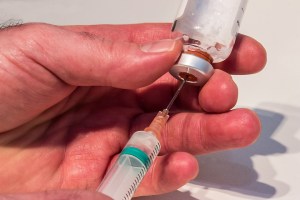 I’m hoping for any input you have at least in the abstract. For instance, would you give the patient more concentrated doses, more frequent doses, larger doses? What kind of medicines would be prescribed/would correlate with the metabolism bit in context of painkillers and treatment of a gunshot wound?
 There are eight different blood types and all ethnicities/races can have one of these blood types though some are more prevalent in a race than others.
  At one point in a play I’m writing, a character attempts suicide. His goal is not actually to die, but he does go through the process. What happens is that he’s very drunk and it’s a combination of probably alcohol poisoning and a lot of pills, something relatively accessible lying around the house, but potentially lethal in a high dose and then he calls 911 right afterwards.
 I’ve heard the hands, forearms and lower abdomen are the three safest places to survive a stabbing, although of course technically there is no safe place, but those three areas avoid major organs/arteries/blood vessels. Though I’ve also heard stab wounds to the extremities i.e. hands can cause lasting disabilities. Where should he stab himself and how long until he is expected to die? He will be able to call an ambulance immediately, and maybe could use some cloths nearby to help put pressure on the wounds, assuming the pain is not debilitating.
 1. Can she die from this and how long would it take?
 Redwood's Medical Edge