Western Medicine Circa 1890: Part 3/4

Lacy continues her four part Friday series today on western medicine. I think her posts have been quite thought provoking! Don’t forget, she’s running a great contest for a chance to win four historical novels so be sure to leave a comment and check out full contest details as posted on June 30th. I echo Lacy’s thankfullness at giving birth with today’s medical techniques.

When I was getting to know my heroine, I met a really tough, independent woman. She has to be, to be able to do her job as town marshal. But what most of the other townspeople don’t know is that she does have a softer side… and she desperately wants a family of her own. Her best friend is pregnant and Danna ends up having to help during the delivery… and it is a really poignant moment for her because of her secret desire for a family of her own.

Also, as a mom who gave birth in a lovely hospital with several nurses and my obstetrician attending, I was still plenty scared. Imagining what it would have been like to deliver a baby back in the 1890s makes me shudder…
CHILDBIRTH
During the 1890s, most women gave birth at home. Hospitals existed in the East, but in the West there weren’t a lot of towns big enough to support one. So the best most women could expect was for a doctor to be present. More common was a midwife or even a neighbor to be present. Or sometimes it was just the husband (my husband pretended to be calm during my first delivery but I later found out it was all an act—I can’t imagine what he would have been like if he had been the only person in that room with me…)
According to Bleed, Blister and Purge (2005) a lot of women could have a normal delivery at home with very minimal help. The problems came when there were complications. Because doctors were often far away, sometimes the mother and/or child would suffer or even die because the doctor couldn’t get there in time. Luckily for my heroine, her best friend was a second-time mom and didn’t suffer any complications.
Here’s an excerpt from Marrying Miss Marshal chapter 13:
“Danna!”
“I’m here!” Rushing to her friend’s side, Danna saw the face creased in pain, the sweat on Corrine’s brow, the marks where she’d obviously clutched the sheets in her fists. “What can I do?”
Corrine let out a long breath, muscles easing. “Nothing yet. I think we have a bit to go, even though the pains have been coming all day.”
“Should I get the doctor?”
“He’s tied up at his office. The young man from the robbery took a turn for the worse. He’s in surgery.”
That wasn’t good. The “young man” was quite possibly the only lead Danna had to find out anything about where the outlaws were going with the bank’s money.
“What about your neighbor…” And why had she rushed out like that?
Corrine clasped Danna’s hand as another pain came. Her lips pinched white. “She doesn’t…she thinks…Brent killed…your husband.” The words came out in spurts and gasps as Corrine panted through the contraction.
Danna found a clean cloth on the end of the bed—someone had prepared things at least—and dabbed at her friend’s forehead. “Ssh. Ssh. It’s okay.”
The contraction eased and Corrine relaxed again. “I don’t suppose there’s any news…?”
Danna wished she had something positive to tell her friend, but there was nothing. “I’m sorry.”
“And Mrs. Burnett,” the preacher’s wife, “is visiting her sister out of town,” Corrine spoke as if the question about her husband hadn’t been asked. “So I sent the neighbor boy to fetch you. Will you stay with me? Help me labor this baby?”
Tears sparkled in Corrine’s eyes.
A lump of responding tears formed in Danna’s throat. “You don’t even have to ask,” she told her dearest friend.
Copyright © 2011 by Lacy Williams. Permission to reproduce text granted by Harlequin Books.
REFERENCES:
The Modern Family Physician (1915) is available in the public domain on Googlebooks.
Volume 1 (Childbirth information starts page 370):
Bleed, Blister and Purge by Volney Steele, M.D. (2005)
***********************************************************************

As a child, Lacy Williams wanted to become a veterinarian “when she grew up”. However, the sight of blood often made her squeamish so she gave up that dream before her teen years. As a college student, Lacy was a physical therapy major for approximately two weeks—until she found out she’d have to take a cadaver lab to complete that degree plan. As a writer, Lacy has finally found a way she can handle blood and gore—fictionally.
A wife and mom from Oklahoma, Lacy is a member of the American Christian Fiction Writers and is active in her local chapter, including a mentorship program she helped to start. She writes to give her readers and mostly reads the end of the book first. You can find out more about Lacy at her website http://www.lacywilliams.net/. She is also active on Facebook (www.facebook.com/lacywilliamsbooks) and Twitter (www.twitter.com/lacy_williams).

Medical Question: Submerged Vehicle Part 2/2

We’re concluding Mart’s question today about treatment of victims that submerged their vehicle into the water. Last post, Dianna covered the EMS response. Today, I’m going to cover emergency department management.

Jordyn (ED Evaluation):
I’m going to start from the point that EMS brings them to the hospital. You say that one patient, Ruby, is conscious. I’m going to assume she had some period of time in the water and assume she was submerged. Yes, we will treat her. We’ll be concerned about how much water she inhaled into her lungs. She’ll be placed on a monitor that watches the electrical activity of her heart, her respirations, her oxygen level and checks her blood pressure every so often.
PhotoBucket/tomcat12161
If she has a fairly normal respiratory assessment: she’s breathing at a normal rate, her breath sounds when listened to with a stethoscope are clear, and she has a good oxygen level we will likely watch her for several hours to make sure these things stay normal. However, if her breathing rate is elevated, her breath sounds indicate fluid might be building up, and/or her oxygen level are low we will escalate her care.
 We would obtain a chest x-ray to look at her lungs. Supplemental oxygen. A blood gas which is a lab test to see how well her lungs are exchanging oxygen. If she is not breathing well on her own then she will be placed on a ventilator. This is a good medical overview: http://emedicine.medscape.com/article/908677-overview
Patients that are brought in unconscious and without pulse or breathing are essentially dead. It depends a lot on what we get from the EMS crew as to whether or not we will “work” the patient… meaning try to save their life by doing CPR, etc. If EMS says, “we saw the kid go in the water and we got him out quickly”– we’ll probably work that patient for awhile. A patient that is submerged when found with an unknown downtime, no pulse, no breathing, and has a normal body temperature may not be worked at all.
If the patient comes in with no pulse, no breathing and is hypothermic or has a low body temperature, it will be up to the physician whether or not to try and save them. There’s this saying in medicine: “you have to be warm and dead”. Many times, we’ll try and correct hypothermia to see if this will bring the patient back to life, particularly in cold water drowning.
If the patient is brought to the hospital but dies, the presiding ED doctor will declare death. However, if an autopsy is going to be done, then law enforcement/coroner’s office will take possession of the body.
It is possible to come in and be in a coma. This means that you have a pulse but may or may not be breathing. If you have a pulse and are not breathing, we will do that for you by putting you on a ventilator. Whether or not a person comes out of a coma depends on a myriad of factors and writers have a lot of latitude here. The person could wake up. The person could be in a persistent vegetative state on life support for the writer’s determined amount of time. The person could progress to brain death and be legally declared dead while still on a ventilator. Or, they could simply die from complications. The sister in the coma will be admitted to the ICU on life support until one of these four things plays out.
***********************************************************************

Martha Ramirez has enjoyed writing stories, poetry, and drawing since childhood. Her first children’s book entitled The Fabulous Adventures of Fred the Frog was created and inspired by the curiosity and fascination her toddler has with books. Writing continues to be her passion as she strives to create stories children will love as well as learn from.
She is a reviewer for Bookpleasures and a member of YALITCHAT, ACFW (American Christian Fiction Writers), the Muse Conference Board, CataNetwork Writers, American Author’s Association, and CWGI (Christian Writers Group International).  She has written articles for Hot Moms Club, Vision, and For Her Information (FHI) magazine. Martha is looking forward to starting new projects and is excited to write in a new genre. She resides with her husband and son in Northern California where she is currently at work on a new series to a YA novel.

Medical Question: Submerged Vehicle Part 1/2

Mart asks a fairly detailed medical question so I’m going to split this post up over two days. Today, our resident EMS expert, Dianna Benson, will offer the EMS response. Next post, I’ll cover the emergency department treatment.

Mart asks:
This is the scenario:
Ruby, Gio and their parents are in a car that submerges in the river.
 Some of the things I need to know:
1.      What happens when paramedics get to them?
2.      Do they do CPR and if so for how long (with no pulse of a drowning victim and one that has a pulse but ends up being in a coma)
3.      Who declares them dead?
I’ve read that it depends on the state. Sometimes the doctor does. This takes place in NY. Ruby is the only one conscious. Do they treat her in any way? What happens to her sister if she is in a coma? Is that possible? What happens to her dead parents?
Dianna(EMS Response):
Clinical Definitions:
Drowning: An incident in which a victim has been submerged in water and dies within 24 hours of submersion.
 

Photobucket/Moonstruck1977

 Near-drowning: An incident in which a victim has suffered a submersion but has not died or dies more than 24 hours after the incident. A near-drowning patient must be treated for at least one submersion-related complication or it’s not considered a near-drowning.

Submersion: An incident where a victim is submerged in water and requires some type of emergency care due to the submersion.
When we (EMS) are dispatched to a water-related emergency, we often suspect a possible spinal injury. In the case of a car landing in water somehow, we’d definitely take spinal precautions, and thus apply a neck collar and strap the patient onto a backboard while the patient is still in the water.
Cold water and warm water emergencies are different. If a victim goes into cardiac arrest in cold water (68 degrees or colder), the mammalian diving reflex may prevent death even after prolonged submersion (even 30 minutes)  – a body could be frozen in cold water temperatures to the point all the systems go into a hibernation-like state.
 Firefighters do not extricate victims from submerged vehicles unless they are trained in water extrication. I’m a scuba diver and trained in water extrication, so when I arrive on scene of a water-related incident, I’d be one of the emergency crew members extricating. Emergency crews include: firefighters, EMS, law enforcement, forest ranger, etc. However, if no one on the scene is trained in water extrication, then whoever is there improvises until someone with training arrives, but risking your own life in ways you’re not trained for causes more chaos to the situation.

PhotoBucket/firefighter8069

A dry team works on shore and a wet team is in the water extricating (removing from vehicle) and immobilizing (collar and backboarding) the patient. The wet team doesn’t just jump in the water (unless it’s safe for us to do so) – we throw the victim a floating device and pull them to the boat we’re in, or dock, or shore (or whatever).

For EMS – we first focus on a patient’s airway, breathing, circulation, and any hemorrhaging issues (bleeding). If Ruby is breathing efficiently, if she has a solid pulse, if she’s A&O X 4 (alert and oriented times four), and if she’s not hemorrhaging anywhere, then she’s a stable patient. Submersion patients can develop complications that lead to death even after 72 hours post incident, so EMS transports ALL submersion patients, so Ruby would be transported as a stable patient.      
On-scene the sister would be considered unconscious (not in a comma). As a writer, you can make the situation be whatever you want, so if you want the sister to be in serious condition, have her respiratory system either be failing or have her be in respiratory arrest with a rapid pulse when EMS arrives. I’ve seen a MVC – motor vehicle collision – where in the same car four people died and one person didn’t. I’ve seen an airline crash where two dozen people survived the crash, hundreds of people died on impact, and of the two dozen who survived the impact most died within an hour or so of the crash. So, whatever you write is believable if you make the details of the “after the incident” believable.  
EMS can “call it” – meaning, we can determine if a patient is dead and we can either stop resuscitation attempts or not initiate them. Every county within each state has different protocols (and criteria to follow) on calling death, but they’re all similar. So, you can certainly have EMS “call it”, and that would increase your tension, especially for Ruby, instead of waiting for the ME to arrive on scene. For fiction, there’s no reason to wait for the ME; just have EMS do it. 
For Ruby: We’d insert an IV line and place her on oxygen at 2 liters per minute via a nasal cannula and we’d monitor her. If she’s stable, we’d retake vital signs every 15 minutes en route to the hospital. If she’s not stable, we’d retake vital signs every 5 minutes en route. We’d place a 12-lead on her (cardiac monitor/defibrillator) to obtain her heart rhythm and to monitor her cardiac functions. We’d inject meds depending on her situation and needs.
 For the sister: We’d insert an IV line and inject meds as needed. We’d place her on O2 via a NRB at 15 lmp. We’d place 12-leads on her as well to do the same as I stated above. We’d retake vital signs every 5 minutes and transport her to a trauma center, possibly via a flight for life helicopter.

Any other thoughts for Mart?

*****************************************************************************

Western Medicine Circa 1890: Part 2/4

Lacy Williams is back with part two of her four part Friday series on western medicine during the 1890’s. She is running a fantastic contest so be sure to leave a comment and check out the full details posted on June 30th. Nothing like a chance to win four books!

I know I’m not alone in the fact that Janette Oke really inspired me to want to read and write inspirational fiction (waaaay back when it was just a dream for me). The next inspirational author that I fell in love with was Al Lacy, who writes westerns/western romance (I liked that his last name was the same as my first name…).
One problem that Mr. Lacy’s characters (a lot of times it was the bad guys) ran into was gunshot wounds. Mostly they didn’t survive, which I think is realistic. My issue when writing MARRYING MISS MARSHAL was that I had a main character, a marshal, who found herself trading bullets with some outlaws… What if she got shot? How bad could I make her injury and still reasonably expect her to go about her duties?
GUNSHOT WOUNDS
Difficult enough to treat with today’s modern medicines, I imagine treating gunshot wounds was probably something that Wild West doctors dreaded. Part of the problem was the damage that a bullet could do to a person’s insides—not pretty to put back together. Another problem was the threat of infection. If any foreign object (a piece of bullet, fabric remnant, dirt, etc.) remained in the wound after cleansing, it could cause major problems, which might lead to amputation or death for the wounded person.
Family Physician: A manual of domestic medicine (1886) suggests that serious wounds requiring surgery only be treated by a doctor, and doesn’t go into explicit detail about the treatment of these wounds, which would probably include gunshot wounds. It does share some information on treating “lighter” types of wounds. Here’s an excerpt:
The after-treatment of a wound cannot be of too simple a character. Where there is no pain or discomfort about the wounded part, there can be no object in disturbing the first dressing applied, and this should be left undisturbed for from two to four days, according to the severity of the injury. If all has gone well, it is quite possible that a skin wound may heal at once, and merely require the application of a piece of plaster over it, to protect it for a few additional days. If, however, it is found on carefully soaking off the original dressing that the wound is open and discharging, the best application will be the ” water-dressing.”…
Because I needed my heroine to be able to be active, not laid up by a gunshot wound, I chose to give her a “flesh wound”, more of a scrape. The bullet that hit her did not pierce her skin, per se. Here’s an excerpt from Marrying Miss Marshal chapter 16 that shows the hero (her husband) helping her treat the wound:
“Do you need help?” He waited for her answer before he turned around.
Danna sighed, a little huff of air to let him know she wasn’t happy about it. “Yes. It’s difficult for me to reach the wound.”
He faced her, and had to swallow hard. She wore an undershirt and had the quilt from the bed wrapped around her; only her shoulder and injured arm emerged. It was her hair that unmanned him, the dark locks falling in waves down her back. She must’ve loosed them from the braid so they would dry.
His knees threatened to knock together as he approached her. She flushed under his gaze and averted her face, pointing to the array of doctoring supplies she’d laid out across the bed.
“You’ll need to clean it out first,” she said. “The wound isn’t bad, but if infection sets in…”
“Yes, I know.” And he did know how bad infection could get. He’d met plenty of men missing limbs or on the brink of dying because of infection from injuries. “I can’t believe you went all morning with a bullet wound and didn’t tell me.”
He located an antiseptic and some clean cloths and moved in front of Danna so her crown was at his chin. He began by wiping the blood off of the inside of her arm. He was entirely too conscious of how soft her skin felt against his palm, and how she smelled sweet, even though the rain must’ve washed away any scent of soap or perfume.
“There wasn’t anything you could do, even if I did tell you.”
“You would’ve told your first husband.”
“Fred—” She bit out the one word. That was it.
He kept his gaze on what he was doing, but he could see her jaw flex from the corner of his eye, as if she’d chomped down on what she really wanted to say.
He leaned away so he could look her in the face. He didn’t release his hold on her upper arm. “Say it.”
Her gaze didn’t waver from his. “Fred would’ve known without me telling him.”
Well. Chas looked down to apply the antiseptic to a rag, pretending her words didn’t sting. He dabbed the rag against the bloody furrow in her skin—she was lucky the bullet hadn’t entered her flesh—and heard her soft intake of breath.
He hated that she was injured. Hated that they hadn’t been able to capture the outlaws. Hated that he had no control over any of this.
Copyright © 2011 by Lacy Williams. Permission to reproduce text granted by Harlequin Books.
REFERENCE:
Family Physician: A manual of domestic medicine (1886) is available in the public domain on Googlebooks:
(Treatment of Wounds begins page 712)
***********************************************************************
As a child, Lacy Williams wanted to become a veterinarian “when she grew up”. However, the sight of blood often made her squeamish so she gave up that dream before her teen years. As a college student, Lacy was a physical therapy major for approximately two weeks—until she found out she’d have to take a cadaver lab to complete that degree plan. As a writer, Lacy has finally found a way she can handle blood and gore—fictionally. 
A wife and mom from Oklahoma, Lacy is a member of the American Christian Fiction Writers and is active in her local chapter, including a mentorship program she helped to start. She writes to give her readers happily-ever-afters guaranteed and mostly reads the end of the book first. You can find out more about Lacy at her website www.lacywilliams.net. She is also active on Facebook (www.facebook.com/lacywilliamsbooks) and Twitter (www.twitter.com/lacy_williams).


Welcome Dr. Frank Edwards!

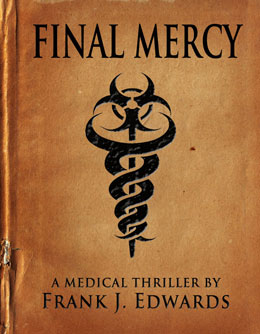
I’m so pleased to announce a new monthly guest blogger to Redwood’s Medical Edge. Dr. Edwards is an emergency medicine physician and will be adding a wealth of information concerning adult ED medicine. I hope you’ll take the time to check out his medical thriller, Final Mercy. Welcome, Dr. Edwards!
Cracking Joints
Frank J. Edwards, MD
You’re coming down a set of steps and become distracted, or you’re jogging and don’t see the pothole, or you’re playing soccer, or maybe you’re strolling in the park at dusk, when suddenly an ankle you’ve always taken for granted painfully twists inward and you hear a snap.  Next morning, the outward (lateral) side of your ankle is swollen and bruised, and weight bearing is not a happy experience.  Surely, it is broken.  You even felt the crack.

Ankle injuries are among the most common presenting complaints to emergency departments and urgent care centers.   The ankle is a very flexible hinge-type joint, held together by ligaments and mainly designed to flex upwards and push downwards when we ambulate.  It also allows for inward and outward movements (inversion and eversion) and even some degree of rotation side to side.  Every joint has inherent weaknesses, and the ankle’s Achilles’ heel (so to speak) is excessive inversion.  In other words, it does not take much force to twist the ankle inwards beyond its structural limitations.  Reach down and check it out.   When this happens, the ligaments on the outside (lateral aspect) of the ankle will stretch and tear, or sometimes even rip off a sliver of bone.   By definition, this is a sprain.  However, given enough force, the same mechanism of injury can cause true fractures, sometimes even severe enough to require surgery.

The vast majority of ankle injuries, however, do not involve broken bones and are completely healed within a week.  The question is—when do you need an x-ray?  Fortunately, we have some good research to guide us, something called the Ottawa Ankle Rules (thank the cost-conscious Canadians for this one), which that allows us to predict the likelihood of fracture. 
Basically, the Ottawa Ankle Rules say that: 1) if the patient was able to bear weight right after the injury; 2) if there is no tenderness to pressure over the tip of the fibula (the bone running down the outside of the lower leg); 3) if there is no tenderness over the base of the fifth metatarsal (the outermost of the five long bones in the foot), and; 4) if the ankle is otherwise stable—the chance of a significant fracture is slight. 
When a patient meets these criteria, we can skip the x-ray for now.  Give the injured person a splint and crutches, and save tens of millions of health care dollars a year.  Many health care providers, however, are either unfamiliar with the rules or unwilling to disappoint a patient’s expectations that the visit is incomplete without some radiation.   Especially if the patient “heard it snap.”   However, in my years of ED experience, this sensation usually points toward a sprain.  It is like cracking your knuckles.
*******************************************************************************

Frank Edwards was born and raised in Western New York.  After serving as an Army helicopter pilot in Vietnam, he studied English and Chemistry at UNC Chapel Hill, then received an M.D. from the University of Rochester.  Along the way he earned an MFA in Writing at Warren Wilson College.  He continues to write, teach and practice emergency medicine. More information can be found at http://www.frankjedwards.com/.

Firework Injuries

What kind of nurse would I be, really, if I didn’t post something about firework injuries on July 4th?

This is one of those time specific things ED’s deal with. One thing you may not know is that in most ED’s I’ve worked, the local fire department likes us to keep track of firecracker related injuries and submit that data to them. It’s generally age and type of injury to avoid violating the patient’s HIPPA rights.

This link is for firework safety: http://www.cpsc.gov/info/fireworks/

Firework related injuries: http://www.traumaf.org/featured/6-29-04fireworks.html

Stats of firework injures: http://www.usfa.dhs.gov/citizens/focus/fireworks.shtm

So, please, enjoy the holiday. But, stay safe and legal! I’ll be working and I don’t want to see you in the ED.

Jordyn

Western Medicine Circa 1890: Part 1/4

I’m very pleased to host Lacy Williams as a guest blogger this month. She is doing a four-part Friday series on western medicine during the 1890’s. Lacy has developed a great contest so check yesterday’s post for details. Though, I’m not sure I’m pleased with her reading the end of books first. I might have to chat with her about that….

Welcome Lacy!

Just want to say a quick thank you to Jordyn for hosting me on her blog this month! I’m really excited to be here and I plan to share some book excerpts and do a book giveaway that you won’t find anywhere else, so stay tuned the next few Fridays.
 I did a considerable amount of historical medical research for my novel, Marrying Miss Marshal, mostly because it seemed my heroine (a town marshal) kept getting into scrapes! Some of the basic research indicated that folks in the Wild West didn’t always have access to a doctor, mostly because there was a shortage of doctors in the less-populated areas. So they tended to doctor themselves. My heroine, Danna Carpenter, is the widow of the former town marshal and often had to doctor him up, so she does have some experience with tending injuries. She also grew up on a ranch, so in my mind, she would have also seen treatment of animals, which was often done by common sense.
DISLOCATED SHOULDER
In the first chapter of Marrying Miss Marshal, the hero falls down a ravine and dislocates his shoulder. One of the sources I used in my research, The Modern Family Physician (1915), gives two methods for treating a dislocated shoulder. One, Stimson’s method, wouldn’t work for my story because both hero and heroine are stranded outdoors in the dark. Here’s an excerpt that tells about the second method of treatment:
The more ordinary method consists in putting the patient on his back on the floor, the operator also sitting on the floor with his stockinged foot against the patient’s side under the armpit of the injured shoulder and grasping the injured arm at the elbow, he pulls the arm directly outward (i. e., with the arm at right angles with the body) and away from the trunk. An assistant may at the same time aid by lifting the head of the arm bone upward with his fingers in the patient’s armpit and his thumbs over the injured shoulder.
Although this isn’t exactly how it happened in Marrying Miss Marshal, this information is what I based my scene on. My brother-in-law (shout out to Ben!) dislocated his shoulder several times during high school, and had either a family member or friend put the joint back into place on the spot, so I know it’s possible for a layman to do it.
How do you think my scene turned out?
From Marrying Miss Marshal chapter 1:
When she reached him, Danna knelt at his head and studied the man. His hat had slipped to one side, and his sweat-matted hair was dark next to his fair skin.
“Mister, you’ve sure got a way of getting into some pretty good scrapes,” she muttered. She probed his scalp and neck gently with her fingertips, searching for injury. Though obscured by a few days growth stubble, he had a strong jawline.
He gasped when her palm brushed his right shoulder. Keeping her touch as light as she could, Danna ran her fingers over the arm and shoulder, and he moaned again. “Hurts.”
“I know. Looks like you’ve knocked it out of place.” She prodded his torso and legs, but found no additional trauma. She did find a gun belt and weapon at his hip, but ignored it for now. “I can reset it for you.”
She smoothed a hand over his forehead, as if she was comforting her almost-niece, Ellie. “Tell me your name.”
“Chas.” A breath. “O’Grady.”
She filed the name away. O’Grady sounded Irish. She nodded absently and murmured, “I’m Danna Carpenter,” as she considered the best way to get his shoulder back into the socket. “What brings you to Wyoming?”
“Job.”
“Not cattle.”
One corner of his mouth quirked upward. “How’d you know?”
“Lawyer?”
He snorted a laugh, then grimaced as if the movement pained him.
“Railroad surveyor?” she guessed, and gave a mighty tug.
O’Grady’s upper arm and the shoulder slid into place with an audible click. She was impressed when he didn’t cry out, just rolled his head and looked at her with those blue eyes.
“Thanks. You’re a doll.”
Then he passed out.
Copyright © 2011 by Lacy Williams. Permission to reproduce text granted by Harlequin Books.
REFERENCE:
The Modern Family Physician (1915) is available in the public domain on Googlebooks:
Volume 1
Volume 2 (dislocated shoulder information starts on page 412 of this volume)
***********************************************************************
As a child, Lacy Williams wanted to become a veterinarian “when she grew up”. However, the sight of blood often made her squeamish so she gave up that dream before her teen years. As a college student, Lacy was a physical therapy major for approximately two weeks—until she found out she’d have to take a cadaver lab to complete that degree plan. As a writer, Lacy has finally found a way she can handle blood and gore—fictionally. 
A wife and mom from Oklahoma, Lacy is a member of the American Christian Fiction Writers and is active in her local chapter, including a mentorship program she helped to start. She writes to give her readers happily-ever-afters guaranteed and mostly reads the end of the book first. You can find out more about Lacy at her website http://www.lacywilliams.net/. She is also active on Facebook (www.facebook.com/lacywilliamsbooks) and Twitter (www.twitter.com/lacy_williams).

Special Post: July Contest

I’m very excited to host Lacy Williams over the next four Fridays starting July 1st. She is going to be discussing the research she did into western medicine during the 1890’s. I’m know she has a lot of fascinating information to share so I hope you’ll keep coming by.

Plus, she’s giving you a lot of incentive. How about the possibility of winning four books!

CONTEST INFO
Since Jordyn is hosting me for four Fridays this month, I thought I would give away four books, three of which are medical-themed Love Inspired Historicals. The contest winner will get:
*Marrying Miss Marshal by Lacy Williams
*Crescent City Courtship by Elizabeth White (June 2009) – great book featuring a woman in med school!
*Courting the Doctor’s Daughter by Janet Dean (May 2009)
*The Doctor’s Newfound Family by Valerie Hansen (June 2010)
HOW TO ENTER
*Leave a comment on any of the four guest posts I’ll be doing on Jordyn’s blog. If you comment on all four posts, you’ll get four entries.
*BONUS ENTRY FOR: Posting a link to any of the four guest posts on Facebook or Twitter (or retweet the promo tweet each Friday from @lacy_williams )—NOTE: since Facebook has changed its rules about promotions/drawings on Facebook, if you post a link on FB please also email me at lacyjwilliams@gmail.com to let me know you’ve done so.
DRAWING
Entries close on Friday, July 22 at 11:59 PM EST. Any comments or tweets or FB posts after that won’t count. Lacy will do a random drawing from all the entries on Saturday, July 23 and notify the winner at that time.

Medical Question: 1950’s Coroner

April asks: For a grad assignment, I have to come up with murder mystery plot line.  I have the general plot line down, but I’m wondering how efficient an autopsy in the 1950s would be?
I need the victim to be poisoned, most likely by a relatively common plant–probably a daffodil, yew, or Wild Cherries (those are my top three choices at the moment).  However, I have no idea how much or what kind of poisons would have been detectable by a small-town, 1950’s coroner.
Jordyn says:  First thing, is a medical examiner and coroner are very different. A medical examiner is a trained physician (the one who does the autopsy) and the coroner is an elected official to decide how an investigation should proceed. For instance, if the coroner feels the cause of death does not involve a crime, there may not even be an autopsy.


Yew Plant

The second thing you need to determine is when tests for toxicology/poisons came about: “Screening tests, such as radio immunoassay, enzyme immunoassay and thin-layer chromatography are often very sensitive, but not very specific. Because they are very sensitive, they will very likely detect the chemical/poison if it is, indeed, present in the sample. Unfortunately, because they lack specificity, they are given to false-positives – mistaking a substance with a similar chemical make-up for the suspected poison. Unless the results of these screening tests are confirmed with a reliable testing methodology, such as gas-chromatography/mass-spectrometry, the results of these screening tests do not satisfy the evidentiary standards for admissibility.”

When I did a little searching, some of these tests were not developed until the 1950’s and 1960’s. So, for them to be widely used would take some years. If you want to be very specific in your ms, you need to research when each of these tests were developed for forensic use. For example, google “development of forensic radio immnoassay”. That will give you a timeline for when they may have been able to detect your chosen poisons on autopsy. I did link you to some forensic timelines below— there are a few of these tests mentioned.
I think the easiest route for you would be this: This small town has a coroner who doesn’t suspect anything criminal is going on. This is still very common today because a coroner may have absolutely little or no medical training and probably no forensic training. Then, maybe based on the victim’s symptoms before death, the very smart local doctor begins to think someone is poisoning these people. This sets up conflict which is always a must. I would research the symptoms people have when they ingest the items you have listed. Then, maybe this local doctor can push the coroner into having a fancy, big-town ME do an autopsy.
3. http://jimfisher.edinboro.edu/forensics/fire/tox.html: forensic toxicology (poisonings)
Hope this helps and gives you some direction.


For Jillian: Head Injuries early 1800’s

I decided to do a special post just for Jillian. She’s an awesome supporter of this blog and had an interesting question in the comments section that was going to be easier to answer here.

Her question:  Did they know if someone had a concussion during the time period I write, which is Regency England.

Jordyn says: Jillian, my best guess is that they understood head injury symptoms but probably not what the exact cause was. Boring a hole in the head to relieve pressure was a common medical practice (probably one of the oldest surgical procedures).

Here are a few resources that may help you:

1. The prevailing view in the 1800s was that headache and other sequelae of head injury were due to malingering or psychogenic or other functional disorders.  Source: http://www.medlink.com/medlinkcontent.asp

2. http://journals.lww.com/ajpmr/Fulltext/2010/08000/The_History_and_Evolution_of_Traumatic_Brain.13.aspx

3. http://en.wikipedia.org/wiki/Traumatic_brain_injury: Look under history section.

4. This was an earlier post on trepanning. http://www.jordynredwood.com/2010/11/truly-historical-medical-question-head.html

Jillian, thanks as always for your support. Hope you find some useful information.