Medical Question: The Morgue

DV asks: I am writing a thriller right now and need a description of a large city hospital morgue. I haven’t tried to secure a tour yet (do they even allow that?) at a city nearby. All I need is to know how they’re set up. I’ve read they’re usually in the basement near a loading dock, and they’re usually unmarked and secure.
Do they use a wall of refrigerated drawers? If not, what does the room look like? How are the bodies marked? Do they still use toe tags or is it all done electronically? Do they include cause of death? I’m afraid the smaller town I live in wouldn’t have the same kind of morgue as a large city (the book takes place in LA). I’d like to have at least a semblance of reality.
Jordyn says:  DV, thanks for sending me your question.
I’m not familiar with a large city morgue either. Just a hospital morgue. I think you could probably call and set-up a tour. I’m sure you won’t be the first person to ask. Another thing I would recommend would be to take your local police department’s citizens’ police academy. I took one locally last year and it was a wealth of information. Sometimes, through a venue like this, you might get the chance to tour a morgue.
Considering your question as a medical person, this is how I would research it.
Do a Google search for known medical examiner’s buildings and get photos of the structure via the Internet for the outside look.
Next, go to You Tube and search for “morgue tour”.
I thought this one was actually pretty good and gave decent enough info to set up a scene.

You could view others as your heart desires. Any other suggestions for DV?

***********************************************************************

DV Berkom grew up in the Midwest, received her BA in Political Science from the University of Minnesota, and promptly moved to Mexico to live on a sailboat.

Several years and at least a dozen moves later, she now lives outside of Seattle, Washington with her sweetheart Mark, an ex-chef-turned-contractor, and writes whenever she gets a chance. You’re welcome to email her at dvb@dvberkom or chat with her on Facebook or Twitter- she loves to hear from readers as well as other writers.

Several Days Before Christmas

I’m pleased to host Frank Edwards, MD today as he writes about telling a family about the death of their loved one.

I have been in this position, unfortunately, as well. Sometimes, getting the feelings of a healthcare provider is hard to do. I think Frank has done it well with this poem.

It was a little after noon
when the drizzle began.

A truck skidded sideways on a bridge

and overturned.

The driver wasn’t hurt,

but underneath his truck

Lay a car,

roof caved flat,
the driver’s head crushed.

Before setting out,

she had firmly buckled her two young sons
in the back seat.

In the hospital

I examine them:
A few scratches from window glass
turned shrapnel.

They do not ask about their mother

who’d gone straight to the morgue.

Her husband,

at work,
was only told
there’d been a wreck,
his wife was hurt.
When he arrives
a silent nurse leads him
to the room we keep for these occasions.

How to do it?

Introduce yourself.

Not by first name–
use your title: doctor.
It’s pragmatically superfluous now,
the little good you did,
but this a time for shamans.

Start easy.

Your sons are fine,

Not hurt . . .
But I do not have good news about your wife
(Husband, mother, father, brother, sister, friend).
Then shut your mouth for about ten seconds,
sit, lean forward, take their hand,
allow them to poise,
their grief to ripen.

Do not proceed,

I repeat,
do not continue–
until you feel it yourself.

Only then

give the truth.
and do not be afraid
to use the word death.

And as the floor caves in–

sink with them.

*****************************************************************************

Frank Edwards was born and raised in Western New York. After serving as an Army helicopter pilot in Vietnam, he studied English and Chemistry at UNC Chapel Hill, then received an M.D. from the University of Rochester. Along the way he earned an MFA in Writing at Warren Wilson College. He continues to write, teach and practice emergency medicine. More information can be found at http://www.frankjedwards.com/.

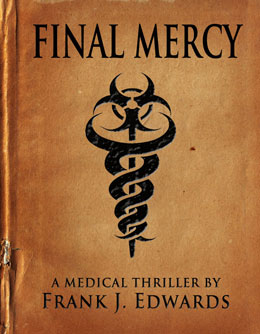
Check out Frank’s novel Final Mercy.

Author Beware: Unsecured Narcotics

I was happily reading along one of my favorite best-selling authors when I stumbled upon a troubling set-up. Now, this author makes a lot of money which is why I’m not sure the reason for his not picking up the phone to consult me on his manuscript.

One character had been beaten up fairly well. He was in the hospital on a Valium drip. Huh? That’s right, just a bag of Valium hanging and dripping into his veins.

Issue One: Valium is not a pain medication per se. It is a muscle relaxant which can relieve pain from a muscle spasm. However, if you have had the snot beat out of you, let me introduce you to my friends the opiates: Morphine, Fentanyl, etc. These are likely what we would give first for pain.

Issue Two: Valium is not given in a bag as a drip. In fact, I can think of few instances where Valium would be given as a continuous medication. Some shorter acting friends of Valium are– but you generally have to be in the ICU on a ventilator to get some. This character was not.

Issue Three: Narcotics need to be secure. If a patient needs a continuous amount– this is what PCA (patient-controlled analgesia) pumps were made for. They are locked IV pumps so that no one can steal the drug from the bag and so that the patient cannot manipulate how much they receive.

Pediatric ICU’s do run a lot of continuous drips that are not locked. In these instances, usually a calculation is made at the end of a shift to look at the amount remaining. If the syringe is off by more or less one millimeter– then generally an incident report is filled out.

So bestselling, multi-million dollar author— really, just call me up. I’d be happy to help.

Have you read a scene with inappropriate use of narcotics?

The Challenge of Caregiving: Rob Harris (Part 1/2)

Today, Rob concludes his first person account of caregiving under crisis. Good news is his wife is strong and well and they are still happily married.
Welcome back, Rob.
The cardiac room was cramped, even without the medical team working over her. I was relegated to the hallway with a nurse that had accompanied us from our oncology floor. She had been on break and was friendly with my wife and me. She was there to make sure I was okay – or was she there to ensure I would not get in the way?
A nurse who was unknown to me walked past with a large syringe.
“Atropine?” I asked as I turned to the nurse who escorted me to the cardiac floor. She nodded in affirmation.
“Just precautionary,” she advised.
In the room, I heard my wife state to the doctors, “I can’t see. Everything is getting dark.”
That’s when I stuck my head into the room and saw it.  By the way in which her head fell to her chest, there was no doubt in my mind that her heart had stopped beating.
For the first time, a doctor acknowledged my presence. “Nurse, please remove him from the room.”
A tug on my elbow instructed me to follow. I comprehended the message.
Though I had no intention of getting in their way or interfering with their efforts to restart my wife’s heart, I was her husband. I had to give it one try.
I pulled away from the nurse’s grasp. “CINDY, WAKE UP!” I screamed at her.
And that is exactly what she did! She came back to life. That is when I agreed to leave the room. Second later, the syringe was dispensed and, after careful and extended monitoring, my wife was relocated to her new home, the Intensive Care Unit of the hospital.
It was 24-hours later before I was spoken to by a cardiologist. Terms that had up to that point been foreign to me were introduced, soon to become a regular part of my ever-expanding medical vocabulary. “Your wife had an episode of what’s known as QT prolongation.   Her electrocardiogram indicated she had a rather unusual occurrence, known as ventricular tachycardia, more formally called Torsades de pointes.”
He then turned to my wife. “You’re very lucky,” he began. “Not many people survive an event of this nature. I’m curious. What did you see, what did you feel when your heart stopped beating?”
My wife smiled, though still extremely groggy. “I was shopping in a mall. I was buying all the purses I wanted and I didn’t need a credit card to pay for them. They were free. I loved it there.”
“What brought you back?” he asked.
“I heard my husband shout my name. It sounded like he needed me badly.”
The cardiologist turned to me and smiled.
In hindsight, I understand why I had been ignored. There was no way I wanted to distract or interfere with the doctors whose mission it was to keep my wife alive.
That said, I would have liked the doctors and nurses who had been working all around me to understand that although I appeared composed, mentally, I was in critical condition. If my wife was dying, so was I. If she was suffering, I was in distress right alongside her.
Keep in mind; we are all human beings, with all-too-real emotions. Any form of communication, even if it’s a nanosecond of recognition is invaluable to someone whose most valuable gift, the life of a loved one, is in life-threatening distress.
***************************************************************************

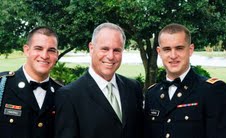
Rob Harris is a seasoned/accredited Human Resources professional. He is the author of two books. The first, “We’re In This Together, A Caregiver’s Story” is scheduled for release in the Spring of 2012. The sequel, “We’re In This Together, A Caregiver’s Guide” will follow shortly thereafter. More importantly, he is a seasoned Caregiver. His wife is a two-time cancer survivor (Non-Hodgkin’s Lymphoma and a radiation-induced leiomyosarcoma).  He and his wife are the proud parents of two U.S. Army officers. Presently, his youngest son is protecting our country’s freedom in Afghanistan after previously being stationed in Iraq. His brother recently returned from his first deployment in Afghanistan.  

The Challenge of Caregiving: Rob Harris (Part 1/2)

I’m very honored to have Rob Harris here at Redwood’s Medical Edge today. He’s giving a first hand account of what it’s like when your loved one nearly meets death. Part 2 will be posted Wednesday.
Welcome, Rob.
7:24 a.m. The nurse tech entered our hospital room and took my wife’s vital signs. I was awake, dressed and ready to record her findings on my Excel spreadsheet. “Temp: 97.5; BP: 122/61, Pulse: 32,” she said as she turned to depart our room.
I looked up from my laptop, my fingers frozen over the keypad. “Excuse me,” I stopped her in her tracks. “You gave me an incorrect number. You said her heart rate is 32? Is the machine working properly?”
She returned and took my wife’s pulse manually. “It’s 45,” she announced. Again, she turned to leave.
“Could you please ask our nurse to come into the room,” I requested calmly, so as not to alarm my wife. My wife’s pulse rate under normal conditions is high, typically in the mid-to-upper 70’s. Being in the 30’s or even the 40’s was cause for alarm.
She didn’t move quickly enough for my liking. I strode past her and turned the corner. Once out of eyesight I raced to the nurses’ station and interrupted the nurse assigned to our room. She was debriefing the attending physician prior to beginning his rounds. I apologized for the intrusion and explained my concern. They followed me and went straight to my wife.
Thus began a day I will never forget. My wife had received her sixth cycle of chemotherapy for a leiomyosarcoma, a 4-hour dose of methotrexate administered via an IV-drip into her port the previous night. Up to that moment, no unusual symptoms appeared.
My caregiver role began and ended at that moment. It commenced by my alerting the doctor and nurse that I was gravely concerned about my wife’s medical condition. It ended as soon as the medical teams descended upon our room.
To use a sports vernacular, I was “benched.” I was immediately transitioned from caregiver to spectator. As anyone who has ever attended a sporting event in which they are loyal to the home team can attest, a spectator, or fan, can yell, scream, cheer and even insult. Much as they may beg to differ, they have no bearing on the final outcome of the game. In other words, they are powerless.
And so was I. Worse, I was alone. I was ignored. I was invisible.
A crash cart suddenly appeared in our doorway.
“Would someone please tell me what’s going on here? Why is this happening?” I inquired to no one individual in particular.
I didn’t want to bother the medical team, but as low as my wife’s pulse was at that moment, mine was definitely heading in the direct opposite direction. Externally, I remained calm. Internally…Jell-O!
“We need to move your wife to the cardiac care floor, the nurse informed me. “Pack your things. We’ll be going as soon as transportation arrives.”
I obeyed. I didn’t exactly feel useful, but I felt, in some small way, engaged in the process. Someone had acknowledged me. Someone gave me direction.
The doctors, three of them, exhibited a calm demeanor. This comforted me to some extent.
I wish someone would look my way and reassure me; talk to me, provide a morsel of encouragement, I thought to myself. Nothing came, not a nod, a wink, a slight smile or even a glance in my direction. I guess I was invisible after all.
Finally, the nurse spoke. “We’re taking your wife now. You can go with us if you’re all packed.”
“Can you tell me anything?” I begged. Nobody, including the nurse responded.
I understood. I felt like a child in a room full of adults. Caregivers and children are to be seen and not heard. The memories came flooding back. I knew my place. My wife is their only focus, as it should be. Again, I remained composed on the outside, but I was combusting internally as we passed another waiting crash cart in the hallway just outside her newly assigned room.
*********************************************************************************
Rob Harris is a seasoned/accredited Human Resources professional. He is the author of two books. The first, “We’re In This Together, A Caregiver’s Story” is scheduled for release in the Spring of 2012. The sequel, “We’re In This Together, A Caregiver’s Guide” will follow shortly thereafter. More importantly, he is a seasoned Caregiver. His wife is a two-time cancer survivor (Non-Hodgkin’s Lymphoma and a radiation-induced leiomyosarcoma).  He and his wife are the proud parents of two U.S. Army officers. Presently, his youngest son is protecting our country’s freedom in Afghanistan after previously being stationed in Iraq. His brother recently returned from his first deployment in Afghanistan.

Medical Question: Pneumonia

Elaine asks: You’ve come highly recommended by quite a few author-friends and I’m hoping you can help me out with a medical question for my story.
I have a high school senior who comes down with a severe case of pneumonia weeks before her graduation. She is hospitalized in the ICU, pulls through, but doesn’t make it to graduation.

Plot wise I need her to miss the fall semester of beginning college & have her family keeping her home during the summer for extra rest while she recuperates more fully. I’d like to know if this scenario is feasible– that a case of pneumonia, if bad enough, could weaken someone enough that she’d postpone starting school in the fall and take it up again in the spring?

Jordyn says: Elaine—thanks so much for sending me your question. And thanks for the compliment! That means a lot to me.
As far as your question—there are a few issues with your scenario. In a previously healthy young adult, it wouldn’t be that feasible for her to be sick so long. Medical treatment for pneumonia is antibiotics for 5-10 days. Then maybe residual cough, easily fatigued for a couple of weeks. This is of course if it is a one-sided simple pneumonia. So, considering those factors, if she were sickened in May I would think she’d be able to attend school in the fall.
Also, people are rarely admitted to the ICU for pneumonia unless they need to be intubated on a breathing machine. So, say she had bilateral (both lungs involved) pneumonia, had to be intubated, popped a lung (called a pneumothorax), needed a chest tube, etc. Again, these might sicken her for a couple of weeks but if she’s generally healthy she should be able to overcome this, rest up for several weeks—back to school in the fall.
My suggestion would be this— give this character a chronic illness that puts her lungs in a more vulnerable state (broncho-pulmonary dysplasia, asthma, cystic fibrosis) and the pneumonia got to the point where she had to be admitted to the ICU on a ventilator and she blew a lung which complicated her situation. Considering her history of chronic disease—it would be more feasible that she’d have a long recovery time and she’d take the fall semester off.
Asthmatics on the ventilator are very hard to manage and get off and often have a complicated course. Most often, they have to be medically paralyzed and sedated. The patient is high risk for developing a pneumothorax. This would be my pick.

******************************************************************************

Elaine Stock is a former RWA member and has presented several writing workshops. Presently involved in ACFW, she was a 2011 semi-finalist in the prestigious Genesis Contest in the contemporary fiction division. She is also active on several social networking groups. Her first short story was published on Christian Fiction Online Magazine. New to the blogging world, Elaine started a blog this past April, Everyone’s Story. Since then, the blog has been graced by an awesome international viewership that totally pings her heart. Everyone’s Story features weekly interviews and reflections from published authors, unpublished writers…and just about anyone who wants to share a motivating story with others that may lift their spirit. She has also been the guest of several other blogs, helping to further grow her presence on-line.

She and her husband make their home in an 1851 Rutland Railroad Station they painfully but lovingly restored.

Author Beware: Hallmark’s Christmas Magic

There’s nothing more charming for me than a Hallmark Christmas movie. Several I loved this past Christmas season– particularly Trading Christmas written by Debbie Macomber. Hilarious if you’re a writer.
Some I didn’t like as much– and you guessed it– had to do with a medical reason.
Christmas Magic was a Hallmark movie where a young PR exec was involved in serious car accident.
Spoiler alert!
Most of the movie, you’re led to believe that she has died and is doing some angel work before going to heaven. At the end of the movie– you learn she has been in a comatose state and the climatic scene is where the man and daughter she was trying to help, come to her side at the hospital, to sing her back to life before her father “pulls the plug.”
My first issue: You should actually look injured if you’ve been in such a devastating car accident that you’ve been lying in a hospital bed for the better part of a week. In her “death” scene, her hair is clean and styled. Nary a scratch on her pretty face. Exactly what was her injury? Supposedly brain trauma. Well, she should at least have a bruise on her head.
My second issue: Pulling the plug generally denotes that you are on a ventilator. Discontinuing the ventilator– pulling the plug– means a patient’s breathing is no longer being assisted, they then cannot oxygenate their body, and the heart will stop beating when it doesn’t have oxygen.
In this scene, she was on a heart monitor (which is merely a monitoring device) and an IV bag of fluids hung at her bedside. She was not on a ventilator. Therefore, no “plug to pull”.
To denote discontinuing “life support” the nurse in the movie turned off the IV solution where then the heart began to slow down. Okay, you will die if you are in a comatose state from dehydration (think Terri Shiavo’s case) but it will not happen in a few minutes. It will take days.
But, this patient was able to comply and nearly died in a few short minutes.

Next season, Hallmark Channel, hire me as a consultant. You might be surprised at how inexpensive I am!

Micheal Rivers: Altered Mental Status

I’m pleased to host guest blogger Michael Rivers today as he discusses the EMS perspective on altered mental status.

Welcome, Micheal!

EMS handles thousands of calls every year especially in the larger cities like Chicago. There is one kind of emergency call that can take the life of a Paramedic or EMT very quickly, or leave him or her with serious injuries. These calls are either for domestic or institutionalized people with altered mental status.

These calls are handled differently from other calls even involving shooting because the medical personnel have no idea what they can be walking into. Although he is there to help, the sight of the uniform alone can cause a very violent reaction from the patient. The ambulance personnel must not only be wary and insure the safety of the scene, but he has to be inventive when handling his patient.
Depending on the scene you never want the patient to hear your siren or see the flashing lights of the ambulance. It frightens them and they automatically become defensive. If you are running code 3(emergency) stop the siren and the lights a block or more before you arrive on the scene. If at all possible gather all the information on your patient and turn this to your advantage. These are some very good examples that work. This knowledge was gained through experience.
The patient was a 320 pound female confined to a psych facility for homicide. She was known to go through fits of rage even when under the influence of her medication. Arriving on the scene she was found in the nurse’s station sitting in a chair brooding. An armed security guard from the Sheriff’s department stood close by her. Due to the experience of the EMT’s, one stayed at the entrance while the attending EMT walked by the patient basically ignoring her while visually accessing her as he passed by. This assessment tells a great deal about who he is dealing with.
With a better knowledge of the problem and a few personal facts you begin to communicate with your patient. They want to be heard. Listen to them and find a way to get them on the stretcher without a fight. You may have to become an accomplished actor, but you have to convince them you are genuinely concerned and you are their friend, their guardian. In this case the attending EMT was able to get the vitals and convince her to get on the stretcher on her own when in the beginning she refused to be touched. If they had tried to force her, there would have been someone taking a lot of body damage. She was strapped x4 thinking it was for her safety.
Knowing the patient was not diabetic and was allowed sweets was a plus. With a simple cookie and the promise she would not be harmed, (history of physical abuse) she co-operated fully. She was even able to display sympathy for the EMT when he said he would get in trouble if she did not let him take her to the hospital. The call went smoothly and the patient was able to receive treatment without causing further harm to her.
These EMTs were very experienced. Experience cannot always let you see the unexpected coming. They specialized in the Altered Mental Status calls and knew exactly what to look for. Yet, Ambulance 04 was retired one year later after nearly being destroyed as the driver was attacked by a street person from inside the ambulance with altered mental status. This was an incident where the driver’s window was down to answer a man’s question. The street person dove through the window attempting to kill the EMT. At the time they had another patient inside the ambulance also with altered mental status.
This is a perfect example of the symptoms of altered mental status not being displayed by a person you are speaking with. If you are an EMT or Paramedic you already know the question; “Is the scene safe?”
***********************************************************************

Micheal, born in 1953, is an American author. He served his country as a United States Marine during Vietnam. Born in North Carolina, he lived in the Chicago area in the past and furthered his education there and served the community as an Emergency Medical Technician. Micheal returned to the mountains of North Carolina where he resides with his wife and his Boxer he fondly calls Dee Dee. You can learn more about Micheal at http://michealrivers.com/.

Florence Nightingale Diagnosis Henry VIII: Part 3/3

This has been an amazing series by JoAnn Spears. I’ve enjoyed having her and I hope you learned something new about medicine during Henry VIII’s time.

Baby blues
Nursing Diagnosis:  Sexuality Pattern, Ineffective
Nursing Diagnosis:  Role Performance, Ineffective
In Tudor times, one of the main imperatives on a king was to father sons. Henry’s inability to achieve this goal was the impetus behind the Reformation in England, and has been made much of in fact and fiction. The fact is, though, that his full complement of male children was two legitimate sons, and one illegitimate son. One of the legitimate boys died in infancy and the other, Edward VI, died in his teens. The illegitimate Henry Fitzroy died shortly after he was married, at the age of seventeen. Henry also fathered two healthy girls, Mary I and Elizabeth I. He was in his mid-forties when he sired his last child.
Rhesus or Kell issues, in which incongruent parental blood types can cause a stillbirth or compromised infant, have been suggested as causes of the many miscarriages suffered by Henry’s first two wives. However, his first healthy daughter was born subsequent to his first wife having a succession of pregnancies, which is quite the opposite trajectory to that usually seen with such incompatibilities.
Syphilis, which, untreated, can lead to mental health problems in both parents and offspring, is an embedded but unlikely part of Tudor medical lore. Henry’s impulsive and violent propensities were not described by contemporaries in a way associated with the dementia and deterioration typical of tertiary syphilis. Also, none of Henry’s surviving children exhibited symptoms of congenital syphilis.
Henry’s first three wives each conceived quickly after marriage and, in the case of the first two, conceived multiple times. None of his subsequent three wives conceived. Henry’s symptoms of substantial weight gain and compromised circulation became noteworthy around the period between Henry’s third and fourth marriages. Erectile dysfunction is another potential side effect of both diabetes and poor circulation, and would account for a lot of the personal history of Henry and his last three wives.
Exit strategy
Nursing Diagnosis:  Mobility: Bed, Impaired
Nursing Diagnosis:  Risk for Compromised Human Dignity
Henry VIII’s last years were anything but majestic. The handsome, charming, 6’2” blond athlete of earlier days was a bloated, irritable, sickly being who was largely confined to bed and chair. A mechanical hoist was required to get the king onto a horse once he donned his outsized armor. The purulence of his leg ulcers caused a nauseating stench. His very last days, in which he was confined to his bedchamber, were spent hammering out a succession plan for the progeny he and his sisters would leave behind.
Henry was in his mid-fifties when he died. During the era he lived in, his would not have been considered an advanced age, but a death at that age was certainly not considered untimely. The actual cause of his death is unknown. An embolus to the heart or lung has been suggested. However, either of these would probably have killed Henry quite quickly, and there were days’ worth of succession planning and priestly officiating before the death. Stroke has also been suggested, but the tenor of the deathbed activity around him is not entirely congruent with the suddenness of a cerebrovascular event. Given the circumstances, the eventual succumbing of a once-healthy body to years of chronic disease seems as likely an explanation as any of Henry’s death.
***********************************************************************
JoAnn Spears is a registered nurse with Master’s Degrees in Nursing and Public Administration. Her first novel, Six of One, JoAnn brings a nurse’s gallows sense of humor to an unlikely place: the story of the six wives of Henry VIII.  
 Six of One was begun in JoAnn’s native New Jersey. It was wrapped up in the Smoky Mountains of Northeast Tennessee, where she is pursuing a second career as a writer. She has, however, obtained a Tennessee nursing license because a) you never stop being a nurse and b) her son Bill says “don’t quit your day job”.

Florence Nightingale Diagnosis Henry VIII: Part 2/3

Today, JoAnn Spears continues her nursing evaluation of Henry VIII.
The King’s pains.
Nursing Diagnosis:  Tissue Perfusion, Ineffective, Peripheral
Nursing Diagnosis:  Pain, Chronic
Nursing Diagnosis:  Skin Integrity, Impaired
Henry VIII and his bandaged, suppurating, painful legs are the stuff of Tudor legend, as is “the gout”. Gout was common in Henry’s time, when diets were high in triggering, purine-rich foodstuffs such as beer, ale, and organ meats. Gout does cause excruciating pain in the lower extremities, but it tends to be episodic and associated with inflammation, rather than chronic ulceration. If Henry did have gout, it may have been the least of his problems.
Poor peripheral circulation seems a more likely explanation of Henry’s lower extremity woes. The weight and immobility that were part of his life after the age of about forty could certainly have caused or contributed to this condition. The weight gain may in turn have been either the cause or the effect of type 2 diabetes. This is the type of diabetes which is acquired later in life. To continue a sad spiral, diabetes also contributes to lower extremity problems such as easily damaged skin, neuropathic pain, and ulcers that will not heal and become chronically infected.
Size Matters.
Nursing Diagnosis:  Nutrition, Imbalanced: More than Body Requirements
Diabetes is a disorder of glucose metabolism, and type 2 diabetes is associated with excess food intake. Henry’s much vaunted gluttony and his weight in middle age—estimated by some to be as much as five hundred pounds—argue strongly in favor of this diagnosis, but not exclusively.
Hypothyroidism is also associated with weight gain and mental irritability such as Henry displayed. This condition is, though, more commonly seen in women than in men.
Tudor portraiture makes a strong argument for Cushing Syndrome as the cause of Henry’s obesity. Pituitary tumors which disrupt normal cortisol activity are a frequent cause of this disease. Portraits of Henry in later life feature the typical moon face of Cushing’s Syndrome and the characteristic distribution of excess fat deposited in the core rather than the extremities. Ironically, Cushing’s Syndrome can also cause or exacerbate mental status changes and diabetic processes, as well as erectile dysfunction
**********************************************************************
JoAnn Spears is a registered nurse with Master’s Degrees in Nursing and Public Administration. Her first novel, Six of One, JoAnn brings a nurse’s gallows sense of humor to an unlikely place: the story of the six wives of Henry VIII.
 Six of One was begun in JoAnn’s native New Jersey. It was wrapped up in the Smoky Mountains of Northeast Tennessee, where she is pursuing a second career as a writer. She has, however, obtained a Tennessee nursing license because a) you never stop being a nurse and b) her son Bill says “don’t quit your day job”.