Child Abuse Injuries: Shaken Baby Syndrome 3/3


April is Child Abuse Prevention month and as a pediatric ER nurse, I thought I’d spend some time talking about the most devastating child abuse injury, in my opinion, and that is Shaken Baby Syndrome or SBS.
In Part I and Part II I talked about the brain injuries associated with SBS: Diffuse Axonal Injury and Subdural Hematomas.
Now—we’ll discuss another classic injury associated with this abusive injury—retinal hemorrhages.
Just what is this bird? Anyone know? Well, it is a woodpecker. Now you may be wondering exactly what do woodpeckers have to do with shaken baby injuries.
Interestingly, Alex Levin, an ophthalmologist from Canada, wondered why woodpeckers did not suffer retinal hemorrhages when they were pounding their beaks against trees. After all, the whiplash type movement is similar to the injury infants suffer when shaken.
So he got a grant and if you found a deceased woodpecker, you could send it in for money and he sent these birds through the CT scanner.
What he found was that anatomically, woodpeckers had certain mechanisms built in that protected their eyes from sustaining injury.
We know that when an infant is shaken—the brain is tossed around within the skull causing injury. Essentially, the same thing happens to the eyes—they are tossed around as well and hit their bony protective area—the orbits. Imagine a tethered ball hit and tossed around. This mimics the eye anchored by the optic nerve and how it is injured during shaking.
The retina has several layers and bleeding happens in between these layers. Retinal hemorrhages associated with SBS are extensive, in both eyes, and cannot be mimicked by any other type of injury—including a violent car accident. 
What people who perpetrate child abuse don’t understand is that the injuries associated with SBS are VERY distinctive. Multiple studies (particularly of falls) have been done and we know that no other injury pattern (major car accident, falls less than four feet and CPR) gives us this cascade of injures.
What’s distressing is getting the public to believe that parents perpetrate these crimes. Surely, no loving parent could cause this type of injury that led to their child’s death.
Sadly, yes they do. Every day.
Please—if you think a child is being injured. It may be you—and only you—who ever stands in the gap to save their life. Please notify someone if you think a child is being abused. 

And please– never, ever shake an infant. 

For help in dealing with a crying baby– click here

Child Abuse Injuries: Shaken Baby Syndrome 2/3


April is Child Abuse Prevention month and this week I’m posting about the most devastating child abuse injury—Shaken Baby Syndrome or SBS.
Last post I discussed the leading cause of death is a brain injury called Diffuse Axonal Injury (DAI) which leads to massive swelling in the brain, which if not controlled will push the brainstem into the spinal cord, and this leads to brain death.
There are other classic injuries associated with SBS. In Part I I described how DAI occurs—by the violent shaking and the brain hitting the inner surface of the skull repeatedly.
What also occurs is the small bridging veins that cover the brain and are attached to the underside of the skull are torn as well. This leads to bleeding on the brain and is referred to as a Subdural Hematoma (SH) or subdural bleed. This can be picked up radiologically and although forensically a specific time and date cannot be given as to when the bleeding occurred—a radiologist can tell if there are old and new bleeds which correlates to different episodes of shaking.
People who have committed this type of child abuse injury have confessed to shaking multiple times. It’s as if they see shaking work one time to quiet an infant’s crying—it’s an easy solution the next time.
As stated in the earlier post—the bleeding is generally not what kills the child—it is the insidious brain swelling and subsequent herniation.
How do these children present to medical personnel?
Mild Presentation:

Large head.
Can’t lift their head.
Eyes can’t focus or track.
Decreased Responsiveness.
Irritability.
Lethargy/Limpness.
Vomiting.
Decreased muscle tone.
Poor appetite.
Not smiling.
Not vocalizing.

Severe Presentation:
Seizures.
Decreased respiratory rate.
Not breathing.
Rigid posture.
Bulging soft spot.
Coma.
Death.
The medical team is generally clued in to the possibility of child abuse when a caregiver gives an implausible account of why the child is so sick. Typical responses are—“Well, my one-month-old baby just rolled off the couch.”
Hmmm… if only he could roll.
Next post we’ll talk about another classic injury associated with SBS.

And please– never, ever shake an infant. 

For help in dealing with a crying baby– click here

Child Abuse Injuries: Shaken Baby Syndrome 1/3


As a pediatric ER nurse, I would be remiss in not taking note that April is Child Abuse Prevention month. Sadly, this is part of my job as a pediatric ER nurse—to recognize and report child abuse injures.
A couple of years ago, I did a two part series on how we identify child abuse injuries. You can read Part I and Part II by following the links.
This week I thought I’d highlight one very specific injury—Shaken Baby Syndrome (SBS).
In the medical community, SBS goes by another name—abusive head trauma (AHT) and many things can fall under this designation. A child who is just shaken, a child that is shaken and then slammed into a surface, or a child who is beat about the head.
Fatal child abuse can occur from a single act (drowning, suffocating, shaking), repeated abuse (battered child syndrome), or failure to act (malnourishment or bathtub drowning.) Eighty percent of perpetrators are generally the biological parent(s) followed by mother’s paramour and babysitters.
SBS is caused when a person generally grabs an infant around their torso and shakes them violently in order to quiet their crying. We don’t know exactly how long it takes and no sane ethical review panel is going to allow infants to be shaken to unconsciousness to find out. What we know from people who have confessed is that it doesn’t take very long—likely twenty seconds or less—typically lasting five to ten seconds.
Imagine holding a ten to twenty pound baby with outstretched arms and sustaining that position. The shaking is violent and requires a lot of energy as well. 
What happens upon shaking is as follows:
1.      The brain strikes the inner surfaces of the skull, causing direct trauma to the brain itself. This is often referred to a coup/contra-coup injury. The brain is injured both ways as it is batted around within the skull.
2.      The axons, which are the long part of the nerve cell (you can view them like an electrical wire) can be broken or sheared. Whenever there is biological injury things swell (like your ankle when it is badly sprained.) This occurs to the brain as well. This is referred to as Diffuse Axonal Injury or DAI.
3.      The lack of oxygen during shaking causes further irreversible damage to the brain. This is referred to as Anoxic Brain Injury.
4.      Damaged nerve cells release chemical mediators which further damage cells.
5.      The end result is brain swelling, brain movement (herniation) and brain death.
There are other injuries that are classically associated with SBS but the diffuse axonal injury and subsequent brain swelling are generally what cause death.
Why is this different than brain injuries from a car accident? Why can’t kids recover?
Think of a car accident. It may entail one or two hits—a focal injury. A focal injury means just one area of the brain may be injured. Given time, the brain may rewire itself pretty amazingly in this age group and they tend to do better than those suffering from SBS.
Sadly, the whole brain is injured in SBS and therefore there is no healthy brain tissue to attempt recovery. Due to pressure and swelling within the skull, the brainstem is forced into the spinal column (herniation) which disrupts blood flow to it. This is the area that control heart rate and respiration.
Next post we’ll talk about other associated injuries. 

And please– never, ever shake an infant. 

For help in dealing with a crying baby– click here

Up and Coming

Hello Redwood’s Fans!

How has your week been? Mine— ohh— I got assigned an editor and will start editing Peril this month. It is due to release in October. A nice scary read for autumn.

As some of you know, I am a real life pediatric ER nurse. Sadly, part of my job is recognition of child abuse injuries. April is Child Abuse Awareness month and this weeks series of posts will deal with the most devastating of child abuse injuries and that is Shaken Baby Syndrome.

And please, if you suspect a child is being injured– please notify someone who can help.

Have a great week.

Jordyn

Author Question: Death by Food Allergy

Sally asks:

My villain is going to kill his wife. She has a severe peanut allergy. My initial plan was for him to put peanut oil in a salad dressing, one that needs to be shaken to combine the oil and other ingredients. He also damages her epi pen. He does this right before he leaves town for business in order to give himself an alibi.

Using Epi Pen

He’s a professional athlete so news of his wife’s death will make media outlets like ESPN. I want initial news reports to say that it doesn’t seem to be foul play, even though it is.

Does that work?

Jordyn Says:

The cause of death would be anaphylaxis. That’s how the person would die. Basically, an allergy causes a huge histamine release that can lead to cardiovascular collapse– difficulty breathing, low blood pressure, increased heart rate (tachycardia.) The reaction can get to the point where it can lead to death.

This is what your character would die from. So– the ME would be able to determine that the patient had an anaphylactic reaction. How easy it would be to pinpoint the exact cause of the reaction may be harder.

My follow-up question to Sally was: What’s to prevent the character from calling 911?

Death by allergic reaction does take a while. There is not set amount of time and my guess is it could be fairly expedient– perhaps 30 minutes for a person who is highly sensitive.

This is where the setting would come into play. In a city– the EMS response time should be 2-6 minutes. However, in the country where there may be only volunteer response, it feasibly could take 30 or more minutes.

The photo from this piece comes from a great article about whether or not to use epi pens.

Some free nursing advice for you here today– if you are a parent or adult and the thought comes to your mind– “Hmm– should I use the epi-pen?” Then yes, you should. Don’t wait. Don’t question it. Give it and either call 911 or go straight to the ER.

The issue with anaphylaxis is that it can spiral to a point where we cannot reverse the reaction and you may die. However, I’ve not yet seen a person die from giving themselves a single epi injection when perhaps they didn’t need it.

We’d rather monitor you alive for several hours than tell your family you’ll no longer be with them. 

**************************************************************************

Sally Bradley has worked for two publishers, writing sales and marketing materials, sorting through the slush pile, and proofreading and editing fiction. She has a BA in English and a love for perfecting novels, whether it’s her work or the work of others. A judge in fiction contests, Sally is a member of ACFW, The Christian PEN, and the Christian Editor Network. She runs Bradley Writing and Editing Services from her home outside Kansas City. A mother of three, Sally is married to a pastor who moonlights as a small-town cop.

Author Question: IV Solutions

Christina Asks:

I have a question relating to my most recent novel that I didn’t see addressed by you, yet.

I’m writing a YA Fantasy book, so while, so far, the majority of my characters are mostly human, they are not quite all so. 

In my novel one character is from an alternate dimension.  As a result of using her healing ability to heal a human male from a gunshot wound, she falls unconscious, for days.  She’s human enough, that I would think that dehydration would be a serious concern.

When someone is comatose, is there any way to drip water down their mouth, or do you HAVE to use some sort of IV to give them fluids to keep them from dying. The teenage boy traveling with her is afraid to take her to a hospital for help because he’s afraid she’ll end up locked in a room somewhere as a government experiment. 

What I’m not sure of though, is what he does to keep her from dying of dehydration. I saw a movie once where a sniper who was on the run used a turkey injector needle, some sort of kitchen tubing, bottled water, and I think sugar and salt to create his own IV after he’d been shot. Is this remotely realistic? If so, I’d like to use something similar in my book.

Jordyn Says:

Wow, Christina! What a great, interesting question. Thanks for letting me take a stab at it.

Dripping liquids into someone’s mouth does not work all that well. If they are unconscious, they won’t swallow it and if they don’t swallow the fluid, they won’t get hydrated. You can’t make an unconscious person swallow.

One– I will say– TV is not a great source for anything medical. For instance, the situation you describe in your e-mail where someone put a tube into someone’s stomach to drain its secretions by cutting a hole into it and inserting a tube– well, you don’t even need to do that to drain a stomach. You can put said hose down someone’s nose or mouth and get it into their gut to do the same thing. I know it’s not as dramatic but cutting into the stomach is dangerous because it will leak gastric contents everywhere– which erodes like acid.

Anyway– on with your question.

The reason I ask if the male companion has a medical background is for the believability for the reader. He has to have some medical training. Starting an IV on someone is not easy. And trying to do it in a crisis when someone is ill will be even harder. So– he needs to have some exposure some way with needles and getting them into veins for this to be plausible. Perhaps he has a sibling who has a chronic illness or a parent is a medical provider and he’s at least spent some time observing their work.

If, as a writer, you’re not too grounded in the medical aspects– I’d keep it more on the vague side. A turkey baster adapter (the one with the smaller metal tip on it) or more like an injector– could work but it would need to be sharpened to get through the skin. The needle is what you’re also going to have to keep in place inside the vein which will be a challenge. What we leave after poking the patient with a needle is a flexible, plastic catheter. You’d have to connect tubing to that (sterile or very very clean) and then connect your homemade solution to that part.

Here is one site I found on how to make IV solution (they are not that easy to find!!)
****************************************************************************
 A second degree martial arts black belt and mother of six, Christina Williams is a young adult and children’s writer, specializing in the fantasy genre.  Her first teenage paranormal romance book, Destined Love is Immortal, is available from Amazon.  One reader says, “In an era full of post-apocalyptic and/or vampire & werewolf books, this is an original story line. Mrs. Williams integrates a trip through Belgium, history of some lesser known European gods, action, and romance. You will turn the last page and begin impatiently waiting for the sequel.” Check out Christina’s blog at http://christinawilliamswrites.blogspot.com or follow @immortalswriter on Twitter.

Author Question: Treatment of Car Accident Victims


Taylor asks the following regarding treatment of multiple victims of a car accident. 
SCENARIO: Serious MVC involving two cars and multiple victims. All passengers were wearing seatbelts, and airbags deployed, but the crash was serious enough that victims are still severely injured.
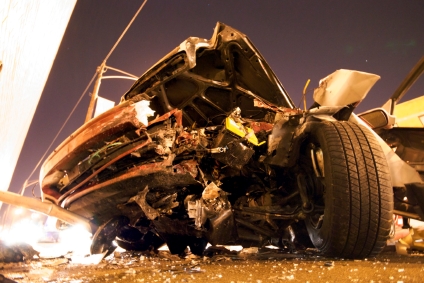
Jordyn: When writing about the car crash—I’d have it be pretty visual that the car is near ruin. Particularly if someone has died on scene. Having the car rollover several times would accomplish this.

Taylor: Three girls (friends) were in one car together, on the way to a Christian concert. Drunk driver character had an argument with his wife about his drinking, denying that he has a drinking problem, then got angry, left the house and went out for drinks (doing the very thing they just argued about, partly to spite her and partly “to calm down”). He causes a crash with the girls.
CAR ONE: This vehicle contains only the driver.
DRIVER:The driver is a male in his early thirties. He is slumped forward in his seat, initially unresponsive, but rouses when medics address him. There is a strong smell of alcohol on his breath, and although he is responsive, he is displaying obvious signs that he is intoxicated. Upon seeing the crash scene in front of him, he becomes upset, crying and saying things like, “I didn’t mean to”, “My wife is going to kill me”, and “What have I done?” He has a bleeding laceration on his forehead and minor scrapes and bruises on his face (from the impact of the crash and airbags), and bruising from his seatbelt. Aside from these, he is uninjured. Vital signs are elevated, but within normal limits.
Jordyn: This patient would be placed in C-spine precautions. An IV/fluids started. Usually, when EMS starts an IV—they’ll grab several tubes of blood that the hospital can send to the lab. They’ll dress the laceration on his forehead and not likely worry about the minor cuts and scrapes. Whenever there is seatbelt bruising, we always worry about what would be injured underneath.
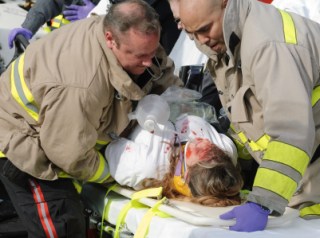
In the ER: Since he’s intoxicated, he’s not a reliable informant about his pain. So, he’ll get automatic C-spine films to rule out neck/back fracture. They might even consider a CT of his chest and abdomen (they’ll take vital signs into consideration). Law enforcement will be involved and they’ll want blood alcohol levels and if your book is in a specific/real location—I would figure out what the procedure is in that town/city. After major stuff is ruled out—his cuts will be cleaned. The laceration to his forehead would be irrigated and stitched. Tetanus shot if none in the last five years. Once he’s medically cleared, I’m guessing he would be off to jail.
CAR TWO:This vehicle contains a driver and two passengers.
DRIVER:The driver is a female, age 18. She has no detectable pulse or respirations. Apparent DOA, killed on impact in the crash.
Jordyn: She may be declared dead at the scene. That would probably be the easiest way to manage this patient.
PASSENGER ONE:Female, age 17. Managed to free herself from the car after the crash, and is sitting in the grass a short distance away. She is displaying signs of shock. Respirations are slightly shallow and rapid, skin is pale and clammy, and pulse and heart rate are elevated but still within normal limits. She is mostly responsive, but groggy/drowsy and complaining of severe headache, nausea, and dizziness. Chest and neck are bruised from her seatbelt, and she has several other bruises and superficial bleeding cuts on her body. Her right arm is bruised, swollen, and oddly angled, and she is cradling it against her chest and complaining of pain.
Jordyn: Since she is shocky, she’ll get an IV/fluids and tubes drawn for labs at the ER. Considering the mechanism of injury (the fact that one of the occupants of the crash has died) she’ll be placed in C-spine precautions as well. All surviving patients (including the drunk) will also be give oxygen (as it is treatment for shock as well). Her arm will be splinted in a position of comfort. It’s hard to know if they would give her pain medication or not—her c/o of headache, nausea and dizziness could signify head injury and giving a narcotic could complicate that assessment. So, she may just have to tough it out until she’s in the ED.
ER: Vital signs. X-rays of neck, back and deformed arm. Possible CT of the head, chest and abdomen. Often times, deformed extremities need to be reduced either in the OR or can be done under conscious sedation while in the ED. Depends on how you want to go. This patient may be able to go home if her arm can be set in the ED and no other significant injuries are noted.

PASSENGER TWO:Female, age 17. Pinned in her seat inside the car, unable to free herself. Conscious and responsive, but clearly very frightened, and displaying signs of shock. She is complaining of some pain in her neck, numbness and lack of sensation below the waist, and inability to feel or move her legs. Chest and neck are bruised from her seatbelt, and she also has several bruises and cuts on her face, arms, and legs. There is a large, deep bleeding laceration on her right lower leg.
Jordyn: Same: C-spine/back board. IV, fluids, oxygen. Get blood for labs. Laceration of right lower leg will be bandaged to control bleeding. 

ED: Largest concern for this patient is her sign of C-spine injury. So, not only would she get C-spine films. She’ll likely get CT of her neck, spine, chest and abdomen. Probably would x-ray the leg with the laceration to look for foreign bodies before closing it up. Stuff like the leg laceration can wait until a medical game plan is decided upon after they figure out what her neck injury is.

Up and Coming

Hello Redwood’s Fans!

I usually post the Up and Coming segments on Sunday’s but in light of the forthcoming Easter holiday I’ve decided to post it on Saturday.

I hope you have a wonderful celebration with family. One of my favorite posts I’ve ever written was about Easter and what it means to me. Hopefully it can bless you as you consider the true meaning of the day.

For you this week:

I’m continuing with author questions!

Monday: Car accident with multiple victims.

Wednesday: Homemade IV solutions. Is it possible?

Friday: Death by Food Allergy.

Have a GREAT Easter.

Author Question: Condition of Body in Two Views

Angela Asks:

I am an Australian writer of crime fiction novels set in SE Asia, specifically Thailand. You can read more about me and my books here: http://angelasavage.wordpress.com

In my current novel, The Dying Beach, a body washes up in the shallows of a cave by a beach. I’ve done a bit of research on forensics and how you distinguish drowning from accidental death. What I hope you can help me with is the following.
The body is that of a young Thai woman. Would the skin of the corpse whiten if it had been in the water for say, 12 hours, or would the skin still appear olive?
The body is found by a war surgeon on vacation, floating face down. When the body is rolled over, would you expect to find the eyes open? Would they be clear or cloudy?
Is there anything else I should know about a corpse found in this state? 
FYI the corpse is found in shallow, tepid water.
Any advice you can give would be much appreciated.

Jordyn Says
I actually ran this question by two sources: a physician coworker and a forensic investigator. Here are their responses.
Physician
As far as the skin pigmentation– she said a person will retain the pigment. They might look gray but won’t be “whiter”. And you’ll have to consider how blood settles when someone dies.
As far as the eyes being open or closed– she thinks partly open because it takes muscles to keep your eyes closed and if you’re dead– these aren’t functioning anymore.
As far as the eyes looking cloudy– I know when I’ve taken care of patients that have died, the color in their irises– this is the colored part of your eye– definitely look like the color leaches out. Almost looking gray. So, no clear answer here– you could probably have a little creative license.
Coroner
1)  A person’s skin pigmentation would not change unless the person has been dead for at least several weeks. Then the body would turn green and eventually black due to the decomposition. But this would take weeks into months depending on the environment the body is in (hot, cold, dry, humid, etc.).

2) When the body is rolled over the eyes may or may not be closed. There is no rhyme or reason for it. I would expect the eyes to be clear. Typically the eyes would become cloudy after the decedent has been dead for at least several days/weeks.
3) There really is not a whole lot more information. The hands would show sign of wrinkling, referred to as “washer woman hands”. This can make fingerprinting for identification difficult. Sometimes marine life will start to eat the body. This typically occurs about the face, eyes, and genitals. This of course would typically not occur within 12 hours of death. Another thing is when a body has been in the water for day(s) and is removed, decomposition will tend to accelerate. The bacteria has had no oxygen source as the body has been in water. Once the body is removed and the bacteria has a oxygen source, they really go to work to make up for lost time.

Author Question: Consent Issues Peds ER

Carol Asks:

Scenario:

Hero’s daughter is spending the night at the heroine’s house b/c he has to work. They think she has the flu but is appendicitis and is gonna burst [based on a friend’s kid’s experience ;)]. Heroine wakes up to hear her crying in the middle of the night. Goes to check on her and gets her roomie who is a licensed [but not practicing] paramedic. Says we gotta get straight to the hospital but hero isn’t answering phone.

So, they get there, but dad’s nowhere to be found. Heroine knows daughter’s name/birthday but that’s it [not even an address].

1. Will they still try to find a patient in the computer based on the info they have [patient’s name, birthday, town, dad’s name etc]?
Jordyn: How old is the child? A first or second grader should know their address so they would look up her name and birthday and try and match the address. If not, they’ll just create a new chart. It’s possible to merge electronic records at a later time. Do they not even have a phone number to reach him? That would be pretty odd.
2a. How much credence will they give to the medic since it’s not someone they know? He’s gonna rattle off information [HR, BP, temp, etc] and don’t they have some sort of ID card he could use to back up his claim that he knows what he’s talking about?
Jordyn: It’s anecdotal. We’d probably be most interested in the temperature. She’ll get her vital signs taken at the time and it might be curious if they are markedly different than what the paramedic got. But, we won’t ask for his ID. We’ll just want to know what treatment they provided at home and probably the last time she ate or drank (for purposes of surgery that’s important to know.)
2b. Should they call the ER en route?
Jordyn: No, this is cheesy. People do it but it won’t move you up in line, it doesn’t reserve a spot, etc. We’ll say, “Okay, see you when you get here.” Unless they are requesting emergency info—like how to do CPR—it doesn’t make a difference in the care of the patient when they arrive. You’d be surprised how many people call and then never show up.
2c. Is it plausible they’re not too busy at 3am on Sunday morning? And go pretty straight back?
Jordyn: Yes, this is plausible.
3. Will the medical staff allow the heroine/medic back into the ER room etc. before dad gets there?
Jordyn: Yes, if she is the only adult and the daughter is comfortable with her, she’d be allowed back.
4. When dad gets there, will they require any ID for him to prove he’s dad?
Jordyn: Typically, we get ID and insurance card if they have one. Before that—attempts will be made to reach him via phone to get verbal consent to treat. This is a big deal with minors. If it’s not an emergency—medical treatment can wait. If it is an emergency—we can go ahead and treat regardless on consent. 

*****************************************************************************

When she’s not writing about her imaginary friends, Carol Moncado is hanging out with her husband and four kids in the big yard of her southwest Missouri home, teaching American Government at a community college, reading, or watching Castle and NCIS. She’s a member of ACFW and RWA, founding member and current facilitator for the MozArks ACFW group, and a category coordinator for ACFW’s First Impressions.