What REALLY Happens While I’m Under Anesthesia: 2/3

I’m continuing with a three part series written by guest blogger Kim Zweygardt on what really happens while you’re under anesthesia. Great information for authors. 
You can find Part I here.
Welcome back, Kim!

4. Why is my throat so sore after anesthesia? (The actual question involved us ripping your throat out under anesthesia but I niced it up!)

With almost all surgeries, you are breathing extra oxygen that isn’t normally humidified and can really dry your throat out and cause it to be sore. Sorry about that! With bigger surgeries, we insert devices to maintain your airway. Anesthetics depress your breathing and these devices allow us to breathe for you to make sure your body gets all the oxygen that it needs. They are made of soft plastic, but they can irritate and cause a sore throat after surgery. And some people have anatomy that makes the insertion more difficult and that can also cause a sore throat. As a general rule, the sore throat is gone in about 24 hours. Treat it like a normal sore throat–pain meds and warm fluids help lots.

5. I love going to la-la land, but why is it so hard to wake up? (I’ve also heard this–“I just wanted to sleep and the nurses kept making me wake up in the recovery room! How come?”)

I could give you lots of technical mumbo jumbo about how drugs are metabolized but I think the more important thing to remember is this: We give you medicines based on your weight and that health history we took but also based on what type of surgery you are having and how uncomfortable that surgery is! It’s not the same amount of pain to have eye surgery or your gall bladder out. We give you these drugs so you will be comfortable and/or asleep, depending on what the surgeon is doing–that even varies at different times during the surgery because some parts of the operation may be more pain producing than others. A few minutes later, the surgery is over and what was the perfect amount of anesthesia now has you really sleepy because that stimulation is gone. We can reverse some of the medications but we also let your body gradually metabolize them so you are groggy and comfortable after surgery. And just like when you are fast asleep at home and someone wants to bug you? You’d rather be left alone!

6. I was told to think of something pleasant as I went to sleep and I woke up great! The doctor said how you go to sleep is how you wake up. Is that true?

There is a lot of truth to this. When you are anxious you release all kinds of stress hormones into your bloodstream and that can translate into a very rocky anesthetic including wake up. Thinking of something pleasant causes you to release endorphins which is like the body’s own morphine. That sense of wellbeing carries over as well not to mention the power of positive thinking! One technique I use with teenagers who tend to wake up wild is to explain to them pre-op how it will feel waking up and what I want them to do. Because they have had a chance to think about it ahead of time, when I tell them surgery is over and they should lie still, they do it because even through the “waking up fog” their subconscious remembers my words. Anything we can do pre-op to allay anxiety makes for a smoother waking up.

Tune in next post for Part III. 

***************************************************************************

Kim Zweygardt always knew she wanted to be someone special.  Her heart’s desire when she was 7 was to be a famous ballerina but when she read their toes bled from dancing on them, it became a less desirable career choice. Then Kim decided to be a famous lawyer solving mysteries and capturing the bad guys just like Perry Mason, but as she got older she discovered sometimes it was hard to tell just who the bad guys were.

Instead Kim chose a career in medicine practicing the art and science of anesthesia as a Certified Registered Nurse Anesthetist in rural Kansas, Colorado and Nebraska.

Kim is married to Kary, the man of her dreams, who has done a fabulous job of making all her dreams come true. They have three children but an empty nest and enjoy conversation with friends over good coffee and great food. They enjoy travel, the arts and taking a nap.
Member American Christian Fiction Writers, International Speakers Network, www.bookaspeaker.netwww.womenspeakers.net


Hostages: Episode 8 Analysis 1/3

Seriously, medically speaking, the CBS drama Hostages is becoming that car accident I can’t avert my eyes from. This episode had me doing some serious eye rolling– one of my eyes may have actually rolled away from me at one point. I have since recovered it so don’t worry.

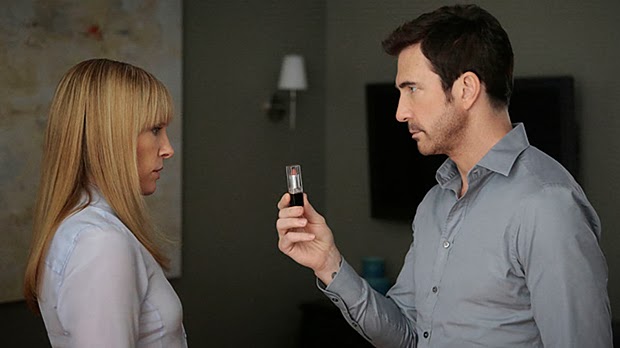
During episode 7– the husband is left alone with the primary hostage taker and his primary goal is to do him in. What remains in the house is the “colorless, non-traceable, fast-acting poison” that was contained in a lipstick holder for Ellen to give the President during surgery.

Hubby finds it, a needle and syringe and draws up the medication. At the end of this episode he manages to put it into his chest and pushes in a little of the medication.

Enter the hero doctor who is now convinced that he must live or all of her family will die.

She asks him, “What is the poison?”

He says, “A rapid-acting paralyzing agent.”

At this point, I’m going to beg the producers of this show to either get a new medical consultant or hire one. Because, whoever is advising them doesn’t know anything about WHY this wouldn’t kill the president during his operation.

Paralyzing agents don’t stop your heart from beating. I’ve blogged here before about the unique characteristics of heart cells. They have their own automaticity. Paralyzing agents work at the neuromuscular juction to stop the muscles from being able to contract. Your heart muscle is different from this system but your diaphragm is not which is the primary muscle used for breathing.

The reason a paralyzing agent will kill you is that it stops the contraction of your diaphragm muscle and therefore you stop breathing. Obviously, if you’re not breathing you’re going to die so to save your life we have to provide rescue breathing and preferably oxygen.

In surgery, especially the type of surgery the president is having which is a lung surgery, he is already going to be intubated and bagged with oxygen to keep him alive. The injection of a paralyzing agent (of which he may already have some on board to get him intubated) would have a net ZERO effect.

You can read more about neuromuscalur blocking agents here

So– it is fiction people and someone in the military wants him gone. You can’t invent an odorless, rapid-acting, undectable poison and give it a cool name?

Part II we’ll continue with the good doctor’s treatment.

Put me to Sleep: Anesthesiology

I’m so pleased to host a new guest blogger, Dr. Kate O’Reilley, anesthesiologist extraordinaire. Today, she’s talking about an anesthesiologist’s main job– putting you to sleep– in a good way!
 
Welcome, Kate!
 

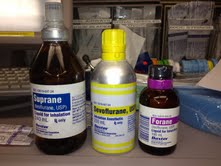
Anesthesia is all about passing gas (no pun intended!)  The most common anesthesia gases administered in operating rooms today include Sevoflurane, Desflurane, Isoflurane, and Halothane.  The gases, which are also referred to as volatile anesthetics, can be given to a patient in one of two ways. The first method involves the anesthesiologist simply holding a mask over the patient’s face and having the patient spontaneously breathe in a mixture of gas and oxygen. The second method employs the use of a ventilator that is attached to a breathing tube inserted into a patient’s airway.  Similar to the first method, the ventilator delivers a mixture of volatile anesthetic and oxygen to the patient’s lungs.

All of the anesthetic gases have similar effects. They cause sedation, muscle relaxation and amnesia – the three components to an ideal general anesthetic. The gases have slight differences in how they are metabolized, toxicities, dosages, and degree of cardiovascular depression.

Induction of anesthesia is simply the process of taking a patient from an awake, conscious state to a state of unconsciousness. With adults, this process is usually achieved through the intravenous administration of a series of drugs. Once the patient is unconscious and a breathing tube is placed, the anesthesiologist turns on one of the gases to an appropriate concentration, and uses the gas to maintain anesthesia during the operation.

With children, we rarely have the luxury of a preoperative intravenous line. It’s simply too difficult and traumatizing to place an IV in the little rascals while they’re awake. As a result, anesthesia in children is often induced with gas instead of drugs. Once the child is asleep, an OR nurse places and IV and surgery commences.

Watching a patient being anesthetized by gas alone is an interesting process. It’s the only time one is able to see the distinct stages of anesthesia. The first stage of anesthesia is a state of voluntary excitation and euphoria. It lasts from when the patient is awake until they are rendered unconscious.  Until the patient is unconscious, their movements are purposeful and they can follow commands.  Stage 2 of anesthesia is a stage of involuntary excitation. In this stage, patients my flail their arms and legs, giving the appearance of being combative or agitated. However, they are completely unaware of their actions. When parents accompany their children to the operating room for induction, this stage is usually unsettling for them to witness. The third stage of anesthesia is the stage of surgical anesthesia. In this stage, the patient has reduced muscle tone and will not respond to surgical stimulation. This is the stage where we want patients to be during the operation.  Stage 4 of anesthesia is where we aim not to be. It is the stage where there is severe cardiovascular and respiratory depression. If allowed to persist, this stage could result in death.

So once the patient’s surgery is done, how do we get rid of the gases? We simply turn the gas off.  Over time, the patient breathes off the gas and eliminates it from their bloodstream. Often times, as patients wake up, we will see the stages of anesthesia in reverse. As patients pass through the second stage, they often need to be restrained in order to protect them and the operating room staff from injury. Once a patient returns to stage 1, they may continue to be groggy and somewhat disoriented, but they should be able to follow simple commands. Only once a patient has returned to stage 1 is it safe to remove a breathing tube.

I hope that helps explain a little about anesthesia gases and how they work.  If there are any questions, always feel free to email me at kateoreilley@gmail.com.
 
*****************************************************************************
 

Kate O’Reilley, M.D. is a practicing anesthesiologist in the Rocky Mountain region.  In addition to being a physician, she has also written two books, both of which are medical thrillers.  She plans on releasing her first book, “It’s Nothing Personal” in the near future. When not writing, blogging or passing gas, Kate spends her time with her daughter and husband. Together, they enjoy their trips to Hawaii and staying active. Please visit her at her website, http://www.kateoreilley.com/ , and her blog www.katevsworld.com.