We’re continuing with Mart’s question. Briefly from last post, a 16 y/o has been struck by a car. What would medical treatment be? She bounces off the hood and these are her injuries. Her elbow stung and her right leg turned back and blue almost instantly. Right hand is swollen. Her shin looked like a giant Easter egg lived under its skin.
EMS Response: Dianna
Contusion is the medical term for bruise. Contused areas don’t color immediately; it takes time – hours to days, sometimes only minutes depending on the injury and how easily the patient bruises, so include in her dialogue she bruises easily, but have most of the coloring appear later (not at the scene). However, patients feel contused pain immediately and a hematoma (mass swelling) can develop within seconds or minutes. The Easter egg you describe is called a hematoma.
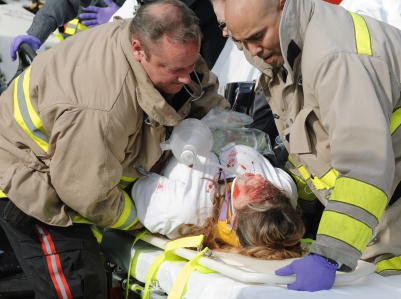
Like human crutches, we’ll assist her inside the ambulance or we’ll place her on our stretcher and wheel her inside our ambulance. We typically assist the walking wounded instead of using the stretcher. Once inside our ambulance, I’ll ask her to lie on the stretcher. I’ll hook her up to our cardiac monitor to obtain a 12-lead just to verify her heart is functioning normal (heart rhythm is normal).
I’ll insert her index finger in a pulse ox to obtain her SPO2 level (blood oxygen saturation). I’ll calculate her breathing rate and heart rate and I’ll take her blood pressure and evaluate her skin and pupils. I’ll perform a rapid trauma assessment, head to toe, to ascertain full extent of injury.
I’ll disinfect all abrasions and control any bleeding. I’ll splint any suspected fractured bones or joints. We’ll offer her Fentanyl (pain reliever) but we’ll only administer it if she allows us to transport her — we can’t inject pain meds and then leave the patient (not transport to an ED).
To clear the patient of C-spine immobilization: I’ll perform an examination of her neck, spine and all extremities, and if she denies any pain, tingling or numbness and I find no abnormalities, then it’s suspected the patient didn’t suffer any neck or back injury, thus no cervical collar or back boarding is necessary.
ER Care: Jordyn
When the patient arrives in the ED, if they are able to walk (a patient in C-spine precautions precludes this), we first obtain a weight. This is important in pediatrics because medications are dose dependent on that weight.
We’ll take report from the ambulance crew. Set of vital signs. Connect to a monitor. Assess pain level. Check IV site to make sure it is patent (lines can come out upon patient movement/transfer). Check splints to make sure distal part of extremity is getting good blood flow. The nurse will listen to her heart and lungs. Quick neuro exam. We’ll likely x-ray the right elbow, right hand and right lower leg. Even though suspicion of fracture might be minimal, the ED doctor has to disprove otherwise. Wounds cleaned and dressed.
Tetanus shot if none in the last five years. This is done for injuries that break the skin. Otherwise, you’re okay for ten years.
If the area is fractured, a splint will be applied. If no fracture, an ace wrap may be applied for comfort. It is important to note that often we will splint even if the x-ray is negative. This is both for support, comfort and compression. And also if the radiologist comes back and reads it as positive. The patient is instructed to leave the splint in place for about a week and if the extremity is still bothersome, to seek another evaluation of the injury. Some fractures won’t show up on x-ray initially but will later when they begin to calcify.
The patient is sent home with R.I.C.E instructions. Rest. Ice. Compression (leave your splint on). And Elevate. Generally, over-the-counter Ibuprofen is sufficient for pain control.

 Redwood's Medical Edge