Child Abuse Injuries: Shaken Baby Syndrome 2/3


April is Child Abuse Prevention month and this week I’m posting about the most devastating child abuse injury—Shaken Baby Syndrome or SBS.
Last post I discussed the leading cause of death is a brain injury called Diffuse Axonal Injury (DAI) which leads to massive swelling in the brain, which if not controlled will push the brainstem into the spinal cord, and this leads to brain death.
There are other classic injuries associated with SBS. In Part I I described how DAI occurs—by the violent shaking and the brain hitting the inner surface of the skull repeatedly.
What also occurs is the small bridging veins that cover the brain and are attached to the underside of the skull are torn as well. This leads to bleeding on the brain and is referred to as a Subdural Hematoma (SH) or subdural bleed. This can be picked up radiologically and although forensically a specific time and date cannot be given as to when the bleeding occurred—a radiologist can tell if there are old and new bleeds which correlates to different episodes of shaking.
People who have committed this type of child abuse injury have confessed to shaking multiple times. It’s as if they see shaking work one time to quiet an infant’s crying—it’s an easy solution the next time.
As stated in the earlier post—the bleeding is generally not what kills the child—it is the insidious brain swelling and subsequent herniation.
How do these children present to medical personnel?
Mild Presentation:

Large head.
Can’t lift their head.
Eyes can’t focus or track.
Decreased Responsiveness.
Irritability.
Lethargy/Limpness.
Vomiting.
Decreased muscle tone.
Poor appetite.
Not smiling.
Not vocalizing.

Severe Presentation:
Seizures.
Decreased respiratory rate.
Not breathing.
Rigid posture.
Bulging soft spot.
Coma.
Death.
The medical team is generally clued in to the possibility of child abuse when a caregiver gives an implausible account of why the child is so sick. Typical responses are—“Well, my one-month-old baby just rolled off the couch.”
Hmmm… if only he could roll.
Next post we’ll talk about another classic injury associated with SBS.

And please– never, ever shake an infant. 

For help in dealing with a crying baby– click here

Child Abuse Injuries: Shaken Baby Syndrome 1/3


As a pediatric ER nurse, I would be remiss in not taking note that April is Child Abuse Prevention month. Sadly, this is part of my job as a pediatric ER nurse—to recognize and report child abuse injures.
A couple of years ago, I did a two part series on how we identify child abuse injuries. You can read Part I and Part II by following the links.
This week I thought I’d highlight one very specific injury—Shaken Baby Syndrome (SBS).
In the medical community, SBS goes by another name—abusive head trauma (AHT) and many things can fall under this designation. A child who is just shaken, a child that is shaken and then slammed into a surface, or a child who is beat about the head.
Fatal child abuse can occur from a single act (drowning, suffocating, shaking), repeated abuse (battered child syndrome), or failure to act (malnourishment or bathtub drowning.) Eighty percent of perpetrators are generally the biological parent(s) followed by mother’s paramour and babysitters.
SBS is caused when a person generally grabs an infant around their torso and shakes them violently in order to quiet their crying. We don’t know exactly how long it takes and no sane ethical review panel is going to allow infants to be shaken to unconsciousness to find out. What we know from people who have confessed is that it doesn’t take very long—likely twenty seconds or less—typically lasting five to ten seconds.
Imagine holding a ten to twenty pound baby with outstretched arms and sustaining that position. The shaking is violent and requires a lot of energy as well. 
What happens upon shaking is as follows:
1.      The brain strikes the inner surfaces of the skull, causing direct trauma to the brain itself. This is often referred to a coup/contra-coup injury. The brain is injured both ways as it is batted around within the skull.
2.      The axons, which are the long part of the nerve cell (you can view them like an electrical wire) can be broken or sheared. Whenever there is biological injury things swell (like your ankle when it is badly sprained.) This occurs to the brain as well. This is referred to as Diffuse Axonal Injury or DAI.
3.      The lack of oxygen during shaking causes further irreversible damage to the brain. This is referred to as Anoxic Brain Injury.
4.      Damaged nerve cells release chemical mediators which further damage cells.
5.      The end result is brain swelling, brain movement (herniation) and brain death.
There are other injuries that are classically associated with SBS but the diffuse axonal injury and subsequent brain swelling are generally what cause death.
Why is this different than brain injuries from a car accident? Why can’t kids recover?
Think of a car accident. It may entail one or two hits—a focal injury. A focal injury means just one area of the brain may be injured. Given time, the brain may rewire itself pretty amazingly in this age group and they tend to do better than those suffering from SBS.
Sadly, the whole brain is injured in SBS and therefore there is no healthy brain tissue to attempt recovery. Due to pressure and swelling within the skull, the brainstem is forced into the spinal column (herniation) which disrupts blood flow to it. This is the area that control heart rate and respiration.
Next post we’ll talk about other associated injuries. 

And please– never, ever shake an infant. 

For help in dealing with a crying baby– click here

Forensic Issues: Bruising

On every crime show where a murder has occurred, there’s usually a big scene with the medical examiner asserting time of death or determining the time of an injury. In pediatrics, this becomes important when we look at timing a child abuse injury so we can place who was with the child during the suspected event.

The question is, can bruising give an exact time for the injury?


http://orthopedics.ygoy.com/

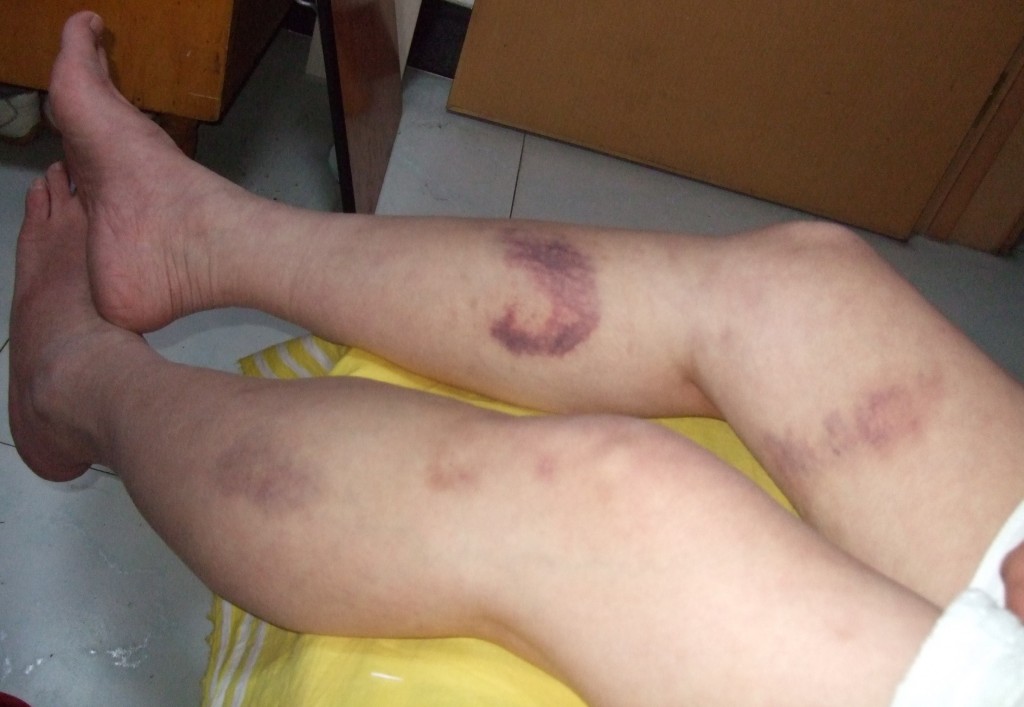
 Bruising happens when an object comes into contact with the skin, and the small capillaries underneath break open and cause bleeding. Generally, patterned shaped bruises are more suspicious for intentional injury. For something to make a pattern on the skin, it generally needs speed or velocity to imprint the pattern onto the skin. For instance, it is far different if I tap you with a belt versus swinging and slapping it down.

Point blank, bruising is not a good way to determine time of injury. Bruising is influenced a lot by the individual person. Are they on blood thinners? Do they normally heal quickly? Age factors influence speed of healing as well. Bruising can give a time frame but color of bruising is also open to interpretation. Here’s one set of guidelines.

Color of Bruise
Red– swollen/tender: 0-2 days
Blue/Purple: 2-5 days
Green: 5-7 days
Yellow 7-10 days
Brown 10-14 days

As you can see, 48 hours is a large time frame. In the case of pediatrics, imagine the potential of how many people could have come into contact with an infant.

Interesting bruising fact: Bruises generally heal from the inside out. If you watch a bruise you have, you’ll notice they become lighter at the center as healing progresses.

Did you think bruises could give an accurate time frame for injury?