How to Lose a Pulse and Still Donate Organs—TV Edition

Sometimes television dramas get it wrong. And then there are times they miss the mark so spectacularly you wonder if they had a consultant on set or just decided on a quick Google search to not slow production down. The Rookie Season 4, Episode 17 (“Coding”) firmly plants itself in the latter category.

A young woman is injured in a motor vehicle collision, dies, and is declared dead on scene from a devastating abdominal injury. Nolan is asked by his firefighter girlfriend, Bailey, to check her driver’s license to see if she’s an organ donor. Check and check. Next cut is her arriving to the hospital with an honor walk already waiting and she’s taken directly to the OR for donation. The only problem? Medicine doesn’t quite work that way. Or at all.

The patient is shown being intubated (so far, so good), but the team isn’t performing compressions. Small problem– she has no pulse. For organs to be viable, blood needs to circulate. Without CPR maintaining blood flow, those organs are not viable for transplant.

In TV land, organ donation is apparently as easy as checking a box on your driver’s license. In reality, donors undergo extensive testing—blood typing, infectious disease screening, toxicology, and so much more. It’s a lengthy, arduous process.

Yes, it’s television. Yes, we suspend disbelief. But medical inaccuracies like this reinforce misconceptions about organ donation. Families already face difficult decisions during an impossibly hard time. Feeding audiences the idea that hospitals snatch organs from people who just happen to check the donor box doesn’t do much to build trust in the system.

The ironic part? Organ donation stories can be powerful, emotional, and medically accurate. Real life has plenty of drama without rewriting basic physiology. You don’t need to sacrifice science to tell a compelling story.

When Carpooling Goes Wrong: Analyzing Dexter S4E2

Ah, Dexter. Few shows juggle serial killing, dark humor, and wildly inaccurate hospital scenes quite like you. In Season 4, Episode 2, our favorite blood-spatter analyst wrecks his van—with a dead body conveniently riding shotgun in the back—and winds up in the ER. What follows is a crash course in how not to portray medicine on television.

Let’s dissect, shall we? (Pun very much intended.)

The ER doctor shines a light into Dexter’s eyes. Normal practice? Sure. But then we’re treated to the statement that his pupils dilate. Pupils constrict when you shine a light into them. They dilate in darkness. This is how the human body properly works.

Next, the doctor looks at Dexter’s CT scan and announces, “You’ve sustained a concussion.” implying that concussions are diagnosed this way. Concussions can be clinically diagnosed, based on symptoms like headache, confusion, dizziness, and loss of consciousness. You don’t need a CT scan to tell you that, and a CT isn’t going to show a concussion anyway. If it does, congratulations—you’re likely now dealing with a bleed, not a simple concussion.

But hey, why rely on pesky medical standards when you can dramatically gesture at a glowing scan instead?

Then comes one of my favorite relics of outdated medical lore: the “Don’t let him sleep” after head injury rule. Dexter is told not to sleep for twelve hours, as if a good nap might somehow erase him from existence.

In reality? We don’t keep people awake anymore after they’ve suffered a head injury if they feel like they need to sleep. That advice has gone the way of lobotomies. Any injured body part needs rest to heal. The brain rests by sleeping. Sleep is good and beneficial for the head injured patient. The guidance is: let the patient rest, check in periodically if symptoms worsen, and maybe—just maybe—don’t torture the poor guy who just got his bell rung trying to hide his crimes.

Ultimate lesson– don’t get into a car accident with a body in the back of your van that the police are going to tow.

Which show do you think butchers medical accuracy the most and which on gets it right?

Why “Poly” Matters: The Perfect Couple (S1E4) and Drug Toxicology Screens

For a long time, I was an avid medical show consumer– whether it be reality or scripted. The reality based ones, that highlight functioning ER’s, are tolerable. The scripted ones just started to drive me crazy and I haven’t partaken in a medical fiction series in a while. I’ll let you know about my trauma related to watching Rescue: HI-Surg in another post(and I’m not even a lifeguard).

Unfortunately, that doesn’t stop other shows from violating medical accuracy. Why does accuracy matter? It proves to the consumer of the product that you took care to present something close to reality. Our goal should also be to keep them in the story bubble. Any time a reader is pulled out of that magic snow globe, they lose pace and connection with the story.

Which brings me to Netflix’s The Perfect Couple. The basic plot is a woman from a modest background marrying into high society when her best friend, and maid of honor, shows up dead on the beach. The series delves into all the ins and out of who murdered her.

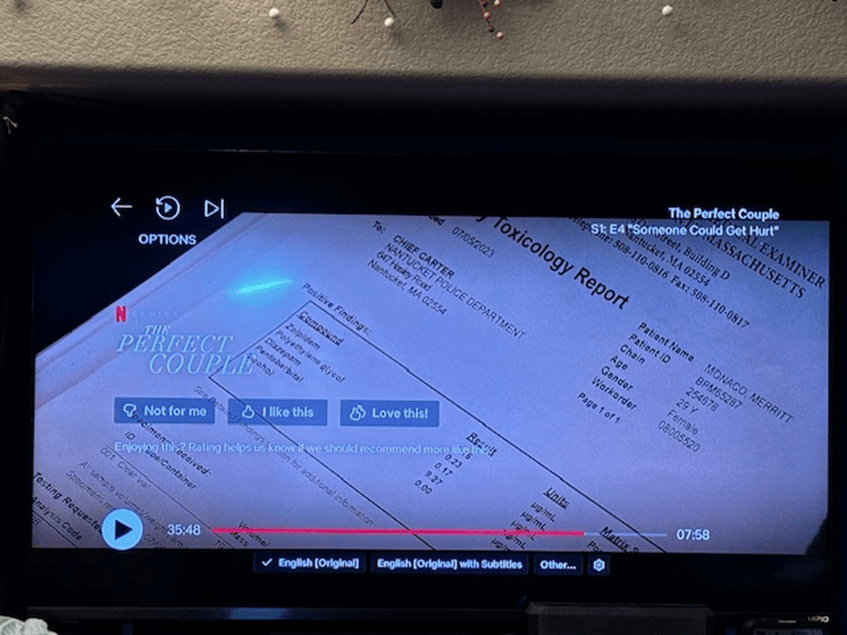
At one point, they show the victim’s toxicology report and I’m including a screen shot of said evidence.

This is hard to read so I’ll give you the details. In the victim’s urine (presumably– the report doesn’t specify) are the following drugs:
1. Zolpidem (Ambien)– sleep agent
2. Polyethylene Glycol– (Miralax)– laxative
3. Diazepam (Valium)
4. Pentobarbital (Barbiturate) Central Nervous System Depressant
5. Alcohol

This report confused me. Why would a dramatic television show reveal the victim was positive for a laxative? Which, by the way, isn’t going to show up on a drug screen.

Then it hit me. My belief is the writing staff really meant this fictitious toxicology report to read “ethylene glycol” which is very different. Ethylene glycol is a highly toxic component typically found in antifreeze. Antifreeze tastes sweet, which is why pediatric patients will continue to drink it if they find it in an open container. It has disastrous effects on the body and can cause death quickly if proper medical treatment isn’t enacted (and even then– it’s dicey).

This toxin also isn’t going to show up on a standard drug screen. The medical team is going to have to look for it specifically and such a niche test isn’t going to be available at every medical center. Also, Ambien is not part of a baseline drug screen.

Wouldn’t it have been more interesting to the plot to have antifreeze found in her system?

What strange things have you noticed on medical show toxicology reports?

Days of Darkness

As I shared in my last post, I was working as a nurse during the COVID-19 pandemic– at the very dawn of it. Looking back, many I know are very blase about what it really was and what happened. It doesn’t help that each political side dug into their version, and it seems transparency and truth telling have succumbed to political power.

I cannot tell you how brave every front-line healthcare worker was to show up to work every day dealing with the unknown. From first responders (firefighters, police, and EMS), to CNA’s, to nurses, to respiratory therapists, and to doctors. Many health professionals assisted in any way they could– perhaps operating outside of their normal comfort zone just to save lives. Everyone who was working was putting their lives at risk. We didn’t know clearly how COVID-19 spread, what were the best therapies to treat, and what patients were more at risk. We were operating in darkness.

At the beginning of the pandemic, it looked very dire for those that went into the hospital. In those early days, if you ended up on a ventilator, you had a very high risk of mortality. Estimates vary wildly but let’s say a median good guess was around 75%. That’s not great.

My mother-in-law, who just turned 94 this year, visits us twice per year between her Minnesota and Arizona stays (yes, she’s a snowbird). In 2020, I told my husband I didn’t believe it was wise to have her come and stay with us as I didn’t want to be the one responsible for giving her an illness that no one knew who would live or die. She bypassed us and went to stay with her son and daughter-in-law that live in Cedar Rapids, Iowa.

I breathed a sigh of relief, thinking she was safe. None of them work in healthcare.

What happens? They all get COVID. My then 90 y/o mother-in-law, her son, my sister-in-law, and my niece. Age ranges from 20 to 90. Who gets sickest and needs to be hospitalized? My brother-in-law ended up needing to be on the ventilator. Knowing the early statistics as I did, I told my husband to brace himself. That this may not turn out very well. He thought I was being my normal, crazy, psychotic, healthcare worker that over-exaggerates everything (which, of course, I’m not. He just doesn’t have the inbred worry of every healthcare provider out there).

The good news is that my brother-in-law, after being intubated for three days, was extubated and is 90% recovered from the illness. To this day, he still has some lingering effects. My sister-in-law and niece got ill but didn’t require hospitalization. The least affected? My mother-in-law who got some slight sniffles.

A couple of years after, my husband was doing some reading on the pandemic and came to me and said, “I see why you were so worried about my brother. You were right– lots of people died in those early days who were put on the vent.”

It’s easy to look back in hindsight and think that what all of us who were heavily involved in the pandemic lived through turned out to be no big deal, but it was a VERY big deal.

Lots of death. We honestly didn’t know if we would be next. Think about this and please don’t ever tell a healthcare worker who lived through those early days that what they experienced what “no big deal”.

If you’re a healthcare worker, I’m curious as to what your experience was in those early days of COVID-19. I’d love for you to share your thoughts looking back. What do you want people to know?

Did Fugitive Spy Predict the 2020 Pandemic?

On March 6th, 2020, my novel Fugitive Spy was released. The inspiration for the novel was a nonfiction title called Biohazard by Ken Alibek which I read around 2016. That book was published in 2000.

The author of Biohazard was intimately involved in the bioweapons program for the Russian Federation (formerly the Soviet Union) in the late 1980’s. His job was to increase the virulence of bioweapons through lab manipulation. He concluded at the end of his book that despite international law– he felt confident these expiraments were ongoing in different parts of the world.

Gain of function research. Sound familiar?

Pandemics are part of our human history and will continue to be. When I first entered nursing in 1993, HIV had been on the scene for about a decade. This virus has killed approximately 40+ million people. COVID-19 and its subvariants, depending on the source you consider and the reliability of the data, is currently around 7 million.

When the pandemic broke in March of 2020, I was working as a Nursing House Supervisor at a mid size children’s hospital. When did I know COVID would be different than other pandemics? After all, I had trained to deal with the Ebola outbreak that occurred from 2014-2016 and there were only a handful of US cases. Lots of prep– no excitement. This is generally what we like in healthcare.

To be honest, my first inkling that something was going to be different was when my daughters’ marching band trip to Disneyland was cancelled days before they were set to fly out. In quick fashion, things began to shut down. Grocery stores were emptying out. I was hoping this was going to be short lived. A few months and we’d be in the clear as I’d experienced with worse than normal flu or RSV seasons. A physician friend of mine said buckle up– this is going to last 2-3 years. She was right.

When the adult hospital on our campus erected a tent in their parking lot for overflow cases–mmmm– I had not seen anything like that before. We changed how we used PPE. We changed what rooms certain patients could go in based on room flow and filtration. We stopped offering some services. OR and PACU nurses were running screening desks. Visiting guidelines changed weekly– if not daily.

I honestly can’t imagine what my adult nursing colleagues were going through. Our cases in the early days did not come close to what they were dealing with. The bravery of every healthcare provider from first responders to specialists astounds me to this day. It’s easy now to look back and think– what were they so worried about?

We were operating in darkness. Physicians were using past experience to treat a novel virus. The toolbelt of medications was sparse. Think about that . . . . standing at a bedside with a patient in front of you sick with something you don’t know how to treat . . . you don’t know how it’s really being spread . . . but you see people dying and are wondering if you are next to get ill or die simply because you showed up and were steadfastly honoring the commitment you made to take care of sick people . . . of perfect strangers.

The WHO estimates a median average of 115,000 healthcare workers lost their lives. The range is 80,000 to 180,000 worldwide. Healthcare workers that have died from HIV as the result of an on the job exposure is far, far less.

In those early days of the COVID-19 pandemic, I would come home from work, throw my scrubs directly in the wash, and shower before I was close to anyone in my family.

That’s what the early days were like . . .

I AM Alive!

One, thank you to all those who still read this blog and perused by for those pesky medically addled writing questions that you’re wondering about. I was honestly pleasantly surprised people would still queery me when I hadn’t posted essentially since the dawn of the pandemic in March, 2020. Secondly, if you did submit a medical question to me during that time, I’m sorry that I didn’t respond.


Ultimately, I had to choose what I could carry forward through the middle of those crazy times. We had two daughters in highschool and my husband and I were facing the challenges of every parent. I chose to focus my efforts on keeping my family sane, still serve patients, and focus my writing on the contracts I had signed.

Surprisingly, I AM still nursing. I AM still writing!! At the start of the pandemic, I was working as a nursing house supervisor at a medium sized children’s hospital– a sister site of a larger children’s conglomerate. Those, to say the least, were interesting times. In pediatrics, we did not have the volume of patients our adult counterparts had until the triple pandemic hit us in November, 2021 (RSV, flu, and COVID). That was when pediatric nurses were crying just as hard as our adult nursing friends.

I will write more here about what I saw during the pandemic– maybe as more of a personal diary to have insight in looking back. It is a dream of mine to share these nursing stories in some kind of format. I don’t want our stories to be forgotten. All that we had to deal with. The nursing lives that were lost. Those stories need to be told.

In February of 2021, I transitioned out of the nursing house supervisor role and became a pediatric triage RN still in the same hospital system I’ve worked since 2006. I’m currently an assistant clinical manager but I still take care of patients, teach, and write novels.

My two most recent novels, Christmas Baby Rescue and Eliminating the Witness released respectively in 2022 and 2023. Both hit the PW bestseller list!


I am reviving the blog! The questions still keep coming. The medical inaccuracies abound. Still much to write about. I’ve updated my information pages if you’re interested in seeking out a medical consultant.

How are you doing? What’s life been like for you over these past four years?

Author Question: Medically Induced Coma

Terry asks:

The information you sent me last time has been great for my story! One thing I forgot to ask though, and it is very important to the ending is this: When my character finally comes out of his coma I need to know two things:

1. He was put into a drug induced coma because of a head injury suffered in an automobile crash. Is it possible he can come out of that coma on his own? Like just open his eyes after about two weeks?

2.  When they finally take the breathing tube out of him how long will it take before he will be able to speak? I want him to be able to tell about what he went through in the coma from his perspective as soon as he can.

I thank you in advance for any and all info you can give me. I really appreciate your help. Your site is THE BEST for writers!!

Jordyn Says:

Hi, Terry!

Thanks for sending me your question.

In your first question it’s hard for me to tell if you mean is it possible for this patient to just wake up from a drug induced coma— like the drugs are still infusing? If that’s the case, then no. The medications would have to be stopped before the patient would have a chance of waking up. In fact, the type of medication on board often plays into whether or not a patient can be declared brain dead.

If a patient still has narcotic and/or sedative medications in their system they cannot be declared brain dead. So first, the medication(s) given has to wear off. Most often, these medications are given as continuous infusions and are weaned down slowly and not abruptly discontinued. If after that has happened then yes— a patient may just open his eyes.

More often, patients are slow to come about. The first time they open their eyes, it might only be for a brief period of time. They may have muscle movements first. Generally, the medical team knows they’re improving when they can respond purposefully to pain by first pulling away from the stimulus, then by trying to push the stimulus away, and then by opening their eyes and understanding and following commands. It’s usually a slow process– from days to weeks (and even months to years) depending on the type of head injury the person suffered.

In regards to your second question, how long before he can speak? If he is awake and able to speak then he should be able to speak right away if the brain injury did not affect the speech sensitive areas. Some patients are extubated (or taken off breathing machines) and they’re not fully alert and responding to commands, but may be breathing adequately enough that they no longer need a ventilator. Many of these patients do have a trach in place, though.

That being said, if your character is awake and alert, his voice will sound soft, hoarse, and strained. His throat will hurt. He may have some trouble swallowing. His voice won’t have the same strength right after the breathing tube comes out as it did before. It will take some time to return to normal. The shorter the intubation the more quickly the patient’s voice should return to normal.  However, he should be able to share his story.

Good luck!

Author Question: Directed Organ Donation– In a Suicidal Way

Susan Asks:

My character ends up killing himself in order to be a heart donor. Problem is how does he kill himself without damaging the heart? Also, there needs to be enough time for EMT’s to reach him before his heart stops. Therefore he needs to be brain dead only . . . Is it something he could plan or is it too far fetched? For instance, a shot to the head?

Jordyn Says:

Hi, Susan.

Very interesting if not morbid question you ask here. It sounds like what this character is trying to accomplish is some sort of directed organ donation upon his death. His demise would have to ensure brain death, but also ensure that paramedics arrive in time to at least establish a heartbeat and get him to the hospital. There is a narrow window for this to happen. The most common time frame given for brain death is lack of oxygen for four to six minutes after the heart stops beating.

This character would have to time his heartbeat stopping and then EMS arriving around four to six minutes after. I actually would probably not choose a gunshot wound to the head. There could be a couple of things problematic with this. EMS might not choose to treat if the wound looked particularly devastating. Also, if there were damage to the facial structures, particularly the airway itself, resuscitation to even get a heartbeat back would be challenging.

I think an injury caused from anoxia (or lack of oxygen) would be your best choice. Of those, I would think drowning, hanging, ingestion of sleeping pills and/or drugs (that wouldn’t cause heart damage), and possibly carbon monoxide exposure might be your best options in my opinion.  However, there is discussion in the literature whether or not it is wise to donate the organs from someone who died as a result of carbon monoxide poisoning.

Hope this helped and good luck with this story!

The History of Vaccines

Typically, historical novels are set before the 19th century and into the early 20th century. Historical medical questions can be some of the more difficult ones to answer because it’s challenging to find source material from the time.

However, when it comes to medicine, historical might be considered a time frame of more than ten to twenty years ago because of the rapidly evolving nature of the practice of medicine. One example of this would be CPR guidelines. Did you know CPR guidelines generally change every five years? To put it simply, the way we are doing CPR now is not the way it looked even ten years ago. Often times, what a writer might consider a contemporary medical question is truly a historical one.

I came across this resource called The History of Vaccines  which reviews what vaccines were available when.

For instance, diptheria vaccines began in 1926, tetanus in 1938, pertussis in the 1940’s, and polio vaccine was widely available around 1955. 

If you’re curious whether or not a character could have had the potential to be vaccinated against a certain disease, this source would be great to check out.

Author Question: Use of Tranquilizer Dart

Christian Asks:

I am writing a book about a 22 y/o male. I want him to be knocked out via tranquilizer dart. I was wondering a few things. Would it work? How long would it take to knock him out? Could he pull it out without falling asleep? If he was sweaty, would the dart still work?

Jordyn Says:

Hi Christian!  Thanks so much for sending me your question.

Yes, using a tranquilizer dart should work to knock your character out. How long would it take? It depends on the medication they use in the dart. You can specifically Google the specific medication you choose and how long before it takes effect intramuscularly which would be the route using a tranquilizer dart. As a generality, intramuscular medications can take 2-4 minutes (for these types of drug classes) to work so he could pull the dart out without falling to sleep.

Would the dart work if he was sweaty?  I don’t see a reason why not. I think whether or not the dart pierces the skin and muscle is a matter of velocity rather than how sweaty the skin surface is.

You can read two other posts here and here that I’ve also done on tranquilizer guns.

Hope this helps and good luck with your story!